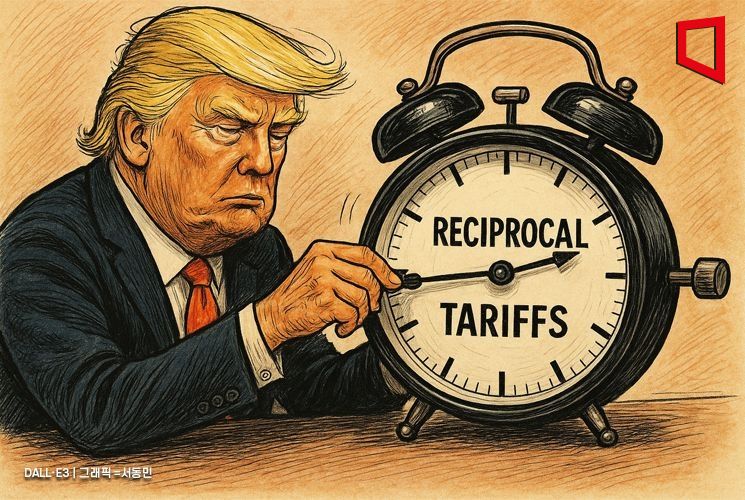
With only four days left until the July 8 deadline for the Korea-US "reciprocal tariffs" negotiations, Yeo Han-koo, head of trade negotiations at the Ministry of Trade, Industry and Energy, is currently coordinating a visit to Washington, D.C. this weekend. The government plans to use this trip to the US as a "last-minute negotiation" to reduce Korea's reciprocal tariffs, which currently stand at a base rate of 10% plus an additional 15%. Within and outside the government, there is a growing consensus that the key issue is how much this 25% tariff rate can be lowered. While Vietnam recently succeeded in reducing its tariff from 46% to 20% in negotiations with the US, and Japan is facing the possibility of an additional 35% tariff, Korea also finds itself at the center of this uncertainty.
"A Realistic Strategy: Minimizing the Blow, Not Complete Withdrawal"
Speaking with Asia Economy on July 4, an official from the Ministry of Trade, Industry and Energy said regarding the Korea-US negotiations, "We are keeping all options open," and added, "Realistically, our top priority is to secure terms that are at least not more disadvantageous than those of other countries."
Some trade officials believe that lowering Korea's total tariff rate to the 10% range could be a realistic compromise in negotiations with the US. This is based on the assessment that such a rate would be lower than Vietnam's 20% and better than the pressure Japan is facing at over 30%.
The government also firmly maintains the logic that "Korea should receive a lower tariff rate than Vietnam." The official explained, "Vietnam was already a high-tariff country and has served as a labor-intensive production base for the US. Korea, on the other hand, contributes to the US in strategic industries such as semiconductors, batteries, and shipbuilding. It is not logical for Korea to be subject to higher tariffs than Vietnam."
The issue, however, is how persuasive this logic will be to the US, especially to President Donald Trump, who is the negotiating counterpart. The official noted, "Even in Japan's case, ministers visited the US seven times and held summit-level talks, but they are still facing the threat of a 35% tariff. The biggest risk is that President Trump could overturn any agreements finalized at the working level."
The business sector is more concerned about uncertainty than the tariff rate itself. If the tariff is a fixed and confirmed figure, companies can respond by adjusting prices or changing export strategies. However, the unpredictability of Trump's sudden decisions and the lack of transparency in the negotiations could paralyze companies' export decision-making.
An industry representative said, "In negotiations with the US, the key issue is not 'how much the tariff is,' but 'how long this uncertainty will last.' Even if tariffs are imposed, they must be predictable within a clear framework."
Extension Still Possible
With the tariff suspension deadline approaching at midnight on the 8th, the possibility of an extension is also being discussed. There is a chance that the suspension could be extended by executive order, or that selective application to certain items could be considered. In fact, just this April, the US decided to suspend the reciprocal tariffs only 13 hours after they took effect.
The Ministry of Trade, Industry and Energy stated, "It is possible to reach a basic agreement and leave the details to future negotiations," adding, "Most other countries have also made announcements while leaving detailed discussions unresolved." The official continued, "In Vietnam's case, a 20% rate was announced, but the administrative details of when and how it will be applied have not yet been made public." As such, there is advice that Korea should also adopt a sequential negotiation strategy?announcing an agreement and then making detailed adjustments?to reduce the burden of the deadline.
The government plans to launch an all-out persuasion effort in this weekend's negotiations in the US, emphasizing Korea's contributions, strategic relationship, and role in supply chains. Yeo Han-koo, head of trade negotiations, is scheduled to visit Washington, D.C. over the weekend for high-level talks with the US Trade Representative (USTR), the Department of Commerce, and others, with the ministry currently finalizing the schedule with the US side. With the tariff suspension deadline imminent, the government sees these negotiations as a critical juncture for either reaching a basic agreement or deciding on an extension. The results of the negotiations are expected to be announced around July 8.
© The Asia Business Daily(www.asiae.co.kr). All rights reserved.

















