Paju City Certified as Age-friendly City by WHO
Following Women-friendly and Child-friendly Certifications
City: "We Will Build a City Where Everyone Can Thrive, Regardless of Age or Gender"
Paju City in Gyeonggi Province announced on July 4 that it obtained certification for joining the World Health Organization (WHO) Global Network for Age-friendly Cities on June 25.
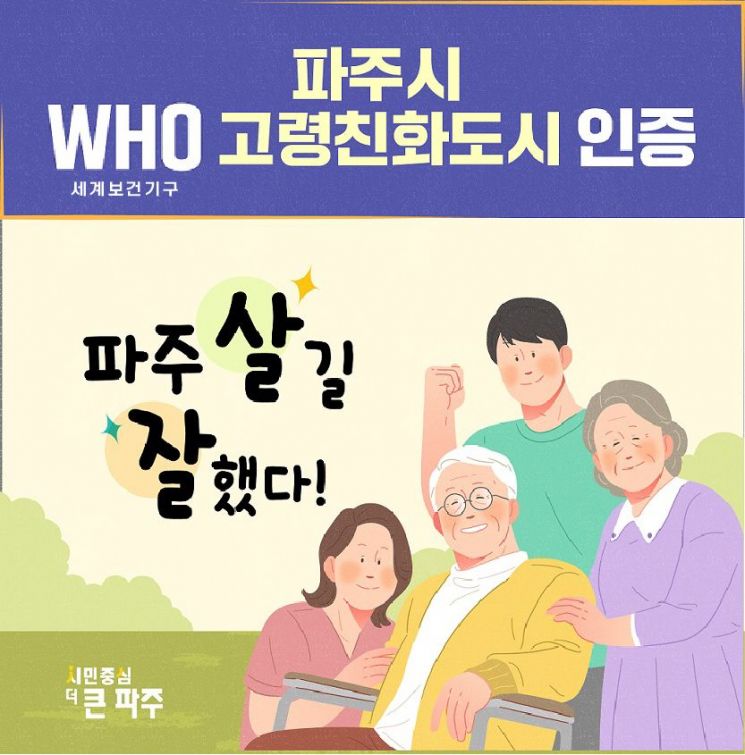 Paju City obtained certification for joining the World Health Organization (WHO) Global Network for Age-friendly Cities on June 25. Photo by Paju City
Paju City's certification as an age-friendly city follows its designation as a "Women-friendly City" by the Ministry of Gender Equality and Family in 2020, and the passage of the "Ordinance on Creating a Child-friendly City in Paju" on June 24. With the addition of the age-friendly city certification, Paju is now pursuing the so-called "Samchin (Three-friendly) City" value, aiming to become a city where people of all ages and genders can thrive, and establishing a solid foundation for realizing this new vision.
The Global Network for Age-friendly Cities is an international network promoted by the WHO since 2006 to effectively respond to the global trend of population aging and the emergence of super-aged societies. To date, more than 1,540 cities in 52 countries have been certified as age-friendly cities, and a total of 60 local governments in South Korea have received this certification.
Paju City sought age-friendly city certification to better prepare for a super-aged society by establishing a more stable foundation for the lives of the elderly. In December of last year, South Korea entered a super-aged society earlier than expected, with people aged 65 and over accounting for more than 20% of the total population. As a result, national-level measures to address this demographic crisis have been rapidly introduced, and there is a growing, society-wide movement to respond to this imminent reality.
Currently, the population aged 65 and over in Paju accounts for 16.7% of the total population, which does not yet meet the threshold for a super-aged society. However, as the elderly population increases by about 1% each year, the city is steadily approaching super-aged status. Therefore, it is now necessary to establish measures that are effectively equivalent to those required for a super-aged society.
To this end, in May of last year, Paju City conducted a research project on creating an age-friendly city to establish an environment in which all generations of Paju citizens can enjoy physically, emotionally, and socially healthy lives. In April of this year, the city submitted an application to join the WHO network for age-friendly city certification. After undergoing evaluations in eight areas?outdoor spaces and facilities, housing safety, transportation convenience, health and community care, social participation and employment, communication and information, social respect and inclusion, and leisure and social activities?the city received approval for certification.
Paju City noted that its policies for the elderly received high marks during the certification process. The city increased the number of basic living support elderly households receiving winter heating assistance by 101 compared to last year, reaching a total of 2,965 households. In addition, to improve the health and well-being of seniors, Paju plans to provide massage chairs to a total of 300 senior centers by 2026, having started distribution in 2024.
Furthermore, by expanding its senior employment program, the city provided customized jobs to 3,551 seniors, thereby increasing their participation in the local community. Earlier this year, Paju also signed a business agreement to supply "Paju Rice" to senior centers, promoting support programs that utilize local specialty products.
In August, the Unjeong Danurim Senior Welfare Center is scheduled to open, and construction began in March on the Munsan Senior Welfare Center (tentative name) in northern Paju, which is expected to be completed in December 2026.
Following its age-friendly city certification, Paju City plans to enact an ordinance on age-friendly cities and promote 42 projects across eight key areas, including health management using AI robots, energy welfare support to cope with heat waves, and senior employment support.
Paju Mayor Kim Kyungil stated, "This age-friendly city certification will serve as an important foundation for actively responding to a super-aged society and achieving intergenerational harmony, making Paju a sustainable city. Now that we have advanced from a women-friendly city to a child-friendly city and an age-friendly city, we will do our utmost to ensure that everyone in Paju, regardless of age or gender, can enjoy a stable and prosperous life."
© The Asia Business Daily(www.asiae.co.kr). All rights reserved.
![Clutching a Stolen Dior Bag, Saying "I Hate Being Poor but Real"... The Grotesque Con of a "Human Knockoff" [Slate]](https://cwcontent.asiae.co.kr/asiaresize/183/2026021902243444107_1771435474.jpg)











