Relocation Loan Limit Set at 600 Million Won, Increasing Burden of Additional Loans
Construction Companies Face Higher Project Financing Needs
Preference Likely to Grow for Builders with Lower Interest Rates

On June 27, due to new lending regulations, the basic relocation loan limit for reconstruction and redevelopment projects was capped at 600 million won per household, increasing the financial burden on construction companies that must secure additional funds. There are concerns that, as interest rates vary depending on the credit rating of construction companies, this could lead to a concentration of contracts among large construction firms, and further fuel polarization, where only high-priced areas see the construction of new homes.
According to the construction industry on July 7, since June 27, the basic relocation loan available to each member in maintenance projects has been limited to 600 million won per household, increasing the burden on construction companies to secure additional relocation funds. Before the regulation, support was available up to 50% LTV of the member’s assets (appraised value). For owners of multiple homes, basic relocation loan support has become entirely unavailable.
The Growing Role of 'Additional Relocation Loans'
With a sharp reduction in basic relocation loan support, the role of additional relocation loans has grown significantly. The basic relocation loan is funding provided by financial institutions to help members secure temporary housing during construction or return deposits to tenants. The additional relocation loan is extra support directly provided by the construction company as part of project costs. Compared to the basic relocation loan, the interest rate for additional relocation loans is higher, typically in the 5-6% range.
For members who have seen their basic relocation loans drastically reduced, whether they can receive additional relocation loans and at what interest rate has become a matter of great concern. However, even a week after the regulation took effect, construction companies have yet to finalize their internal policies regarding the provision of additional relocation loans. The interest rate for additional relocation loans is determined by the credit rating of each construction company, meaning that small and medium-sized construction firms must secure relocation funds at higher interest rates compared to large firms. Even then, whether support is possible depends on negotiations with financial institutions. A financial industry official said, "Since there are no clear standards after the lending regulation, banks will apply even stricter criteria," adding, "For mid-sized or regional construction firms, obtaining loans may become even more difficult."
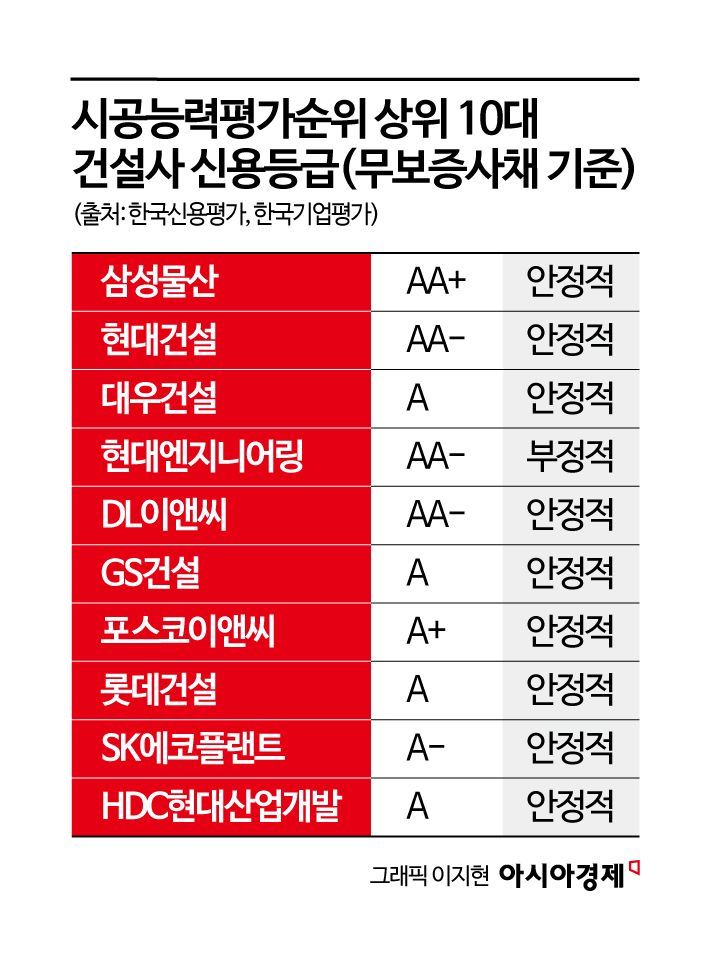
In future maintenance project bidding, the ability to secure additional relocation loans is likely to become an important requirement for winning contracts. The higher the credit rating of a large construction company, the greater its chances of winning a contract. An industry insider explained, "Even among construction companies just below Hyundai Engineering & Construction and Samsung C&T in terms of rating, there is about a 1 percentage point difference in funding rates," adding, "In competitive bidding for maintenance projects, members will inevitably choose the contractor offering lower interest rates. Even among the top 10-20 construction companies, interest rate competitiveness has become crucial." As of July 3, the credit ratings (for unsecured bonds) of the top 10 construction companies are as follows: Samsung C&T AA+ (Stable), Hyundai Engineering & Construction and DL E&C AA- (Stable), Hyundai Engineering AA- (Negative), POSCO E&C A+ (Stable), Daewoo E&C, GS E&C, Lotte E&C, and HDC Hyundai Development Company A (Stable), and SK Ecoplant A- (Stable).
Will Only Gangnam See New Homes?
As more associations seek financially strong contractors, there are concerns that only highly profitable projects in areas like Gangnam and Yongsan will proceed, while others are left behind. Large construction companies with high credit ratings may selectively bid only for projects with strong business potential where they can bear the financial burden, resulting in the polarization of new home supply. An executive at a construction company said, "In less profitable areas like Gangbuk, contractors are unlikely to secure construction rights by directly arranging financing."
A construction company official said, "Recently, construction companies have been offering relocation loans ranging from 100% to as much as 150% LTV, but for owners of multiple homes who cannot get even the basic relocation loan, the only option is for the construction company to lend directly," adding, "Regulating even the costs for temporary housing is not logical."
Kim Jaekyung, head of ToMe Real Estate Consulting, pointed out, "If relocation loans are provided as project loans, the interest rate will be 6-7%, which will increase financial costs and could raise the burden on members," adding, "Many projects have already become less profitable due to rising construction costs, so to keep ongoing maintenance projects moving forward, excluding relocation loans from regulation should also be considered."
© The Asia Business Daily(www.asiae.co.kr). All rights reserved.


















