Selling Industrial Goods under the Guise of Agricultural and Fishery Direct Sales Outlet Approval
Violations of Distribution and Construction Laws amid Passing the Buck
Damage to Nearby Traditional Markets and Small Retailers Snowballing
"Neglecting Abuses Fuels a Vicious Cycle... Calls for Legal Reform"
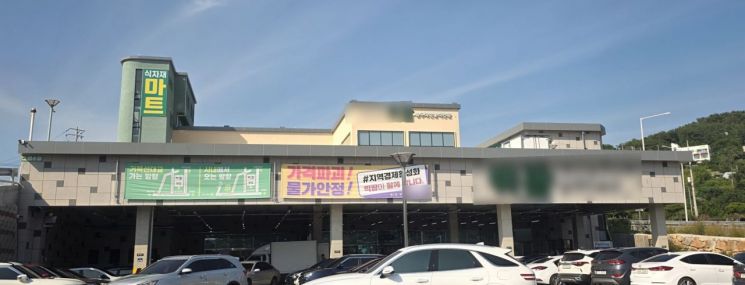
There is an urgent need for institutional reform as cases are increasing in which businesses, after obtaining permission from local governments to operate as agricultural and fishery direct sales outlets, are running quasi-large or large-scale stores (such as food material marts) through loopholes, negatively impacting surrounding commercial districts.
Even when these stores operate as large-scale outlets, there are no regulatory provisions to sanction them, leading to widespread abuse of related laws. Meanwhile, the authorities responsible for oversight are effectively shirking their duties, which is being criticized for exacerbating the damage.
According to Yeosu City and the distribution industry on July 4, A Food Material Mart located in Dolsan-eup, Yeosu, received approval for use as an 'agricultural and fishery direct sales outlet development and sales facility' from Yeosu City in July last year, in accordance with the Agricultural and Fishery Distribution Act.
Since Company A received approval as an agricultural and fishery direct sales outlet, it is required by law to sell only agricultural, fishery, livestock, and forestry products. However, the store is openly selling non-agricultural and fishery products, industrial goods, daily necessities, and alcoholic beverages, engaging in clear circumvention of the law.
In particular, the site where Company A operates is designated as a Type 1 residential area, where, according to the National Land Planning Act (Yeosu City Urban Planning Ordinance), sales facilities must have a floor area of 2,000 square meters or less. Nevertheless, it has been confirmed that the store is operating with a total floor area of approximately 9,400 square meters.
Due to this circumvention, nearby businesses such as Gyodong Market and small and medium-sized retailers in Yeosu are reporting both direct and indirect damages.
To obtain approval for a quasi-large store like Company A, procedures such as a commercial district impact assessment, traffic impact assessment, regional coexistence agreement, and fire safety standards are required under the Distribution Industry Development Act. However, since the company received approval under the Agricultural and Fishery Distribution Act, all these procedures were bypassed.
Moreover, complaints about the company's circumvention are being filed almost daily, but the authorities responsible for management and supervision are merely passing the responsibility to each other, which is further aggravating the damage.
An official from the Ministry of Agriculture, Food and Rural Affairs explained, "The Agricultural and Fishery Distribution Act only specifies which direct sales outlets are eligible for government support, but does not regulate the scope of business operations. The licensing authority (Yeosu City) must review the regulations applied to each region, business type, and store regarding the scope of operations and circumvention."
In response, an official from Yeosu City stated, "Since the company sells industrial goods and daily necessities, we regard it as a retail store. Therefore, in accordance with the Urban Planning Ordinance, we have sent a prior notice of corrective order to the company. We believe the company is exploiting the regulation that allows agricultural and fishery direct sales outlets to operate stores up to 10,000 square meters in size."
A Yeosu City council member pointed out, "After receiving initial approval for use, the company illegally expanded its building, so there are violations not only in distribution activities but also in construction. The Distribution Industry Development Act does not prohibit the sale of industrial goods or daily necessities, which are non-agricultural products, so there is no proper way to sanction such sales activities. Ultimately, an authoritative interpretation is needed, and in the meantime, all the damage is being shifted onto the surrounding local commercial districts."
Regarding this, a representative of Company A explained, "We have received many complaints about the alleged circumvention, but the administrative tribunal concluded there is no legal basis for sanctions, so we are operating accordingly. Although many agricultural, livestock, and fishery outlets nationwide also sell industrial goods, this location receives particularly many complaints. Our company pursues a high-volume, low-margin strategy not for profit, but to stabilize prices in Yeosu."
As cases like Company A's show, the circumvention of regulations by food material marts is widespread nationwide, prompting calls for institutional support for regulation. In fact, some food material marts construct multiple buildings at each location, each under 1,000 square meters, and operate them as if they are separate businesses. By keeping each building under 3,000 square meters and annual sales per building below 100 billion won, they are avoiding the requirements for quasi-large or large-scale stores.
Under the current Distribution Industry Development Act and the Large-Scale Retail Business Act, stores classified as large marts are subject to regulations such as mandatory closure two days per month, opening only after 10 a.m., and a ban on opening stores within one kilometer of traditional markets.
Additionally, some food material marts are circumventing the regulation that restricts the use of local gift certificates for stores with annual sales exceeding 3 billion won by changing their business operator every year. Even if annual sales exceed 10 billion won, if the operator is changed the following year, the store is classified as a new business and can continue to accept local gift certificates.
A distribution industry official said, "Currently, food material marts are effectively in a regulatory blind spot, which is leading to a vicious cycle of declining sales for surrounding traditional markets and small business owners. If these cases continue to be neglected, there are concerns that additional damage will occur."
© The Asia Business Daily(www.asiae.co.kr). All rights reserved.

















