"AI Analyzes Startup Account Balances... Utilizing Non-Financial Information"
As the development of the corporate credit evaluation market lags behind that of the personal credit evaluation market, the financial sector has suggested that it is necessary to advance artificial intelligence (AI) evaluation systems and refine related regulations. There is a need to strengthen AI-based credit evaluation systems by training on non-financial data from both individual and corporate (financial institution) clients.
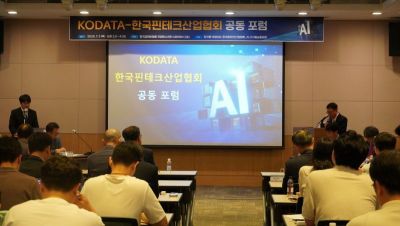 Geunju Lee, Chairman of the Korea Fintech Industry Association, is delivering the opening remarks at the "Credit Evaluation Using AI" forum jointly hosted by the Korea Fintech Industry Association and Korea Data Evaluation (KODATA) on the 3rd at the Korea Economic Association Conference Center in Yeouido, Seoul. FinSanHyup
Yoo-Shin Jung, Chairman of the AI Digital Finance Forum, made these remarks at the "Credit Evaluation Using AI" forum, which was jointly hosted by the Korea Fintech Industry Association and Korea Data Evaluation (KODATA) on the 3rd at the Korea Economic Association Conference Center in Yeouido, Seoul.
Chairman Jung pointed out that the domestic alternative credit evaluation market is facing issues such as concerns over personal information and privacy violations, lack of explainability, data bias, and insufficient legal and regulatory frameworks. He argued that dedicated guidelines for alternative credit evaluation should be established as soon as possible.
The credit evaluation market is largely divided into personal credit evaluation and corporate credit evaluation. He explained that, in Korea, the level of development of the corporate evaluation market is low.
Chairman Jung cited the case of Upstart, a U.S. fintech company. Upstart has established an AI system that evaluates non-financial intangible assets, such as the future growth potential of college student clients. The company has secured credit information for 20% of Americans, approximately 70 million people.
Upstart introduced an AI evaluation system capable of identifying non-financial factors that are difficult to assess using traditional credit evaluation models, significantly increasing loan approval rates. The approval rate for Black borrowers rose by 35%, for Hispanic borrowers by 46%, for borrowers aged 25 and under by 32%, and for those with an annual income below $50,000 (about 68 million KRW) by 13%.
Chairman Jung advised, "Non-financial factors such as corporate technology and intangible assets could also be introduced as business items in the (Korean) alternative credit evaluation market."
Kim Youngdo, Senior Research Fellow at the Korea Institute of Finance, pointed out that the Korean credit evaluation market must address issues such as fairness problems caused by algorithmic bias in the AI-based credit evaluation market, the opacity of complex AI models, and the limitations of evaluation indicators.
Senior Research Fellow Kim stated, "A flexible regulatory framework tailored to the characteristics of AI, technological standardization, and measures to resolve information asymmetry must all be established together," and added, "It is necessary to build AI governance within companies to manage the potential risks of AI."
Companies such as PFCT, Gowid, Crepassolution, and Korea Data Evaluation also presented cases of credit evaluation and alternative information services utilizing AI.
PFCT explained that it entered the Australian and Indonesian markets by securing a variety of algorithms through publicly available open-source tools and finding the optimal combination.
Lee Suhwan, CEO of PFCT, said, "Based on data from overseas credit bureaus such as Equifax and Illion, we verified the performance of our optimal AI algorithms and found that delinquency rates were reduced by about 32%." He added, "Traditional credit evaluation models often made errors by rejecting high-quality customers, but after applying the AI model, we were able to identify and secure high-quality customers who had been rejected by existing models, which helped our client financial institutions lower their delinquency rates."
Fintech company Gowid supports loans for small businesses that have difficulty securing funds through the traditional screening methods of mainstream financial institutions. Currently, it has partnerships with three card companies: Shinhan Card, Lotte Card, and BC Card.
Junghwan Wi, Head of Gowid, said, "There was even a case where the loan limit for a startup that first underwent Gowid's AI credit evaluation before applying for a card company loan increased by about ten times compared to a startup that applied directly to the card company." He added, "We are focusing our efforts on advancing our 'usage classification engine,' which analyzes changes in the client's (startup's) account balance to assess fundamentals and growth potential."
Sangbin Kim, Head of Crepassolution, presented an alternative credit evaluation service that applies a 'score (credit evaluation score)' developed by patterning data with AI. Eunjeong Na, Head of the Data Science Center at Korea Data Evaluation, showcased database (DB)-based real estate information service 'Realtop' and alternative information services developed in collaboration with the Korea Financial Telecommunications and Clearings Institute.
© The Asia Business Daily(www.asiae.co.kr). All rights reserved.

















