Visitors Ignoring "Do Not Sit" Signs Face Possible Charges of Obstruction of Business and Property Damage
Children Damaging Artworks Due to Parental Negligence
Difficulties in Determining Fault Ratio for Damage Compensation
Amid a recent string of art damage incidents overseas, there is growing attention on the issue of liability for damages. While most of these accidents occur due to the carelessness of visitors, the possibility of criminal charges is also being raised depending on whether the act was intentional.
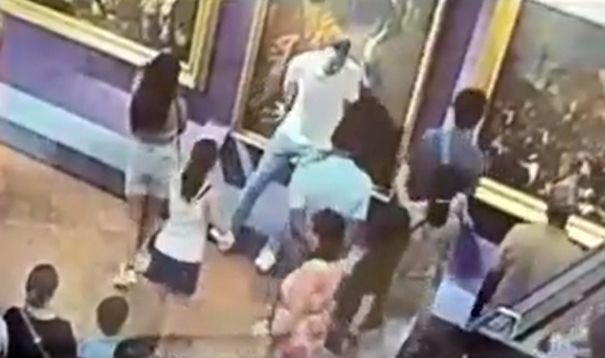 A man fell while taking a commemorative photo at the Uffizi Gallery, hitting the wall and damaging an artwork. Screenshot from Rai 1 news program 'TG1'
Last month, at the Palazzo Maffei Museum in Verona, Italy, a crystal-decorated chair on display was damaged by a couple visiting the museum. CCTV footage released to the public showed a man pretending to sit on the chair for a photo, only for the chair to collapse under his weight. The artwork was a special piece created by Italian painter and sculptor Nicola Bolla in tribute to Vincent van Gogh. Although there was a warning sign in front of the chair that read "Do not sit," the accident occurred when the visitors ignored the warning and tried to take a commemorative photo.
A similar incident occurred the same month at the Uffizi Gallery in Florence, Italy. A tourist damaged the 18th-century portrait "Grand Duke Ferdinando de' Medici of Tuscany" while trying to take a selfie. The tourist, imitating the pose of the figure in the portrait for a photo, fell backward and damaged the lower part of the painting.
There have also been cases where children have damaged artworks due to the negligence of their guardians. In April, at the Museum Boijmans Van Beuningen in Rotterdam, Netherlands, a child damaged American artist Mark Rothko’s work "Gray, Orange on Maroon" (from the 1960s). The incident occurred while the parents were momentarily distracted. The artwork is a high-value piece, estimated at around 80 billion won (50 million euros). It was confirmed that a scratch was left on the unvarnished paint layer at the bottom of the piece.
In response to such incidents, exhibition institutions are reviewing not only civil claims for damages but also the possibility of criminal charges. According to experts, if the damage to the artwork is found to be intentional, criminal punishment is possible under Article 314 (Obstruction of Business) and Article 366 (Damage to Property) of the Criminal Act. These articles allow for up to five years of imprisonment or a fine of up to 15 million won, and up to three years of imprisonment or a fine of up to 7 million won, respectively. In fact, in 2018, an individual who spray-painted graffiti on the "Berlin Wall" exhibited near Cheonggyecheon in Seoul was fined 5 million won.
On the other hand, in cases where the damage is caused by mistake or negligence, criminal punishment is difficult to impose. In such cases, only civil liability for damages applies, but disputes often arise because it is not easy to determine the degree of fault between the exhibition institution and the visitor. For example, the Uffizi Gallery labor union claimed, "There was a protective platform where the visitor fell, but it was difficult to distinguish due to the dim lighting," arguing that the museum was also at fault. Because there is room for debate over the proportion of fault, most exhibition institutions have comprehensive insurance to cover damages in such cases.
The National Museum of Modern and Contemporary Art, a leading institution in Korea, also has an insurance system in place to prepare for similar incidents. A museum official explained, "Unlike overseas cases, our museum installs barriers from the beginning of exhibitions to keep a physical distance between visitors and the artworks," adding, "We also prevent accidents in advance through guidance and warning signs." In fact, the National Museum of Modern and Contemporary Art has never exercised the right of recourse against a visitor.
However, in cases where intent is clear, liability for damages cannot be avoided. The museum official added, "If an artwork is damaged intentionally or through gross negligence, the obligation to compensate for damages may arise," and explained, "The scope of liability depends on the circumstances of the incident and the management status of the exhibition institution. Usually, the matter is resolved through coordination with the insurance company, and in some cases, the visitor may have to pay a deductible."
© The Asia Business Daily(www.asiae.co.kr). All rights reserved.

















