Commercial Act Amendment with "3% Rule" Passes National Assembly Plenary Session
Cumulative Voting System and Expansion of Audit Committee Members to Be Discussed Later
The amendment to the Commercial Act, which includes the 3% rule, has passed the plenary session of the National Assembly through bipartisan agreement. This is the first bill to be enacted through bipartisan cooperation since the inauguration of the Lee Jaemyung administration.
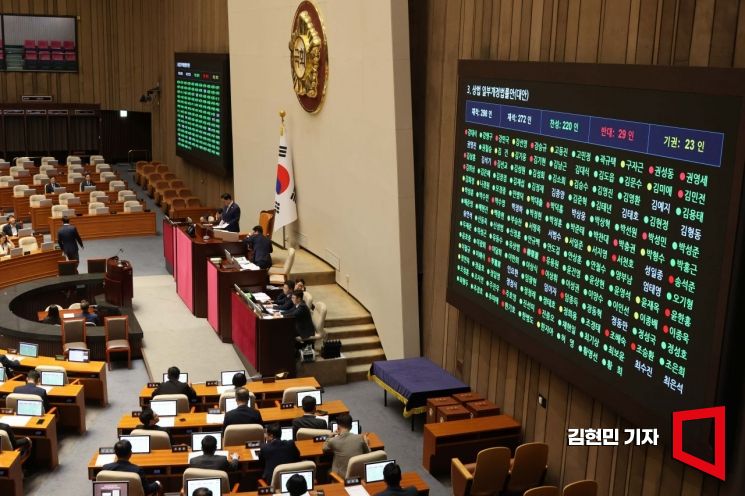 On the 3rd, the amendment to the Commercial Act is being passed in the plenary session of the National Assembly. Photo by Kim Hyunmin
On July 3, the National Assembly held a plenary session and passed the amendment to the Commercial Act with 220 votes in favor, 29 against, and 23 abstentions out of 272 members present. The amendment includes the following: codification of directors' fiduciary duties to shareholders; introduction of electronic general meetings of shareholders; and a 3% limit (the 3% rule) on the combined voting rights of major shareholders and their special affiliates when electing independent audit committee members.
Lawmakers from the People Power Party, who had left the chamber during the vote on the confirmation of Prime Minister nominee Kim Minseok, participated in the vote on the Commercial Act amendment. After the bill was passed, Democratic Party lawmakers applauded to welcome the result, while People Power Party lawmakers did not take any action. National Assembly Speaker Woo Wonsik stated, "This bill involved difficult issues, and I would like to express my deep gratitude to both parties for reaching an agreement."
Among the Democratic Party's reintroduced party platform bills, those not included in this amendment?such as the introduction of cumulative voting for the appointment of directors in large listed companies and the expansion of separately elected audit committee members?will undergo further discussion through public hearings. It is also expected that concerns regarding breach of trust, which companies have raised in relation to the implementation of the Commercial Act amendment, will be addressed through supplementary measures after the law takes effect.
This amendment to the Commercial Act passed the National Assembly through bipartisan agreement after the People Power Party shifted its position. In March, the National Assembly had also passed an amendment to the Commercial Act in a plenary session that included the codification of directors' fiduciary duties to shareholders and the introduction of electronic general meetings of shareholders, but it was discarded after former Acting President and Prime Minister Han Ducksoo exercised the right to request reconsideration (veto).
© The Asia Business Daily(www.asiae.co.kr). All rights reserved.

















