"Urgent Need for Supplementary Measures on Business Judgment Rule"
Strong Opposition to Directors' Duty of Loyalty
IT Industry: "At a Time When Large-Scale Investment Is Needed,
Worried That Commercial Act Amendment May Hold Us Back"
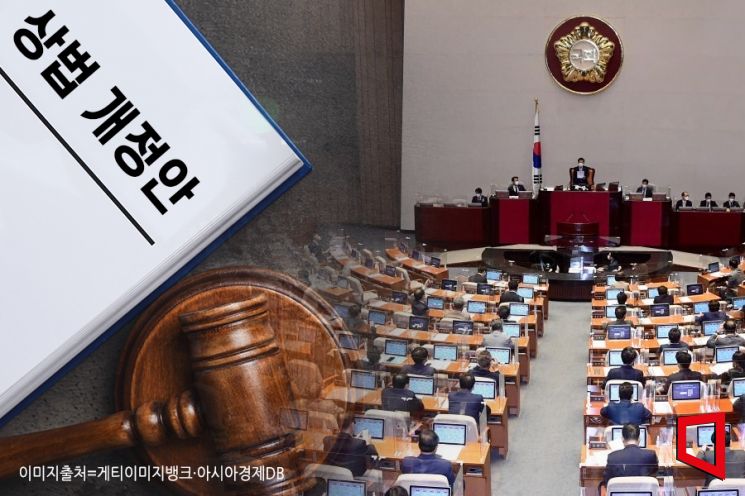
As the passage of the Commercial Act amendment by the National Assembly has become a foregone conclusion, the business community is voicing strong concerns about a potential contraction in investment and is calling for urgent supplementary measures, such as the establishment of a business judgment rule. The amendment to the Commercial Act is scheduled to be finalized at the plenary session after passing through the full meeting of the Legislation and Judiciary Committee on July 3.
 On July 2, the Subcommittee on Bill Examination No.1 of the National Assembly's Legislation and Judiciary Committee is reviewing the partial amendment bill of the Commercial Act and other agenda items. 2025.7.2 Photo by Kim Hyunmin
According to the business community on this day, companies responded with cynicism. A CEO of a major corporation told Asia Economy, "Executives set aside reserves not only for the present but also in consideration of future environmental changes. I doubt whether increasing dividends will truly help ensure the sustainability of a company."
Another executive commented, "It feels more like empty theorizing than a real supplement. Companies are now in a state of resignation," adding, "The political circles seem intent on wrapping up discussions on the amendment, but I wish they would take a closer look at how it affects the private sector in detail."
There is particularly strong resistance to the 'duty of loyalty of directors,' which was not omitted even during the supplementation process of the amendment. Once the Commercial Act is amended, directors of companies will be required to faithfully fulfill their responsibilities not only to the company but also to the interests of shareholders. A corporate official stated, "There can be differences between the opinions of management and shareholders. Shareholders may demand large dividends for short-term performance, while management is likely to pursue investments for long-term results. It is unclear how to resolve the conflict between these two opposing choices." An executive of a business association predicted, "When companies seek to enter overseas markets or pursue innovative businesses such as mergers and acquisitions (M&A), they may hesitate due to the increased risk of management rights being challenged."
The information technology (IT) sector, which is currently engaged in fierce competition to develop artificial intelligence (AI), is feeling an acute sense of urgency. An industry insider said, "AI requires intensive, large-scale investment, so we are concerned that the amendment to the Commercial Act could hinder us at a critical time. Of course, shareholders would not pursue actions that harm the company, but there is concern that necessary investments for competition could be significantly delayed."
Companies predict that if management does not act in accordance with the wishes of shareholders, lawsuits may follow under the revised Commercial Act. The ruling party has proposed codifying the 'business judgment rule' as a legal provision to prevent such litigation and has suggested discussing the abolition of the crime of breach of trust after the amendment is passed. The 'business judgment rule' is an unwritten legal principle under which courts recognize the uniqueness and autonomy of business decisions made by management in cases of litigation over poor management. Currently, there are no relevant provisions in Korean law, and the rule exists only in case law. However, companies are skeptical about the likelihood of this becoming a reality. A company representative said, "Codifying the business judgment rule is extremely important, but at present, it is very unclear whether it will be properly discussed."
Companies are concerned that this amendment to the Commercial Act may signal the beginning of increased burdens on management. They believe that other burdensome bills, such as the Yellow Envelope Act, are likely to pass the National Assembly in succession. A business community official said, "There is a high possibility that a series of laws unfavorable to companies will be passed in the future, so it is necessary to closely examine how to respond to each one."
© The Asia Business Daily(www.asiae.co.kr). All rights reserved.


















