Measuring Social Perceptions by Adding the "Cohabitation Without Marriage" Category
The Statistics Korea announced on July 3 that the sample survey items for the "2025 Population and Housing Census," marking the 100th anniversary of the census, will remain the same as the previous cycle, totaling 55 items. Of these, 13 items will be replaced with administrative data and will not be surveyed in the field. Compared to the previous cycle, there are 7 new items, 7 discontinued items, and 18 revised items.
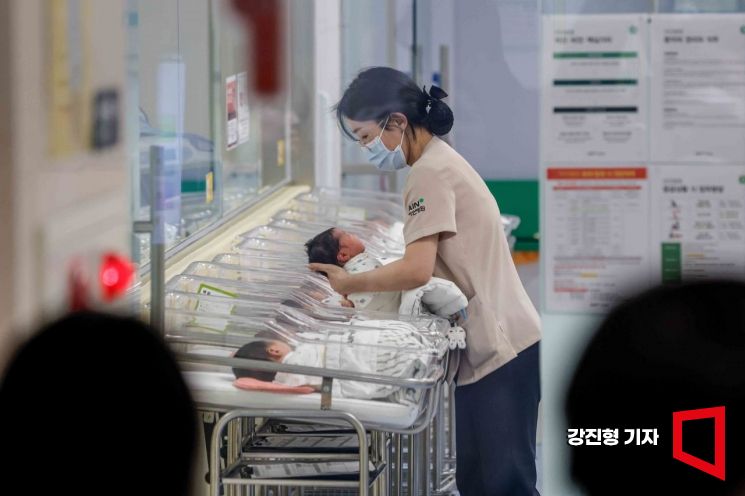 Medical staff caring for a newborn in the neonatal unit at Ain Hospital, Michuhol District, Incheon, last February
The Statistics Korea selected survey items this year to reflect the diverse social and economic changes in the country. In order to measure rapidly changing social phenomena such as perceptions of marriage, diversification of household formation, aging, and multiculturalism, new survey items were developed.
The main new items include ▲family caregiving time and ▲marriage plans and intentions, which reflect policy needs related to low birth rates and aging. For multicultural households and foreigners, ▲language used within the household and ▲Korean language proficiency were added. In addition, ▲rental provider was included to better understand the status of households living in rental housing.
In addition, the category of "cohabitation without marriage" was added to the survey item on "relationship to head of household" in order to measure changes in societal perceptions of marriage and cohabitation. This aims to capture the increasingly diverse types of households and provide basic data necessary for policy development and analysis.
The Statistics Korea also made efforts in this survey to reduce the response burden on the public. While reviewing the practical benefits of field surveys in terms of data utility, accuracy, and sensitivity, the agency actively utilized administrative data to reduce the number of questions asked to respondents.
The items "number of children born" and "timing of childbirth," which were previously identified as sensitive survey items, will be replaced with administrative data and will not be surveyed in the field. Among the items based on first marriage, "year and month of marriage" and "number of children born," the "number of deceased children" will be discontinued, taking into account the response burden and data utility.
An Hyeongjun, Deputy Commissioner of Statistics Korea, said, "This year's Population and Housing Census is the first large-scale sample survey (covering about 5 million households) to be conducted since the COVID-19 pandemic, and it will help us understand the diverse social and economic changes in our country," adding, "We ask for the public's active participation and accurate responses."
© The Asia Business Daily(www.asiae.co.kr). All rights reserved.

















