A construction technology for concrete composite mats that reduces installation time by more than half has been developed.
The Korea Institute of Civil Engineering and Building Technology (KICT) announced on July 3 that it has developed an "ultra-rapid setting concrete composite mat construction technology for unpaved road pavement," and has completed field verification in the Philippines.
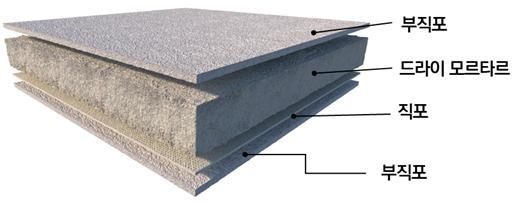 Ultra-rapid setting concrete composite mat structure. Provided by Korea Institute of Civil Engineering and Building Technology
The verified technology is expected to help address poor road infrastructure issues in rural areas of Southeast Asia in the future.
The ultra-rapid setting concrete composite mat is a product made by placing concrete material between civil engineering fiber layers to form a mat. After installation, when water is applied, the concrete hardens and becomes solid within one hour.
Because it sets faster than conventional concrete, it enables rapid construction. Another advantage is that installation is relatively simple and can be carried out by a small workforce without heavy equipment. Currently, ultra-rapid setting concrete composite mats are mainly used for reinforcing railway slopes, embankments, levees, and canal structures.
KICT's newly developed ultra-rapid setting concrete composite mat has improved structure and enhanced performance, making it suitable for application to unpaved roads.
It prevents rainwater from penetrating the ground during heavy rainfall, thereby protecting against ground subsidence and road damage. In addition, it can be installed manually without large equipment at the site, and the installation time has been reduced by more than half compared to previous products.
The KICT research team conducted a field test on an actual unpaved road in the Pampanga region of the Philippines, confirming that the newly developed composite mat maintained stable performance without deformation, damage, or subsidence.
KICT explained that the reliability and objectivity of the technology were ensured, as the field test was directly carried out by the local accredited testing agency MJAS Zenith.
KICT believes that this technology enables low-cost construction of small-scale unpaved roads and shortens construction periods, making it effective for Southeast Asian countries in urgent need of road infrastructure expansion. Above all, by improving production facilities and securing high quality, it has also laid the foundation for enhancing the competitiveness of domestic small and medium-sized enterprises through reduced manufacturing costs.
Park Seongyu, President of KICT, said, "This technology development will serve as a practical foundation for not only effectively improving unpaved road problems in Southeast Asia, but also supporting domestic SMEs in entering overseas markets," adding, "KICT will continue to take the lead in securing international technological competitiveness in cooperation with domestic SMEs."
Meanwhile, the technology developed through this research has been transferred to Contech ENG Co., Ltd.
© The Asia Business Daily(www.asiae.co.kr). All rights reserved.

















