Hana Securities forecast on July 3 that if the amendment to the Commercial Act passes the National Assembly plenary session, the KOSPI could rise to the 3,710 level in the short term.
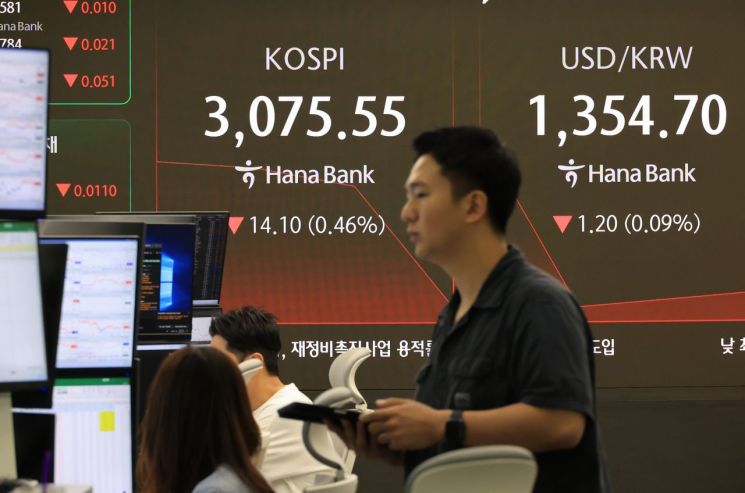
The Democratic Party of Korea and the People Power Party agreed the previous day to process the amendment to the Commercial Act, including a partial revision of the key issue known as the "3% rule," during the June extraordinary session of the National Assembly. The bill is expected to be finalized at the plenary session after passing through the Legislation and Judiciary Committee's general meeting on this day.
Hana Securities evaluated the amendment to the Commercial Act as a signal marking the beginning of resolving the "Korea discount." Kim Dooun, a researcher at Hana Securities, explained, "Seasonally, July is a period when the stock index tends to rise. However, concerns about a market correction are increasing due to a combination of factors, such as the unusually strong gains in the stock index in June and the fatigue from surpassing the psychological resistance level of 3,000 points in a short period."
He added, "Additional factors such as the Trump administration in the United States, which insists there will be no further delays, lingering tensions in the Middle East, and a wait-and-see stance ahead of the corporate earnings season have all contributed to growing concerns in the financial market. Nevertheless, this agreement on the amendment to the Commercial Act is a factor that will boost the upward momentum of the KOSPI."
Kim stated, "Momentum is confirmed through supply and demand, and we expect capital inflows led by foreign investors. Rather than dismissing the amendment to the Commercial Act as a spent catalyst, it should be viewed as a major turning point marking the beginning of resolving the Korea discount."
He continued, "Hana Securities believes the likelihood of reaching the upper KOSPI target of 3,710 points?calculated by applying the average price-earnings ratio (PER) of 14.2 times from previous periods when the index surpassed its previous highs?has increased."
In addition, he predicted that continued inflows of foreign capital would support a strong Korean won. He said, "The USD-KRW exchange rate is likely to continue its current downward trend. The global US dollar is weakening due to the end of US exceptionalism and expectations of a rate cut by the Federal Reserve. Furthermore, increased inflows of foreign capital into the domestic stock market, driven by the amendment to the Commercial Act, are expected to support the strength of the Korean won."
He also noted, "Since June, the strong upward trend in the domestic stock market and expectations for enhanced corporate governance transparency due to the amendment have led to increased net buying of KOSPI stocks by foreign investors. As a result, the supply-demand battle between domestic investors investing overseas and foreign investors investing in Korea has become somewhat more balanced. This is highly likely to act as a factor that could lower the support level of the USD-KRW exchange rate."
© The Asia Business Daily(www.asiae.co.kr). All rights reserved.
![Clutching a Stolen Dior Bag, Saying "I Hate Being Poor but Real"... The Grotesque Con of a "Human Knockoff" [Slate]](https://cwcontent.asiae.co.kr/asiaresize/183/2026021902243444107_1771435474.jpg)
















