Korea Land and Housing Corporation (LH) has begun reorganizing its structure to smoothly carry out national projects such as "balanced national development" and "infrastructure building for future industries including artificial intelligence (AI)," which are key priorities of the new administration.
Since 2021, following allegations of real estate speculation by some employees, LH has implemented strong reform measures, reducing its size and role. However, there is a growing consensus both inside and outside LH that expanding its role is inevitable under the new administration in order to secure new national growth engines. Nevertheless, in line with the government's policy of enhancing public sector efficiency, LH plans to first examine the validity of its organizational and personnel structure and seek consensus at the inter-ministerial level.
According to explanations from relevant ministries and agencies on July 3, LH recently commissioned a study on organizational diagnosis and personnel reassignment. This decision was made because LH's role has become more significant in implementing the new administration's real estate policies, and it is necessary to reflect LH's business environment and conditions. The study will closely examine the current status of ongoing projects and management conditions, and also establish a basis for redefining LH's core functions.
Through this study, LH will analyze its internal organization and personnel. It will then identify functions that need to be strengthened or focused on, as well as those that should be transferred or reduced. In addition, LH plans to develop a roadmap for job-centered organizational management, taking into account policy conditions and project volume. The company will also look for elements to support private AI businesses and consider ways to reassign personnel according to the business cycle.
The expansion of LH's role has become unavoidable since the new government was established. In the case of balanced national development, President Lee Jaemyung made this a major campaign pledge, and the National Planning Committee, which acts as the transition team, strongly requested the Ministry of Land, Infrastructure and Transport to pursue it. In the future, the Ministry will take the lead in drawing up the blueprint, while LH and individual local governments will work together to develop and implement detailed plans. Balanced development is one of the founding purposes of LH.
For the AI industry, which the new administration has identified as a future growth engine, infrastructure is also essential for its development. In order to provide basic facilities such as power and water supply that match large-scale AI investments, an organization to support these needs must be established in advance.
Although the need to increase the organization and personnel has grown, as a public institution, LH or the Ministry of Land, Infrastructure and Transport cannot make such decisions on their own. Consensus at the inter-ministerial level, including fiscal authorities, is necessary. An LH official said, "Rather than increasing or adjusting personnel immediately, the results of this organizational diagnosis can be used as supporting data if expansion becomes necessary in the future." It is known that even in the past, when LH had to increase its workforce by dozens due to work overload, reaching an agreement with the Ministry of Economy and Finance was not easy.
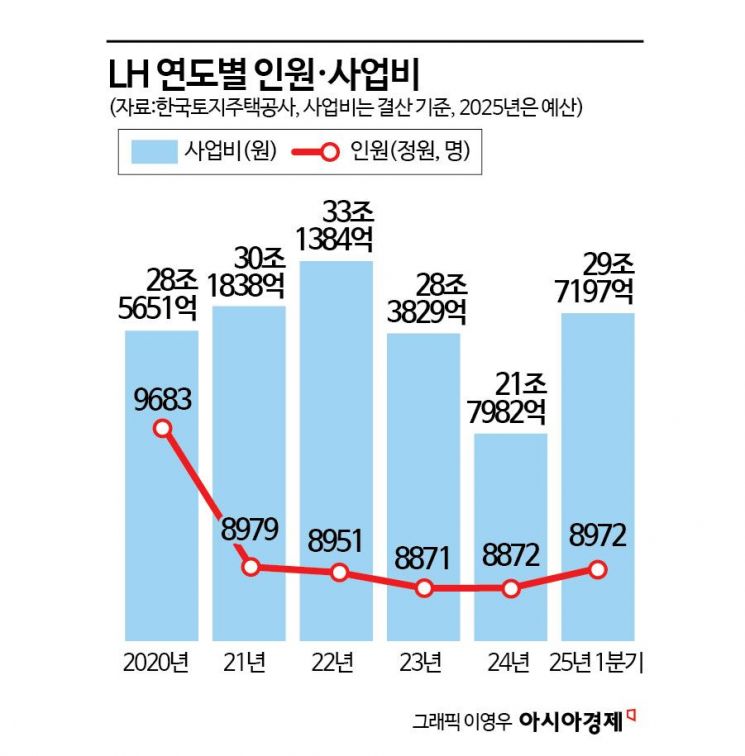
When LH was launched in 2009 by merging two corporations responsible for housing and land, the total number of employees was less than 6,000. Since then, the number has steadily increased, reaching about 10,000 by 2021. Amid this growth, employee misconduct emerged as an issue, leading to criticism of organizational bloating and lax management. This was the background for the strong reform measures, including restructuring and reducing the workforce.
However, LH has continued to expand its role as it is responsible for most land-related projects. Its main duties include developing housing sites, industrial complexes, and new towns, as well as supplying housing. Due to the nature of the housing and real estate sector, most projects are large-scale and long-term. In addition, LH participates as a developer in urban regeneration projects to improve living conditions in aging downtown areas and in the redevelopment of planned cities, which began with the first-generation new towns. LH also plays a leading or involved role in most public real estate projects, such as relocating public institutions due to the relocation of US military bases and the creation of innovation cities, land reserves, and housing welfare for low-income and vulnerable groups.
An LH official explained, "The purpose is to determine the appropriate level of personnel and organization needed to carry out major projects," and added, "Following the 2021 LH innovation plan, we reduced personnel and adjusted functions, but since then, business in each sector has increased significantly, so we determined that it is necessary to establish a system to carry out these projects efficiently."
© The Asia Business Daily(www.asiae.co.kr). All rights reserved.


















