A joint research team from Pukyong National University and Hanyang University has developed, for the first time in the world, a technology that enables the separation and reuse of organic electronic devices, which are core components of electronic equipment.
The research team, consisting of Pukyong National University Chemical Engineering students Kyuwon Woo and Changmin Lee, Research Professor Yonghee Kim, Professor Eunkwang Lee, and Hanyang University Professor Hochun Yoo, developed a next-generation regenerative device in the field of organic electronics called the "π-ion film." They also identified the operating principles of a modular synaptic electronic device based on this film.
This research is considered a breakthrough that overcomes the limitations of organic electrochemical transistors (OECTs), which are increasingly required to deliver both low-power operation and biocompatibility as artificial intelligence-based edge computing and flexible electronics technologies advance. Conventional OECTs have suffered from short lifespans and inability to be reused due to irreversible degradation of the organic semiconductor layer.
The team developed an enhanced "π-ion film" by combining an organic semiconductor material (P3HT) with an ionic liquid (BMIM:TFSI), producing it in a detachable form that achieves both electrochemical stability and neuromorphic characteristics. By implementing a large-area array consisting of 64 devices, the team demonstrated the potential for future expansion into biosensors, wearable medical devices, and edge AI devices.
The researchers explained that their achievement opens the possibility of realizing modular electronic devices in which only the core components need to be replaced to maintain overall functionality, moving away from the disposable structure of organic devices. This is expected to provide an important technological foundation for reducing electronic waste and enabling sustainable electronic device manufacturing.
Professor Eunkwang Lee stated, "This is the first case to simultaneously achieve sustainability and modularity in neuromorphic electronic devices, and it has high potential for industrial applications."
The research results were published in a recent issue of Advanced Materials (IF 29.4), a prestigious international journal in the field of materials science. The study was supported by the National Research Foundation of Korea (NRF), Pukyong National University-Industry Cooperation Foundation, the AI Semiconductor Professional Training Program (IITP), and the Technology Innovation Program of the Ministry of Trade, Industry and Energy (MOTIE).
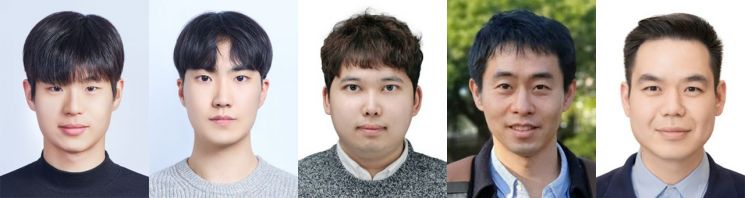 (From left) Students Kyuwon Woo and Changmin Lee, Research Professor Yonghee Kim, Professor Eunkwang Lee, Professor Hochun Yoo.
© The Asia Business Daily(www.asiae.co.kr). All rights reserved.

















