Average Price of Samgyetang in Seoul Nears 18,000 Won
Dining Out Costs Rise Due to Higher Labor and Other Expenses Despite Stable Chicken Prices
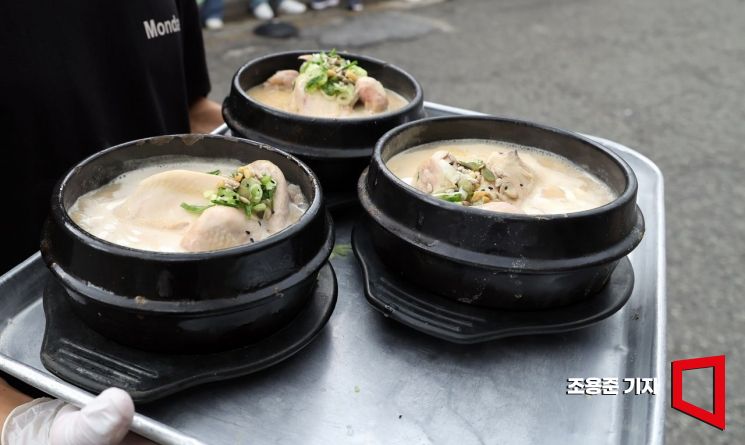
With the peak summer heat approaching, demand for summer health foods such as Samgyetang is expected to rise. However, the average price of a bowl of Samgyetang is nearing 18,000 won, increasing the burden of dining out. Despite the recent stabilization in the price of fresh chicken, inflation has led to higher labor and other incidental costs, preventing Samgyetang prices from declining.
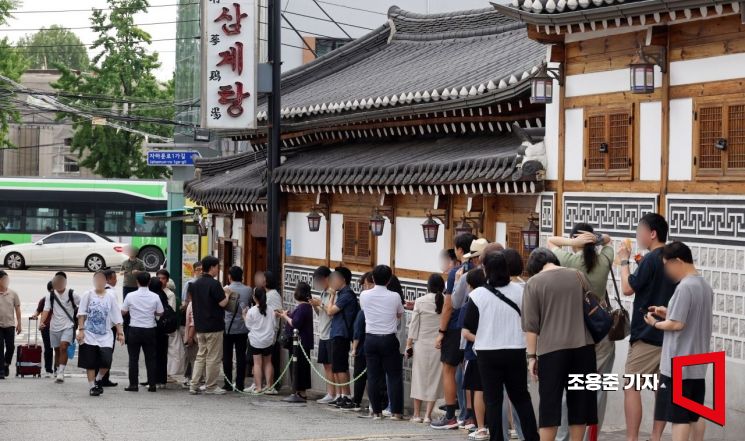
According to the Korea Consumer Agency's price information portal 'Chamkaegyeok' as of May, the average price of a bowl of Samgyetang at restaurants in Seoul was 17,654 won, up 4.6% (769 won) from the same period last year (16,885 won).
The average price of a single serving of Samgyetang in Seoul first exceeded 15,000 won in July 2022, rose to the 16,000 won range in January 2023, and surpassed 17,000 won in July last year. At well-known restaurants, the price is even higher than the average. In fact, popular Samgyetang specialty restaurants in Seoul such as Tosokchon, Nonhyeon Samgyetang, and Goryeo Samgyetang are already selling a basic bowl of Samgyetang for 20,000 won.
Chicken prices are also high. BHC's 'Bburinkle' is 21,000 won, Kyochon Chicken's 'Honey Combo' is 23,000 won. BBQ's 'Mara Hot Chicken' sells for 28,000 won, and 'Ttaeng Shock Chicken' and 'Maepsody Chicken' are priced at 25,000 won and 24,500 won, respectively. Adding a delivery fee (1,000 to 2,000 won), the price of a single chicken can approach 30,000 won.
While the prices of Samgyetang and chicken have surpassed 20,000 won and continue to rise, the price of broiler chickens remains relatively stable. According to the Livestock Products Quality Evaluation Institute's Livestock Distribution Information, as of July 1, the average retail price of chicken per kilogram was 5,764 won, down 5.1% from the same period last year (6,073 won). Wholesale prices have also fallen. During the same period, the average transaction price of slaughtered chicken delivered to large retailers was 3,966 won per kilogram, a 15.5% decrease from the average price in the same month last year (4,694 won).
The supply of broiler chickens is also expected to remain stable. According to the Korea Rural Economic Institute's Agricultural Outlook Center, the number of broiler chickens slaughtered this month is expected to be between 72.6 million and 74.09 million, about 0.8% lower than the average year. However, there is a possibility of fluctuation depending on the occurrence of damage from heatwaves and other factors. Regarding imported chicken, Thai chicken will arrive at the end of this month, and Brazilian chicken will be imported starting mid-next month. The government announced that, as Brazil has declared itself free from avian influenza (AI) and submits supporting documentation, imports of Brazilian chicken will be fully resumed after evaluation.
Despite the stable supply of broiler chickens, Samgyetang prices continue to rise because the drop in the farm price of fresh chicken is not reflected in the distribution process, while high inflation is causing labor costs, rent, and other ingredient costs to increase rapidly. According to Statistics Korea, the price of dining out rose from 2.9% in January to 3.0% in February, and has remained in the 3% range for five consecutive months through last month. In the first quarter of this year, the average monthly dining out expenditure per household was 417,000 won, a 2.5% increase from the same period last year (407,000 won). Compared to the first quarter of 2019, before the COVID-19 pandemic, when the figure was 323,000 won, monthly dining out expenses per household have risen rapidly, increasing by 29.1% over six years.
© The Asia Business Daily(www.asiae.co.kr). All rights reserved.


















