It has been found that, in the 2010s, the number of days with heat waves and tropical nights increased by 1.7 times and 2.1 times, respectively, compared to the 1970s.
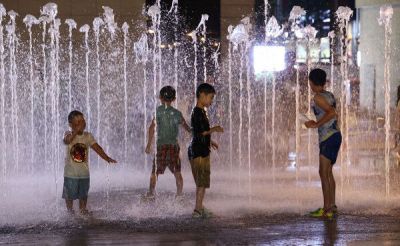 Children are cooling off from the heat at the ground fountain in Gwanghwamun Square, Jongno-gu, Seoul, to escape the tropical night heat. Photo by Yonhap News
According to the Korea Meteorological Administration on July 2, an analysis of the annual number of heat wave and tropical night days from 1973 to 2024 showed that the number of heat wave and tropical night days remained relatively unchanged until the 2000s, but saw a significant increase starting in the 2010s.
Compared to the 1970s, the average number of heat wave days in the 2010s rose from 8.3 days to 14.0 days, a 1.7-fold increase, while the average number of tropical night days increased from 4.2 days to 9.0 days, a 2.1-fold rise. In the 2020s, these figures further increased to 16.7 days and 12.9 days, respectively, surpassing the levels of the 2010s.
Based on the most recent 10 years (2015?2024), the average annual number of heat wave days and tropical night days reached 16.3 days and 11.0 days, respectively, which is 5.3 days and 4.4 days higher than the average for 1991?2020.
Tropical nights mainly occurred in July and August, with the largest increase in August since the 2010s. The years 2024, 2018, and 1994, which were marked by long and hot summers, ranked first to third in both the number of heat wave days and tropical night days.
The highest number of heat wave days was recorded in 2018 with 31.0 days, followed by last year with 30.1 days. In 2024, the number was 24.5 days, which is overwhelmingly higher compared to 16.8 days in 1994, the previous second-highest year. The trend for tropical night days was similar, with 13.6 days in 2001?2010, 19.7 days in 2011?2020, and 28 days in 2021?2024.
In the past 10 years, the regions with the highest average annual number of heat wave days were Miryang (33.6 days), Daegu (33.4 days), and Uiseong (32.6 days), mainly in the inland areas of Gyeongsang Province. For tropical night days, the highest numbers were recorded in Jeju Island (Jeju 45.3 days, Seogwipo 37.6 days), Yeosu (30.0 days), Mokpo (28.2 days), Pohang (27.7 days), and Busan (27.2 days).
© The Asia Business Daily(www.asiae.co.kr). All rights reserved.

















