Eiffel Tower Restricts Access to the Top Until July 2
School Closures and Bans on Outdoor Activities in Many Areas
As Europe continues to experience record-breaking heatwaves, outdoor activities have been banned in many areas, including school closures and restrictions on access to the Eiffel Tower, a must-visit tourist destination in Paris, France.
According to CNN (US), The Guardian (UK), and AFP on July 1 (local time), French authorities have issued a nationwide heatwave alert and will restrict visitor access to the top of the Eiffel Tower for two days until July 2.
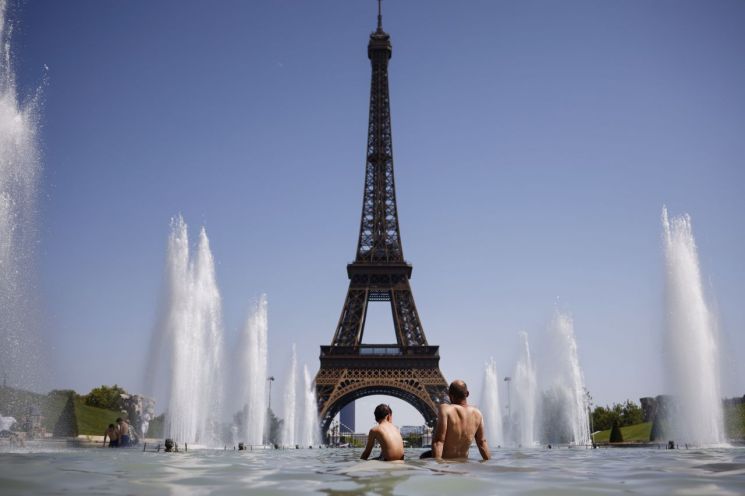 People are cooling off by drinking water at the Warsaw Fountain next to the Eiffel Tower. Photo by EPA Yonhap News.
A notice on the Eiffel Tower's official website reads, "We apologize for the inconvenience. Please protect yourself from the sun and stay hydrated during periods of high temperatures." The Eiffel Tower, a steel structure, can bend slightly at different angles throughout the day depending on the movement of the sun. Because the Eiffel Tower is made of steel that is highly sensitive to heat, it can contract by up to 10 centimeters in winter, the opposite of what happens in summer.
France also decided to close all or part of 1,350 public schools nationwide on this day. In Belgium, the Atomium, a tourist attraction in Brussels, also restricted visitor access for two days starting the same day.
In Italy, outdoor work was banned from 12:30 p.m. to 4:00 p.m. in Lombardy and Emilia-Romagna, two major industrial hubs. As a result, the number of regions in Italy where outdoor work is prohibited has increased to 13. These measures were implemented as fatalities continued to occur due to the heatwave. The previous day, a 47-year-old man collapsed and died at a construction site in Emilia-Romagna. On July 1, two more workers collapsed at another construction site, with one falling into a coma.
That afternoon, in the Catalonia region, a child died after being left in a car during the heatwave. Italian authorities reported that, over the past few days, emergency room visits have increased by 15 to 20 percent, with most patients being elderly people who collapsed due to dehydration and other heat-related causes.
Amid the abnormal weather conditions causing the heatwave, wildfires and floods have also occurred in several areas. In T?rkiye, tens of thousands of people evacuated as wildfires spread, and in France, heavy rains forced the suspension of tourist trains running between France and Italy for at least several days.
Previously, on June 29, temperatures in Mora, Portugal, reached 46.6 degrees Celsius, as record-breaking heatwaves continued across Europe.
© The Asia Business Daily(www.asiae.co.kr). All rights reserved.

















