Democratic Party Includes All Five Key Agenda Bills, Including the '3% Rule'
People Power Party: "Supplementary Measures Needed, Such as Easing Burden of Breach of Trust"
Negotiations Remain Possible, But Agreement Uncertain
The Democratic Party of Korea has decided to proceed with discussions on the Commercial Act amendment bill without excluding the '3% rule.' There had been speculation that the party might use the exclusion of the 3% rule as a bargaining chip, as it is a provision opposed by the People Power Party and the business community. However, the Democratic Party has opted to include all five key agenda bills. The party's stance is to discuss proposals such as easing criminal liability for breach of trust and providing corporate tax incentives, which are demands from the People Power Party, only after the amendment bill is passed. Therefore, disputes over the Commercial Act amendment are expected to continue until the very end.
On July 2, the Democratic Party announced that it would proceed with discussions on the Commercial Act amendment bill, including the '3% rule,' at the National Assembly Legislation and Judiciary Committee. Hwang Jeonga, spokesperson for the Democratic Party, told reporters after the Supreme Council meeting that the party would include the 3% rule. However, there is still a possibility that the exclusion of the 3% rule could be considered as a bargaining chip during the negotiation process. Moon Jinseok, Senior Deputy Floor Leader of the Democratic Party, said, "It is difficult to say definitively whether the 3% rule will be excluded from the final bill," adding, "This is an issue that needs to be resolved during negotiations between the ruling and opposition parties."
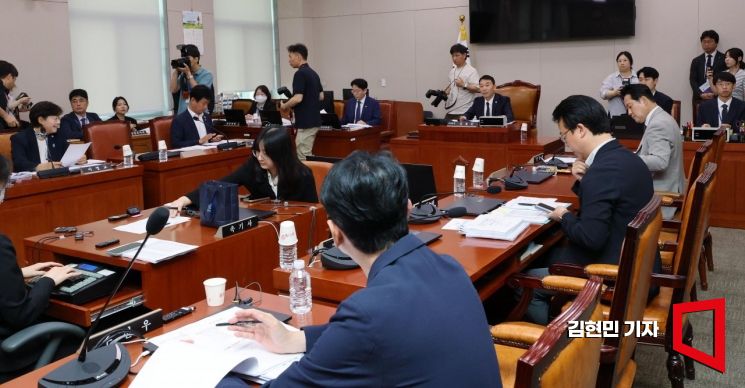 On July 2, at the National Assembly Legislation and Judiciary Committee's First Subcommittee on Bill Examination, Kim Yongmin, the subcommittee chairman from the Democratic Party of Korea, presented agenda items including the partial amendment bill of the Commercial Act. 2025.7.2 Photo by Kim Hyunmin
The main points of the Commercial Act amendment bill are as follows: 1) the 3% rule (limiting the voting rights of the largest shareholder to 3% when electing auditors or audit committee members), 2) expanding the fiduciary duty of directors from the company to shareholders, 3) strengthening cumulative voting for large listed companies, 4) introducing electronic general meetings of shareholders, and 5) converting outside directors to independent directors.
Among these, the 3% rule has been strongly opposed by the business community and the People Power Party. Their concern is that restricting the voting rights of the largest shareholder could expose the boards of domestic listed companies to threats from foreign activist funds and speculative capital. The Democratic Party intends to keep the core provisions on the negotiation table. However, it is also possible that the party may consider excluding some of the three additional provisions, which were added during the reintroduction of the amendment bill and are strongly opposed by the opposition, as a bargaining chip.
For other contentious issues where there are differences between the ruling and opposition parties, the plan is to address them after the bill is passed. The People Power Party argues that expanding directors' fiduciary duty will lead to an increase in lawsuits against companies and heightened concerns over criminal liability for breach of trust, and therefore calls for supplementary measures. They also insist that corporate incentives, such as tax benefits, should be considered as part of a package. In response, Deputy Floor Leader Moon stated, "If it is agreed that concerns about criminal liability for breach of trust raised by the business community and the opposition will be discussed after the bill is passed, I believe the opposition will have little reason to strongly oppose it," adding, "Tax issues will also be discussed later."
On the other hand, the People Power Party maintains that simply excluding the 3% rule will not be enough to allow the Commercial Act amendment bill to pass. Shin Dongwook, a member of the Legislation and Judiciary Committee from the People Power Party, said in a phone interview, "It is not our party's policy to negotiate by trading off any of the five key issues," and predicted, "There will be difficulties in today's discussions because we will comprehensively demand supplementary measures."
The main issue for which supplementary measures are deemed necessary is the proposal to expand directors' fiduciary duty to shareholders. If the fiduciary duty of directors is expanded from the company to both the company and its shareholders, even a small number of shareholders who suffer losses due to board decisions could apply criminal liability for breach of trust, which is a major concern for the business community. The People Power Party therefore argues that supplementary measures, such as amending the Criminal Act to include exemption clauses for breach of trust, should be discussed together.
The People Power Party is accelerating its response by introducing related bills. On this day, Ko Dongjin, a member of the People Power Party, submitted a special law on corporate breach of trust to the National Assembly to counter the Commercial Act amendment bill. The bill stipulates that if a director acts in the company's interest based on careful judgment, without the intention of gaining property benefits for themselves or a third party, they cannot be punished for breach of trust even if the company suffers losses.
The party also insists that tax benefits must be included in the Commercial Act amendment bill. They argue that including incentives for companies is essential to ensure the effectiveness of the system. Song Seokjun, a member of the Legislation and Judiciary Committee from the People Power Party, said in a phone interview, "While the Commercial Act amendment bill may cause stock prices to rise in the short term, it will ultimately dampen corporate motivation and negatively affect the stock market," emphasizing, "Because supplementary measures need to be carefully discussed, this is not an issue that can be resolved in a day or two."
Even if an agreement is not reached during the standing committee discussions, the ruling party is highly likely to push ahead with the amendment bill. For now, the goal is to have the bill processed at the National Assembly plenary session on July 3. An opposition member of the Legislation and Judiciary Committee said, "Even if the Democratic Party ultimately pushes it through, we cannot just give up in advance," adding, "At this point, it is difficult to predict the outcome."
© The Asia Business Daily(www.asiae.co.kr). All rights reserved.
![Clutching a Stolen Dior Bag, Saying "I Hate Being Poor but Real"... The Grotesque Con of a "Human Knockoff" [Slate]](https://cwcontent.asiae.co.kr/asiaresize/183/2026021902243444107_1771435474.jpg)
















