Professor Jeongwoo Yoo and Professor Changhee Son's Team Develops RuO2-Based Collinear Antiferromagnet Magnetic Tunnel Junction Device
World's First Observation of Tunneling Magnetoresistance Reversal in Junction Device, Published in Phys. Rev. Lett.
A semiconductor device utilizing a new material called a collinear antiferromagnet has been developed.
This breakthrough is expected to contribute to the development of ultra-fast, low-power AI semiconductor chips.
The research teams led by Professor Jeongwoo Yoo from the Department of Materials Science and Engineering and Professor Changhee Son from the Department of Physics at UNIST have developed a magnetic tunnel junction device based on ruthenium oxide collinear antiferromagnet and successfully measured a significant tunneling magnetoresistance (TMR) value in this device.
 Research team, (from the bottom left corner counterclockwise) Professor Jeongwoo Yoo, Researcher Seunghyun Noh (first author), Researcher Gyehyun Kim (first author), Professor Changhee Son. Provided by UNIST
Magnetic tunnel junction devices are components used in MRAM memory semiconductors. Currently, MRAM is based on ferromagnetic magnetic tunnel junction devices. Although MRAM is a non-volatile, low-power AI memory capable of computation, its practical applications have been limited.
Unlike conventional memory, which utilizes the 'charge' of electrons, MRAM writes and reads information using a physical property called 'spin.' However, the spins in ferromagnetic materials require a large amount of energy to reverse, have limited switching speeds, and are highly sensitive to interference from external magnetic fields.
The research team has developed a device based on collinear antiferromagnets that can overcome these limitations. Collinear antiferromagnets, like ferromagnetic materials, can store information using spins, but they are less affected by external magnetic fields and enable ultra-fast switching.
In this study, the team utilized ruthenium oxide (RuO₂), which has attracted attention as a potential collinear antiferromagnet. Although this material has long been discussed in academia as a candidate for collinear antiferromagnetism, its experimental properties are still subject to various interpretations.
The team synthesized ruthenium oxide by precisely stacking thin films at the atomic level under high vacuum conditions and fabricated the magnetic tunnel junction device by sequentially depositing an insulating layer and a top ferromagnetic layer.
In the actual device, the researchers observed changes in the 'tunneling magnetoresistance value' when the magnetization direction of the magnetic layer was switched. The change in the tunneling magnetoresistance value provides experimental evidence that this device can be used as a real magnetic memory device.
The research team stated, "This is the world's first experimental confirmation that the tunneling magnetoresistance value changes according to the spin direction in a collinear antiferromagnet-based magnetic tunnel junction device. This research enhances the feasibility of AI memory semiconductors based on collinear antiferromagnet devices. We are currently conducting follow-up studies to develop devices that exhibit even clearer changes in tunneling magnetoresistance values."
This research was conducted in less than a year, from material synthesis to device fabrication and measurement, thanks to the rapid support of the 'Challenge-Driven R&D Project,' which began in September 2024.
The 'Challenge-Driven R&D' program is a Korean initiative designed to quickly realize high-risk, high-impact topics at the forefront of basic science, modeled after the U.S. DARPA system.
Kim Dongho, Director of the Challenge-Driven R&D Project at the National Research Foundation of Korea, commented, "This research is the result of the research team's bold challenge in the field of collinear antiferromagnets, which is difficult to approach using conventional R&D systems, and the rapid support provided by the Challenge-Driven R&D program. We will continue to support this technology so that it can lead to the next leap forward in the semiconductor industry."
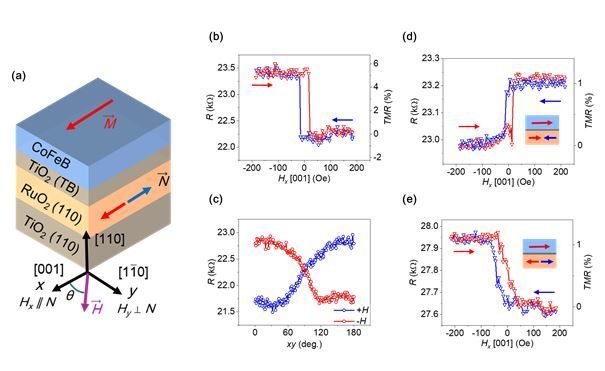 Structure of the magnetic tunnel junction semiconductor device and tunnel magnetoresistance measurement results.
This research was co-led by Researcher Seunghyun Noh from the Department of Materials Science and Engineering at UNIST and Researcher Gyehyun Kim from the Department of Physics, both as first authors. The results were published on June 20 in Physical Review Letters, the most prestigious journal in the field of physics.
© The Asia Business Daily(www.asiae.co.kr). All rights reserved.


















