Standard Floor Area Ratio Increased Up to 30%
Legal Maximum FAR Expanded to 1.2 Times
Diversified Incentives Introduced to Respond to Future Societal Changes
The Seoul Metropolitan Government will introduce incentives to housing redevelopment projects in order to enhance the profitability of urban renewal promotion projects, and will improve standards such as floor area ratio (FAR) requirements. The city has devised a plan to grant additional FAR when facilities are built in response to social changes such as aging, low birth rates, and eco-friendly incentives.
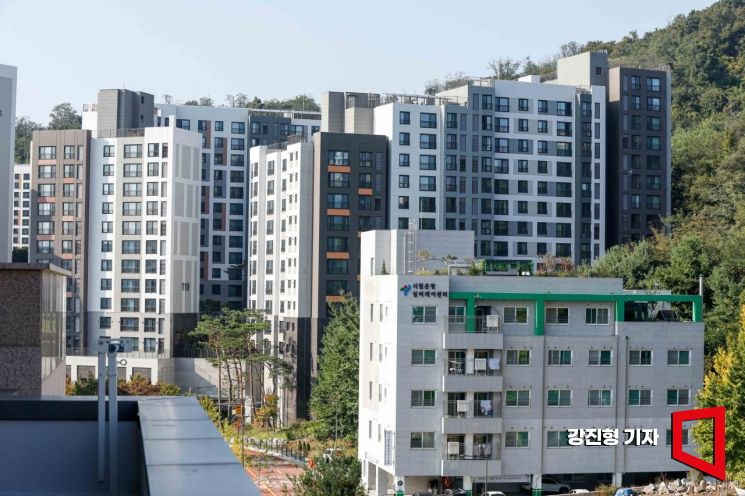 On the 24th, at the Eunpyeong-gu Municipal Eunpyeong Silver Care Center in Seoul. The Municipal Eunpyeong Silver Care Center is a facility that Seoul City established as the first in the nation to receive a senior-exclusive care facility as a public contribution through a private development project, built in the Susaek 13 District housing redevelopment site. It is a public senior care facility spanning from basement level 1 to the 6th floor above ground, which opened in May. Photo by Kang Jinhyung
On July 2, the Seoul Metropolitan Government announced that it had prepared the second round of improvements to the criteria for establishing urban renewal promotion plans (housing redevelopment projects) and reported them to the 6th Seoul Urban Renewal Committee. The city implemented the first round of profitability improvement measures in March and will implement the second round within this month.
This round of improvements focuses on enhancing project profitability in line with social changes such as aging, low birth rates, and the increase in single-person households.
Under the new plan, the standard FAR can be relaxed up to 30%, compared to the previous maximum of 20%. Previously, the FAR could be relaxed by up to 20% if small housing units (exclusive area of 60 square meters or less) were provided. Going forward, if facilities addressing aging or low birth rates are provided, or if housing for multi-generational or single-person (newlywed) households is introduced, a profitability adjustment incentive will be applied, allowing the FAR to be relaxed by up to 30%. The profitability adjustment incentive, which had previously been applied only to general urban renewal projects, will now also be extended to housing redevelopment projects.
Housing for single-person households or newlyweds is categorized as units with an exclusive area of less than 40 square meters, 40 to 50 square meters, or 50 to 60 square meters, and can receive up to a 10 percentage point FAR relaxation. Facilities related to aging include senior care facilities, comprehensive senior welfare centers, and home-based senior welfare facilities. Facilities supporting low birth rates and childcare include public postpartum care centers, care facilities, national and public daycare centers, Seoul-type kids cafes, community child care centers, shared parenting spaces, and indoor children's playgrounds. Facilities for aging and low birth rates can each receive up to a 10 percentage point FAR relaxation, and these can be combined with the maximum FAR. Multi-generational housing refers to units exceeding 85 square meters with separate units, where the separated unit must have an exclusive area of at least 40 square meters including a kitchen and living room, and can receive up to a 10 percentage point FAR relaxation.
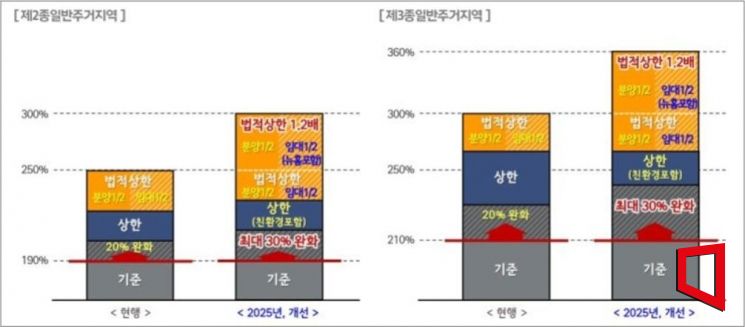
The legal maximum FAR will be increased from 1.0 times to 1.2 times the standard set by the National Land Planning Act Enforcement Decree. The legal maximum FAR refers to the sum of the additional FAR granted for providing public facilities and the standard/permissible FAR. For example, in Type 1 General Residential Zones, the standard FAR will increase from 150% to 180%, and the legal maximum FAR from 200% to 240%. In Type 2 General Residential Zones, the standard FAR will increase from 190% to 220%, and the legal maximum FAR from 250% to 300%. In Type 3 General Residential Zones, the standard FAR will increase from 210% to 240%, and the legal maximum FAR from 300% to 360%.
Projects applying the 1.2 times legal maximum FAR will be required to establish a 'Smart Complex Specialization Plan' to promote the creation of future-oriented residential environments, such as smart homes based on Internet of Things (IoT), unmanned robot technologies (for delivery, cleaning, security, etc.), and smart community infrastructure. This plan will be reviewed and adopted through the Urban Renewal Committee, encouraging private sector creativity.
To address the climate crisis, an 'eco-friendly incentive' reflecting green building and zero-energy policies will also be introduced. If a project obtains energy efficiency ratings, ZEB (Zero Energy Building) certification, or green building certification, it will be eligible for up to a 7.5% FAR incentive. If a certain level of certification is obtained, the project can receive the same benefits as public contributions, thereby improving business conditions.
The formula for calculating the maximum FAR has also been improved to grant greater incentive benefits to projects that secure more infrastructure. This means that the same amount of public contribution can now yield greater FAR relaxation benefits, which is expected to stimulate infrastructure investment.
This round of improvements can be applied to both new and revised urban renewal promotion plans. The principle will be to maintain as much of the existing infrastructure as possible. After training sessions for officials from the Seoul Metropolitan Government and district offices, full implementation is scheduled to begin in July.
Choi Jinseok, Director of Housing at the Seoul Metropolitan Government, stated, "This round of improvements marks a shift from simple urban renewal to a future-oriented housing supply policy," adding, "By presenting a smart housing model that responds to social changes such as aging, low birth rates, and the increase in single-person households, we expect to supply at least 3,500 additional housing units."
© The Asia Business Daily(www.asiae.co.kr). All rights reserved.


















