"Even with 17 years of experience, care workers still receive only the minimum wage."
The Gyeongnam Branch of the National Care Workers Union under the Korean Confederation of Trade Unions Service Federation held a press conference at the Gyeongnam Provincial Government Press Center on the 1st, which is Care Workers' Day, calling for improved treatment for care workers.
Care workers are professionals who assist and support individuals who have difficulty performing daily activities on their own due to old age or age-related illnesses, either in residential welfare facilities or in homes connected through home care services.
The profession was established on July 1, 2008, with the implementation of the Long-Term Care Insurance for the Elderly system, marking its 17th year in 2025.
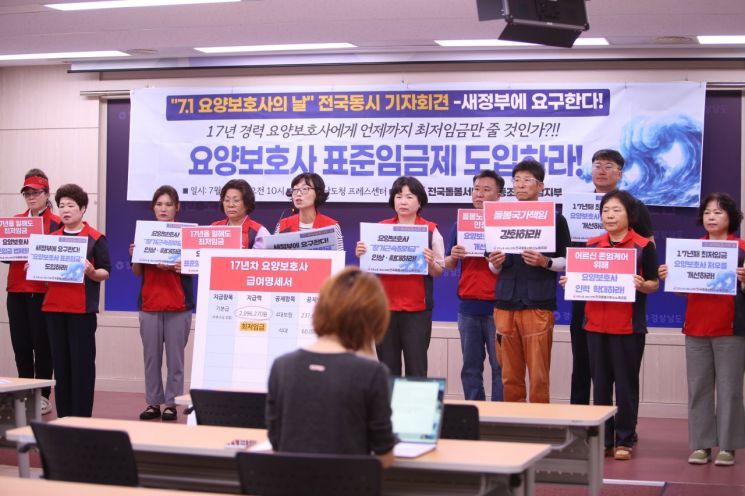 The Gyeongnam Branch of the National Care Workers Union under the Korean Confederation of Trade Unions Service Federation is holding a press conference urging the introduction of a standard wage system for care workers. Photo by Lee Seryoung
The branch pointed out, "With the low birth rate and the super-aged society, the elderly population has surpassed 10 million, and while the number of seniors in need of care is increasing, the number of care workers is decreasing." The branch explained that this is because, despite the high intensity of care work, care workers still receive only the minimum wage even after 17 years of service.
They also stated, "Visiting care workers work in the homes of seniors who need care, but their monthly working hours are less than 60, so they are not eligible for social insurance or severance pay." Additionally, "In the pilot areas for integrated care to be implemented next year, travel time for care workers is not counted as paid work, so they cannot even receive the minimum living expenses."
Furthermore, "The Ministry of Health and Welfare claims that 120% of the minimum wage is paid as the base salary, but in reality, we only receive the minimum wage," they argued. "This is because, while the government has emphasized the importance of elderly care, it has not taken responsibility for care workers' wages and working conditions, nor has it properly guided or supervised long-term care institutions for the elderly."
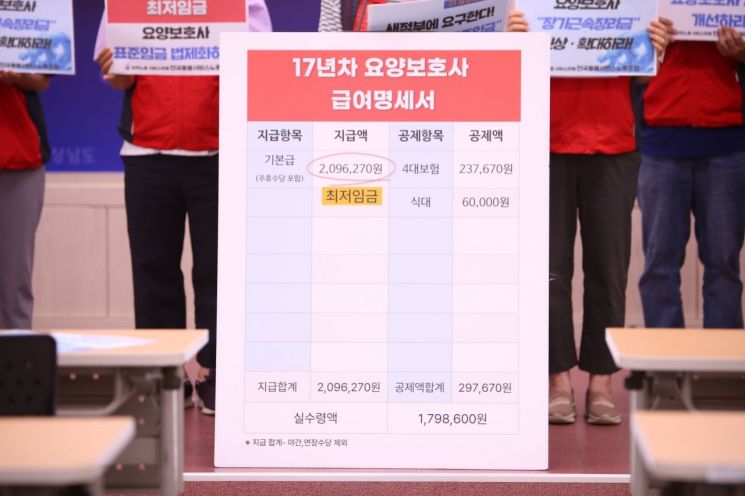 Salary statement of a 17-year veteran caregiver presented at the press conference urging the introduction of a standard wage system for caregivers. Photo by Lee Seryung
According to the branch, the average monthly wage for care workers is around 1.27 million won, the lowest among care workers, and even after 17 years of service, only the minimum wage applies, resulting in a net take-home pay of just 1,798,600 won.
It was found that in the Gyeongnam region, about 49,000 care workers are active in nursing hospitals, day care centers, welfare centers, and homes using home care services.
The branch appealed, "Care workers are devastated by the reality that they are held responsible if a senior loses their dentures, or if a kitchen duty that is not part of their job causes a food waste machine to break, and even have to resign if they contract tuberculosis from an elderly person."
One care worker at a facility who attended the press conference said, "It is not easy to help seniors with dementia or those who are bedridden by cleaning and assisting them with their daily needs." The worker added, "It is common to feel threatened by sudden actions such as violence from seniors with dementia, but even after working day and night on the front lines of care for more than ten years, our treatment does not improve."
On this day, they demanded that the new government strengthen the state's responsibility for care by enacting the Care Policy Act and the Basic Care Labor Act, and by making at least 30% of facilities in each city, county, and district publicly operated.
They also called for the immediate implementation of the standard wage legislation, including the introduction of a seniority-based pay system, family allowances, and holiday bonuses, as well as the expansion and increase of long-term service incentives for those who have worked for more than one year.
Lim Hyuna, the branch chief, said, "If the value and professional expertise of care work and experience are recognized and treatment is improved, the shortage of care workers will be resolved." She added, "Only when care workers are happy will the seniors receiving care also be happy."
© The Asia Business Daily(www.asiae.co.kr). All rights reserved.


















