Causes Blisters and Burns Upon Skin Contact
No Cases Reported Yet in Korea
Giant Hogweed, known as the "most dangerous plant in the world," has been discovered in Japan, prompting authorities to launch an investigation. If confirmed, this would be the first time Giant Hogweed has been found in Japan. On June 30, local media outlets including the Asahi Shimbun reported that authorities had received a report of Giant Hogweed being found on the Hokkaido University campus in Sapporo, Japan. Hokkaido University recently announced on its website, "A plant believed to be Giant Hogweed has been identified on campus, and experts are currently conducting an investigation," adding, "Access to the affected area is restricted to prevent any danger."
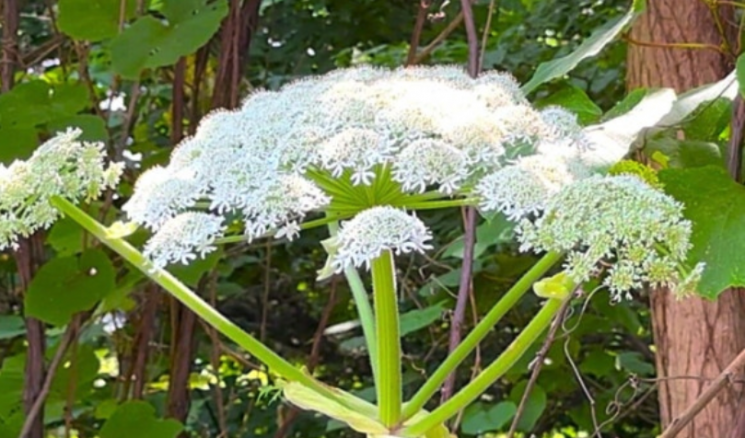
The Hokkaido University campus is located near Sapporo Station and close to a daycare center, and many local residents walk through the campus. As a result, access was immediately restricted. According to local media reports, Giant Hogweed is believed to have taken root on the Hokkaido University campus several years ago, and it is estimated that there are more than 10 plants growing there. Environmental authorities have removed all flowers and leaves from the plants, some of which reached heights of 3 meters. Japanese environmental authorities explained, "It is possible that the plant, originally cultivated for ornamental purposes, spread outdoors, or that seeds unintentionally escaped attached to something else." They also noted, "There have been reports overseas of Giant Hogweed being found in residential areas as well."
Giant Hogweed is an invasive and harmful plant belonging to the Apiaceae family. Its scientific name is Heracleum mantegazzianum. It is native to the western Caucasus Mountains near the Black Sea, and has spread to Europe, the United States, and Canada as a poisonous plant. It typically grows to between 2 and 5.5 meters tall and produces umbrella-shaped white flowers from late spring to summer. Each plant can produce 20,000 seeds at a minimum, and up to 100,000 seeds in some cases, but the germination rate is less than 5%.
Be Careful Not to Touch the Sap of the "Most Dangerous Plant in the World"
The problem is that the sap secreted from the stems, leaves, flowers, seeds, and roots contains a substance called "Furanocoumarin." Furanocoumarin is a phototoxic compound that reacts to light; when the sap comes into contact with skin, it reacts with sunlight to cause blisters, rashes, swelling, and burns. Severe scarring may also result. If the sap gets into the eyes, it can even cause blindness. In the United Kingdom, cultivation of the plant has been legally prohibited since 1981, and in the United States, it is designated and managed as a toxic weed. While the plant requires substantial moisture to grow, it is known to thrive in any area except very dry regions.
One man who developed blisters as large as oranges after passing near Giant Hogweed struggled even to put on clothes and described the pain as "absolute hell." If you suffer painful blisters or burns from contact with Giant Hogweed, exposure to sunlight can further worsen the symptoms, so the affected area should be covered to keep it out of the sun. Afterward, the sap should be washed off the area with water and soap.
 The sap secreted from the stems, leaves, flowers, seeds, and roots of large hogweed contains a substance called "Furanocoumarin," which is highly harmful to humans. Online community
Giant Hogweed has not yet been found in Korea, as the winters are dry. However, about 10 years ago, a related urban legend spread via social networking services (SNS) in Korea, claiming that people developed blisters after touching Giant Hogweed and that the plant was spreading exponentially in the country. This incident was caused by confusion with Common Hogweed (Angelica decursiva), a plant in the same genus as Giant Hogweed, which is commonly found in Korean mountains. However, it is not the same species as Giant Hogweed and is considered safe enough to be eaten as a wild vegetable in certain regions. At the time, the Korea National Arboretum issued a statement clarifying, "The Korea National Arboretum continues to conduct distribution surveys of invasive plants, but the presence of Giant Hogweed in Korea has not yet been confirmed."
© The Asia Business Daily(www.asiae.co.kr). All rights reserved.


















