Korea Disease Control and Prevention Agency Releases Results of 2024 National Child Oral Health Survey
Proper Tooth Brushing and Limiting Cariogenic Snacks and Beverages Are Needed
A survey found that 60% of 12-year-old children in South Korea either have cavities in their permanent teeth or have received treatment for cavities. Although the number of dental visits has increased, the overall health of permanent teeth has not significantly improved, as children continue to consume large amounts of snacks and beverages that are harmful to dental health.
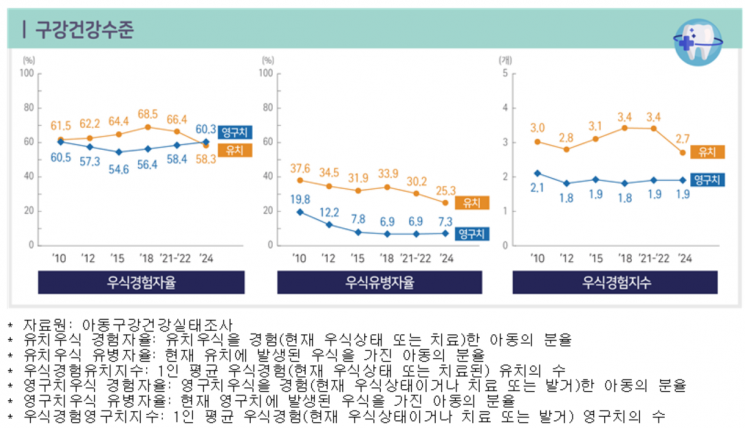
According to the "2024 National Child Oral Health Survey" released by the Korea Disease Control and Prevention Agency on July 1, 2025, a total of 20,055 children aged 5 and 12 were surveyed last year. The proportion of 12-year-olds who have experienced permanent tooth decay (either currently having cavities or having completed treatment) was 60.3%. This figure is 1.9 percentage points higher than in the previous survey conducted in 2021-22.
The prevalence rate of permanent tooth decay (currently having cavities) among these 12-year-olds was 7.3%, and the average number of decayed permanent teeth per child (DMFT index) was 1.9, showing little change compared to the previous survey.
The National Child Oral Health Survey is conducted every three years based on Article 9 of the Oral Health Act. It serves as foundational data for establishing and evaluating oral health policies and projects for children in South Korea, as well as for related research. The survey mainly targets 5-year-olds, who are suitable for assessing primary tooth health, and 12-year-olds, who are suitable for assessing permanent tooth health. Dentists visit institutions such as daycare centers, kindergartens, and schools to conduct the survey.
For 5-year-old children, the rate of experience with primary tooth decay was 58.3%, the prevalence rate (currently having cavities) was 25.3%, and the average number of decayed primary teeth per child was 2.7. Since 2018, all these indicators?experience rate, prevalence rate, and number of decayed teeth?have been on a downward trend.
However, the government's targets for reducing the rate of dental caries experience among children and adolescents, as outlined in the National Health Promotion Plan and the Basic Plan for Oral Health Projects, have not yet been met. The targets are: 55.0% for primary tooth caries experience rate (age 5), 45.0% for permanent tooth caries experience rate (age 12), and an average of 1.5 decayed permanent teeth per child. All current indicators require further improvement.
In the 2024 survey, 57.7% of 12-year-old children (oral examination) had undergone "fissure sealant" treatment, which is highly effective in preventing cavities in permanent teeth by sealing the narrow and deep grooves on the chewing surfaces. However, this rate was 8.4 percentage points lower than in 2021-22. The average number of permanent teeth per child that received fissure sealants was 1.8.
The proportion of 12-year-olds who brushed their teeth after lunch was 22.6%. This is 7.4 percentage points higher than during the COVID-19 pandemic (2021-22), but it has not yet returned to the pre-pandemic level of 33.3% in 2018. The rate of brushing teeth before bedtime was 72.7%.
On the other hand, the rate of consuming snacks that cause cavities (twice or more per day, age 12) was 58.1%, and the rate of consuming beverages that cause tooth erosion (twice or more per day) was 29.4%, both showing a clear upward trend.
The proportion of 12-year-olds who received oral health education at dental clinics or hospitals, such as instruction on brushing and using oral care products, was 43.8%. This is an improvement over the 39.9% reported in 2021-22, but it remains low. In addition, the rate of experiencing gum (gingival) pain and bleeding due to oral health management issues such as improper brushing was 39.8%, an increase of 5.0 percentage points.
In the past year, 72.1% of children had visited a dentist, an increase of 11.1 percentage points compared to 2021-22. The proportion of children who thought they needed dental care but did not receive it was 14.7%, a decrease of 3.0 percentage points. The main reasons for not receiving dental care were lack of time (51.5%), mild symptoms (23.3%), and fear of dental treatment (9.8%).
Choi Yeonhee, professor and former chair of the Epidemiological Survey Committee of the Korean Academy of Preventive Dentistry and Oral Health, who led the study, stated, "Over the past decade, the oral health of primary teeth among children in South Korea has improved, but the condition of permanent teeth has stagnated without significant change. Active involvement from oral health professionals in oral health education and preventive care, as well as full support from the government and local authorities, is necessary to reduce the incidence of dental caries."
Ji Youngmi, Commissioner of the Korea Disease Control and Prevention Agency, said, "The experience of permanent tooth decay is increasing, while practices such as tooth brushing and the consumption of cariogenic snacks and beverages are not improving. Since oral health behaviors during childhood and adolescence affect oral health in adulthood, we plan to continuously monitor changes in oral health status and related factors."
© The Asia Business Daily(www.asiae.co.kr). All rights reserved.


















