Real Estate PF Loan Delinquency Rate Rises to 4.49% in Q1
Loan Balance Declines Amid PF Insolvency Resolution
"Concerns Over Sudden Market Shock Expected to Ease"
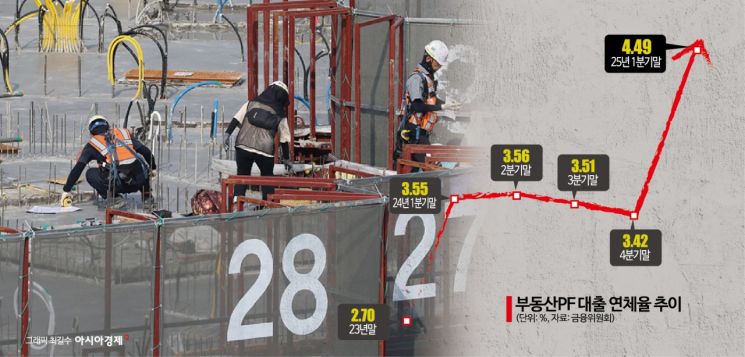
The delinquency rate for real estate project financing (PF) loans in the financial sector rose significantly in the first quarter of this year compared to the previous quarter. However, this phenomenon is seen as a result of the ongoing process of resolving PF insolvencies, and the market impact is expected to be limited. The government has decided to extend ten temporary financial regulatory easing measures related to real estate PF, which were originally set to expire in the first half of this year, until the end of the year to support the soft landing of PF.
Real estate PF loan delinquency rate rises to 4.49% in Q1
On July 1, the Financial Services Commission, the Financial Supervisory Service, the Ministry of Economy and Finance, and other related agencies held a "Real Estate PF Situation Review Meeting" at the Korea Federation of Banks in Jung-gu, Seoul. They announced that as of the end of the first quarter, the delinquency rate for PF loans in the domestic financial sector stood at 4.49%, an increase of 1.07 percentage points from the previous quarter. The PF loan delinquency rate in the financial sector rose from 2.7% at the end of 2023 to 3.42% at the end of last year, and surpassed 4% for the first time in the first quarter of this year.
The government explained that the rise in the delinquency rate is due to an increase in the amount of delinquent loans while the total loan balance is decreasing as PF insolvencies are resolved. Since more than half of all insolvent PF cases were resolved by the first half of this year, the government assessed that there will be no sudden shock to the financial market going forward.
At the end of the first quarter, the delinquency rate for land-backed loans at small and medium-sized financial companies (savings banks, credit card companies, mutual finance) also rose to 28.05%. This rate more than doubled from 12.86% at the end of the first quarter last year. This phenomenon also occurred as the total loan balance decreased significantly. The balance of land-backed loans fell from 29.7 trillion won at the end of 2023 to 16.9 trillion won at the end of the first quarter this year.
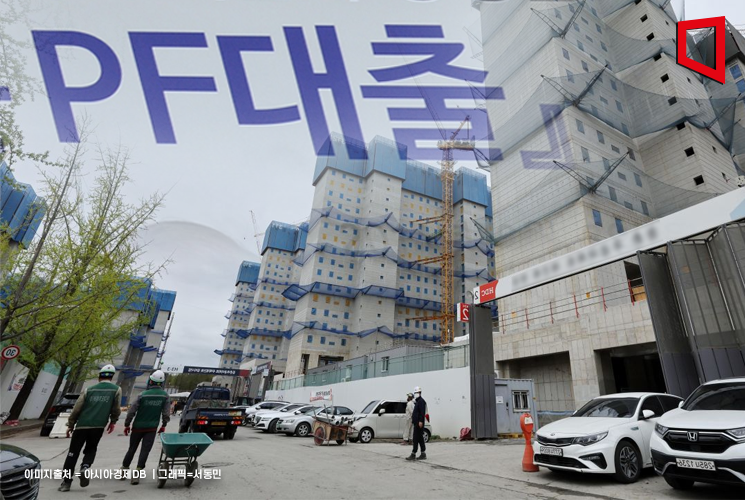
As of the end of the first quarter, the total PF exposure?including PF loans, land-backed loans, and debt guarantees?stood at 190.8 trillion won, a decrease of 11.5 trillion won compared to the end of last year. This was because the reduction in exposure due to project completion, resolution, and restructuring outweighed the amount of new PF exposure. According to project viability assessments, loans classified as "watch-list" or "potentially insolvent" amounted to 21.9 trillion won, representing 11.5% of total PF exposure. The amount of "watch-list" or "potentially insolvent" loans increased by 2.7 trillion won compared to the end of last year, mainly due to new delinquencies.
With the increase in "watch-list" or "potentially insolvent" loans, the ratio of substandard and below PF loans rose to 12.33% at the end of the first quarter, up 2 percentage points from the previous quarter. PF loan-loss provisions also increased by 500 billion won, from 13.1 trillion won to 13.6 trillion won.
By the end of the first quarter, 9.1 trillion won, or 38.1% of all "watch-list" or "potentially insolvent" loans, had been resolved or restructured. Of this, 6.5 trillion won was resolved through auctions, private contracts, and write-offs, while 2.6 trillion won was restructured through new funding and changes to funding structures. The government explained that, as a result of resolving and restructuring 9.1 trillion won in loans, the ratio of substandard and below PF loans decreased by 4.2 percentage points, and the PF delinquency rate dropped by 3.0 percentage points, indicating improvements in soundness indicators.
In the savings bank sector, the creation of the fourth PF normalization fund enabled the sale of insolvent PF assets, resulting in the resolution of 1.2 trillion won in insolvent projects by the end of last month. In addition, financial authorities have continued to encourage voluntary sales in the market by utilizing information disclosure platforms and have strengthened monitoring of medium and large-scale projects (with loan commitments of 50 billion won or more). Through these additional resolutions, a total of 3.5 trillion won in resolutions and restructurings was completed in the second quarter. As a result, it is estimated that a total of 12.6 trillion won, or 52.7% of "watch-list" or "potentially insolvent" projects (23.9 trillion won), was resolved or restructured by the first half of this year.
Extension of temporary financial regulatory easing measures related to real estate PF
At the meeting, the government also discussed future plans for the temporary financial regulatory easing measures related to real estate PF that are set to expire in the first half of the year. The government is currently operating a total of 11 temporary financial regulatory easing measures to support the soft landing of PF. Of these, 10 measures will be extended until the end of this year, with the specific timing for normalization to be determined later. The extended regulatory easing measures include exemptions for executives and employees related to funding and restructuring/resolution, allowing separate classification of asset soundness for new funding, easing of K-ICS (risk coefficient) requirements for PF normalization support, and relaxation of limits on holdings of PF-related securities.
The meeting also included discussions on improvements to real estate PF soundness regulations developed by a financial sector task force, such as differentiating PF loan risk weights based on the capital adequacy ratio of PF projects. The government plans to manage soundness by reflecting the capital adequacy ratio of PF projects in future PF lending. In addition, it will revise soundness management regulations for each financial sector to match the actual risk levels, including PF delinquency rates.
A government official stated, "Following one year of efforts to resolve insolvent PF cases since the introduction of new project viability assessment standards, 52.7% of all insolvent PF cases were resolved or restructured in the first half of this year, alleviating some concerns about a sudden shock in the real estate PF market." However, the official also noted, "There are still risk factors, such as widening disparities by region and by use, and ongoing liquidity difficulties for small and medium-sized construction companies, so continued support and close monitoring are necessary."
The official added, "Going forward, we will continue to pursue the resolution and restructuring of insolvent PF projects on an ongoing basis, keeping in mind the possibility of additional insolvencies due to a delayed recovery in the real estate market, in order to strengthen the soundness management of financial companies."
© The Asia Business Daily(www.asiae.co.kr). All rights reserved.
![Clutching a Stolen Dior Bag, Saying "I Hate Being Poor but Real"... The Grotesque Con of a "Human Knockoff" [Slate]](https://cwcontent.asiae.co.kr/asiaresize/183/2026021902243444107_1771435474.jpg)

















