A team of Korean researchers has proposed a new therapeutic strategy to enhance the effectiveness of immunotherapy for brain tumors using gut microbiota and their metabolites. This finding also suggests the potential for developing microbiome-based immunotherapy adjuvants in the future.
On July 1, KAIST announced that a research team led by Professor Lee Heungkyu of the Department of Biological Sciences has identified and demonstrated a method to improve the efficacy of glioblastoma immunotherapy by leveraging changes in the gut microbiota ecosystem.
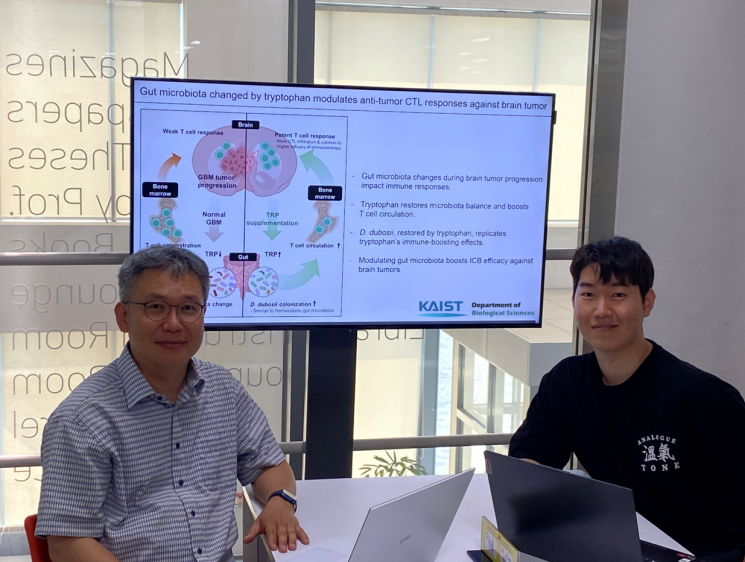
The research team focused on the observation that, as glioblastoma progresses, the concentration of the gut amino acid tryptophan decreases sharply, leading to changes in the gut microbiota ecosystem.
They also discovered that supplementing tryptophan to restore microbial diversity enables certain beneficial strains to activate CD8 T cells, a type of immune cell, and redirect them back to tumor tissues.
This principle was confirmed through experiments. When tryptophan was supplemented in a mouse model of glioblastoma, the response of tumor-attacking T cells (especially CD8 T cells) was enhanced, and these T cells migrated more actively to tumor sites such as lymph nodes and the brain.
The team further revealed that Duncaniella dubosii, a beneficial commensal bacterium present in the gut, plays a key role in effectively redistributing T cells in the body and, when used in combination with the immune checkpoint inhibitor anti-PD-1, significantly increases the survival rate of glioblastoma in mice.
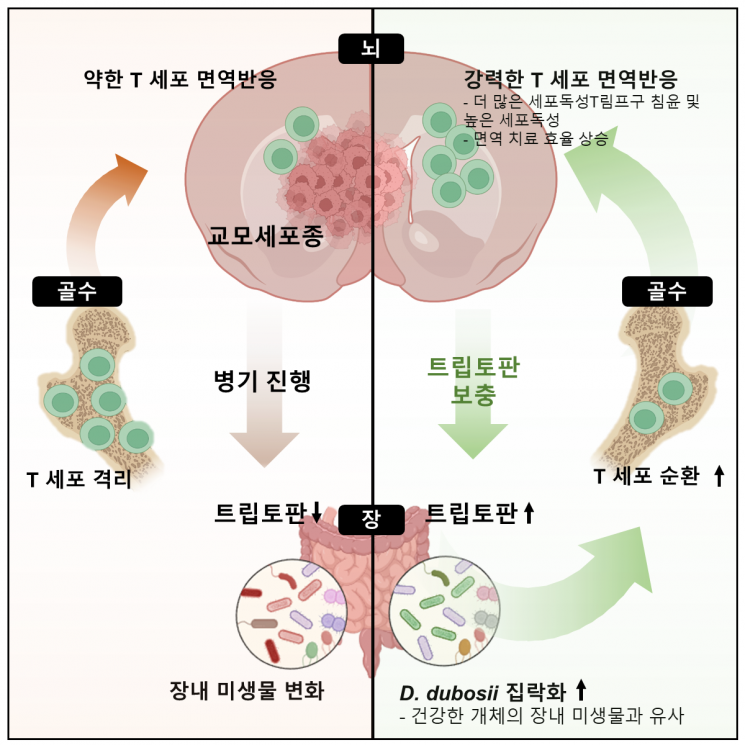 Overview of research showing that gut microbiota regulate the efficacy of anti-brain tumor immunotherapy. Provided by KAIST
Notably, even when Duncaniella dubosii was administered alone to germ-free mice with no gut microbiota, the survival rate of glioblastoma improved. This demonstrates that this strain regulates the gut environment by utilizing tryptophan, and that metabolites produced during this regulation process enhance the cancer-fighting ability of CD8 T cells.
Professor Lee Heungkyu emphasized, "This study is significant because it shows that even intractable brain tumors, which do not respond to immune checkpoint inhibitors, can achieve a meaningful increase in therapeutic response through combination strategies involving gut microbiota."
This research was conducted as part of the Individual Basic Research Program and the Bio-Medical Technology Development Program, supported by the Ministry of Science and ICT and the National Research Foundation of Korea. Dr. Kim Hyuncheol of KAIST (currently a postdoctoral researcher at the Institute of Biological Sciences) participated as the first author.
The results of the study were published online in the international journal Cell Reports in the field of life sciences on June 26.
© The Asia Business Daily(www.asiae.co.kr). All rights reserved.
![Clutching a Stolen Dior Bag, Saying "I Hate Being Poor but Real"... The Grotesque Con of a "Human Knockoff" [Slate]](https://cwcontent.asiae.co.kr/asiaresize/183/2026021902243444107_1771435474.jpg)

















