Secretary Besant's Bloomberg Interview
"Even Good-Faith Negotiators May Face Return to April 2 Tariff Levels"
Secretary of the Treasury Scott Besant stated that once the reciprocal tariff suspension, which is set to expire on August 8 next month, ends, the United States may reimpose the high tariffs announced in early April on certain countries.
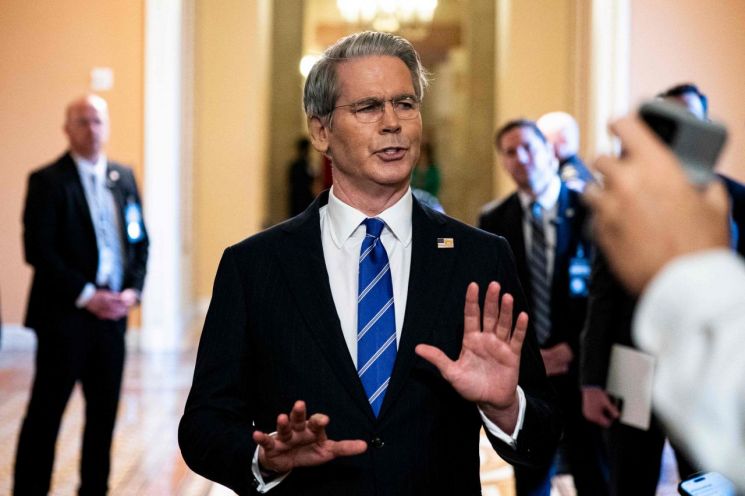
In an interview with Bloomberg TV on May 30 (local time), Secretary Besant said, "While some countries are negotiating in good faith, if they remain intransigent and we fail to reach an agreement, the tariff rates could return to the April 2 levels. I hope that does not happen."
This serves as a warning that even if countries participate in trade negotiations in good faith, they may not be able to avoid the previously announced country-specific reciprocal tariffs if an agreement is not reached before the reciprocal tariff suspension deadline.
Secretary Besant expressed hope that many trade agreements would be concluded before July 9. He explained that after that date, the country-specific reciprocal tariffs could be raised from the current base tariff of 10% to the 11-50% range announced by President Trump in early April. He added that any extension of the reciprocal tariff suspension would depend on President Trump's decision.
Until May 27, Secretary Besant had suggested the possibility of an extension by stating, "We hope to conclude tariff negotiations with major trading partners by Labor Day on September 1." However, after President Trump indicated there would be no extension of the reciprocal tariff suspension, Besant adopted a more cautious stance.
In an interview with Fox News released the previous day, President Trump was asked about the possibility of extending the tariff suspension and responded, "I don’t think it will be necessary," adding, "What we will do is send letters to all countries before the 9th." Regarding the tariff rates, he said, "It could be 25%, 35%, 50%, or 10%." As the decision on whether to extend the reciprocal tariff suspension now rests with President Trump, tariff uncertainty is increasing.
However, President Trump also mentioned, "We might extend it," leaving some room for flexibility. This statement is interpreted as an attempt to urge trading partners to take a more proactive approach to negotiations and to press for a swift conclusion of agreements ahead of the expiration of the reciprocal tariff suspension next week.
Previously, on April 2, President Trump announced the "Liberation Day" tariffs, declaring that, in addition to a base tariff of 10% on all countries, country-specific reciprocal tariffs reflecting each nation's trade barriers would be imposed. The base tariff of 10% remains in effect, while the country-specific reciprocal tariffs were suspended for 90 days immediately after implementation. The United States is currently engaged in trade negotiations with each trading partner, and the suspension is set to end on August 8 next month.
© The Asia Business Daily(www.asiae.co.kr). All rights reserved.

















