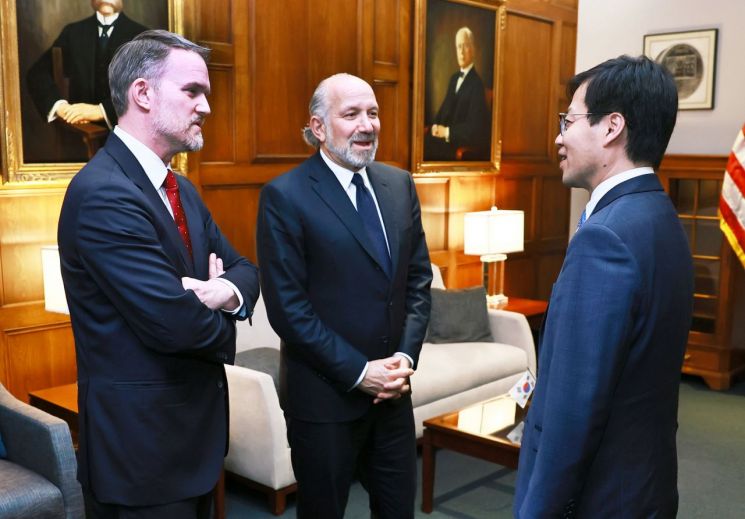
The government is reportedly accepting the United States' high-tariff policy as the 'new normal' and is seeking a breakthrough through a pragmatic approach. In Korea-US trade negotiations, the Korean government is focusing on expanding manufacturing cooperation and easing non-tariff barriers.
On June 30, a senior official from the Ministry of Trade, Industry and Energy told reporters, "While the United States is demanding structural adjustments from countries with trade surpluses, Korea is applying an 'expanded balance' strategy in negotiations to achieve mutual benefits even under high tariffs."
The official explained, "The time to debate whether a trade surplus is theoretically good or bad has passed. We are now focusing on achieving realistic and practical results in response to the new international trade environment characterized by high tariffs."
Previously, Trade Minister Yeo Han-koo visited Washington, D.C., along with officials from relevant ministries, to hold the third round of technical working-level talks. While the first and second rounds focused on understanding US demands, this latest round is being evaluated as an 'advanced negotiation' that clarified Korea's potential responses.
It is reported that this round of negotiations also prioritized resolving non-tariff barriers and expanding cooperation in the manufacturing sector over tariff issues. The official explained, "The United States is imposing tariffs as part of its strategic goal to revive manufacturing, and Korea, as a related cooperation partner, has room to propose its own 'deal.'"
Regarding the US's negotiation priorities, the official stated, "Most of the issues have already been covered in the NTE (National Trade Estimate Report on Foreign Trade Barriers), and the US is gradually narrowing its priorities. The Korean government is accepting issues that are feasible and is also seeking creative alternatives."
On the point that the US is seeking to reduce its trade deficit through tariffs, the official said, "There are various objectives involved, including not only adjusting exports and imports, but also creating jobs through manufacturing investment, supplementing tax cut legislation, and preserving fiscal revenue. We are also pursuing an approach that contributes to structural rebalancing through investment and cooperation."
He particularly emphasized, "The US is aware that simply increasing imports has its limits, and in fact, expanding investment by Korean companies within the US to promote exports to third countries can also be utilized as a negotiation strategy."
Regarding the negotiation deadline of July 8, the official predicted, "Rather than a blanket agreement, multiple paths such as deferral, settlement, or continued negotiations by country are possible, and substantive negotiations may continue even after that date." However, on specific issues, he added, "Since media reports can directly influence the negotiation table, it is important to be cautious about revealing whether any particular issue is viewed optimistically or pessimistically."
On issues such as defense cost-sharing and energy cooperation, the official said, "These matters are being discussed through separate channels and have not been addressed at the trade negotiation table."
© The Asia Business Daily(www.asiae.co.kr). All rights reserved.
![Clutching a Stolen Dior Bag, Saying "I Hate Being Poor but Real"... The Grotesque Con of a "Human Knockoff" [Slate]](https://cwcontent.asiae.co.kr/asiaresize/183/2026021902243444107_1771435474.jpg)
















