All Proposals on Judicial Independence and Public Trust Rejected
"Statement Needed" vs "Restraint on Collective Opinions"
Two Subcommittees Formed on Judicial System and Judicial Appointments
The National Judges' Representatives Meeting, which addressed the controversy surrounding the Supreme Court's appellate review of President Lee Jaemyung's violation of the Public Official Election Act, reconvened on June 30 but ultimately ended without reaching a consensus.
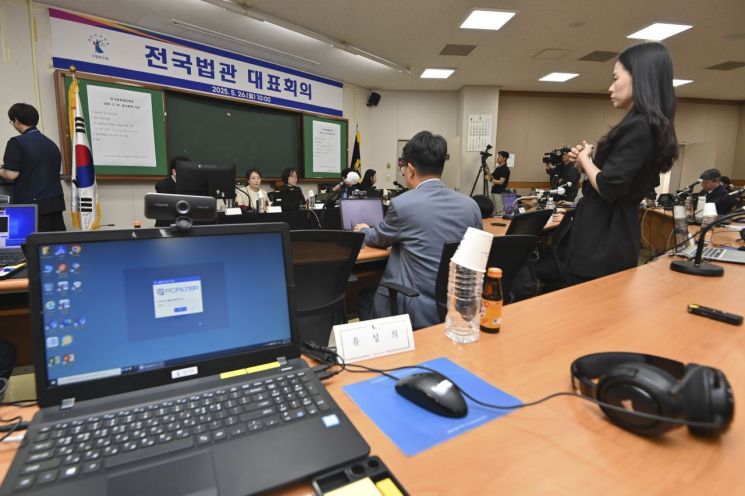 On the 26th of last month, the National Judges' Representatives Meeting is being held both online and offline at the Judicial Research and Training Institute in Goyang, Gyeonggi Province. Photo by Yonhap News
On this day, the National Judges' Representatives Meeting held an extraordinary session via online remote conferencing starting at 10 a.m. Out of a total of 126 representatives, 90 attended. The meeting lasted for about two hours, concluding at noon.
During the meeting, seven agenda items were proposed, including concerns about public trust in the judiciary and potential infringements on judicial independence. After consolidating overlapping items, five proposals were put to a vote. However, all were rejected, as the number of dissenting votes far exceeded those in favor. One major proposal, which stated that "the Supreme Court's ruling has raised doubts about the political neutrality of the courts and the procedural fairness of trials, thereby negatively impacting public trust in the judiciary," was rejected with 29 votes in favor and 56 against. Another proposal, which declared that "actions such as special investigations, impeachment, or hearings against judges who rendered the ruling, beyond mere criticism of the decision itself, constitute a serious infringement on judicial independence and should be prevented from recurring," was also rejected, with 16 in favor and 67 against.
A representative of the Judges' Meeting explained, "Although the discussions were intense, opinions were divided among those who believed that the Supreme Court's ruling had damaged public trust in the judiciary and therefore required a statement from the National Judges' Representatives Meeting to restore trust; those who felt a statement was needed regarding concerns that various actions taken in response to the Supreme Court's ruling could infringe on judicial independence; and those who argued that making a collective statement on the validity of the ruling and the ongoing procedures could be seen as an inappropriate expression of opinion by judges regarding a pending case. As a result, none of the proposals met the requirements for adoption."
This meeting was prompted when the Supreme Court's Grand Bench, by a vote of 10 to 2, remanded President Lee's case with instructions to convict, leading some judges to call for a session, citing concerns over a "violation of political neutrality." The Judges' Representatives Meeting had convened an extraordinary session on the 26th of last month, but decided to postpone adopting any position until after the presidential election (June 3), due to concerns that it might influence the election.
However, the National Judges' Representatives Meeting decided to establish two subcommittees?one on the judicial system and one on judicial appointments?to continue further discussions. A representative stated, "At the regular meeting in the second half of the year, scheduled for December, the Judges' Representatives Meeting will fulfill its role by expressing opinions and making recommendations on judicial administration and judicial independence."
© The Asia Business Daily(www.asiae.co.kr). All rights reserved.

















