Majid Takht-Ravanchi, Iranian Deputy Foreign Minister
Reveals in Interview with BBC
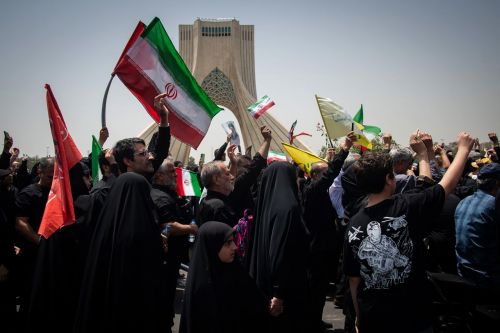 On the 28th (local time), Iranian citizens attended a funeral procession held at Enghelab Square in Tehran, Iran, to pay their respects. Photo by UPI
Regarding the resumption of nuclear talks between the United States and Iran, which President Donald Trump mentioned last week, Iran stated on the 29th (local time) that dialogue between the two countries can only begin if the United States promises not to carry out additional attacks.
Majid Takht-Ravanchi, Iran's Deputy Foreign Minister, said in an interview with the British broadcaster BBC aired on this day, "We have not yet agreed on the date or modality of the negotiations," adding, "We are currently seeking an answer to this question."
This contradicts President Donald Trump's earlier statement on the 25th, after attending the NATO summit in The Hague, Netherlands, where he said it would be possible to hold talks and reach an agreement with Iran.
Deputy Minister Takht-Ravanchi explained, "The Trump administration has not made its position clear on whether it will carry out additional attacks during the negotiations," adding, "This is a very important issue." He thus made it clear that Iran would only come to the negotiating table if the United States provides such assurances.
When asked whether Iran could reconsider its nuclear program in exchange for the easing of sanctions, Deputy Minister Takht-Ravanchi responded, "Why should we agree to such a proposal?"
He repeatedly asserted that uranium enrichment to 60% is for peaceful purposes. Uranium enriched to 60% is sufficient to produce up to nine nuclear weapons. Despite this level exceeding that of commercial facilities for power generation (3.67%), the BBC added that Iran emphasized its legitimacy.
Deputy Minister Takht-Ravanchi said that discussions could be possible regarding the level of nuclear material, but argued, "To demand that we do not enrich uranium, or to set enrichment at 'zero,' and threaten bombing if we do not agree, is the law of the jungle."
He also conveyed that Iran had received a message through a mediator country that the United States does not wish to target Supreme Leader Ayatollah Ali Khamenei or be involved in regime change in Iran.
While Iran did not provide a definitive answer regarding whether it would maintain a ceasefire with Israel, it stated that it would uphold the ceasefire as long as there are no military attacks. He said, "We do not want war," and added, "We want dialogue and diplomacy, but we must also be prepared and cautious so as not to be taken by surprise again."
Meanwhile, the United States and Iran were scheduled to hold the sixth round of nuclear talks in Oman on the 15th of this month, but this was canceled due to Israel's airstrike on Iran. The armed conflict between the two countries, triggered by Israel's preemptive attack, lasted for 12 days.
© The Asia Business Daily(www.asiae.co.kr). All rights reserved.
![Clutching a Stolen Dior Bag, Saying "I Hate Being Poor but Real"... The Grotesque Con of a "Human Knockoff" [Slate]](https://cwcontent.asiae.co.kr/asiaresize/183/2026021902243444107_1771435474.jpg)
















