Next-Generation Biotechnology Applications Expected
Catholic University announced on July 2 that a research team led by Professor Seokmin Kim from the Department of Biotechnology, in collaboration with Professor Yonghwan Kim from the Department of Energy and Chemical Engineering at Ulsan National Institute of Science and Technology (UNIST) and Professor Hyungho Lee from the Department of Chemistry at Seoul National University, has developed the world's first metal-based biocatalyst that operates stably in the presence of air.
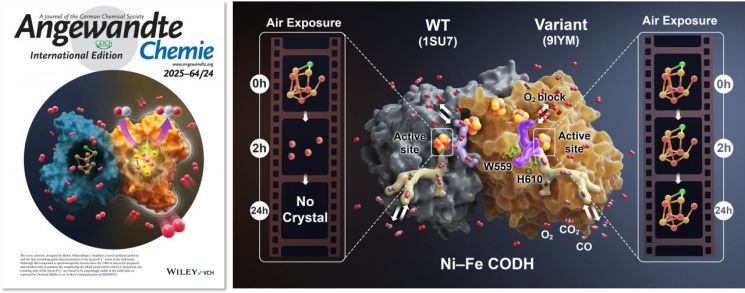 Professor Seokmin Kim's team develops world's first metal-based biocatalyst resistant to oxygen. Catholic University
Biocatalysts that function in air can dramatically reduce the process costs of carbon dioxide and carbon monoxide conversion, making them a key technology for achieving carbon neutrality. However, conventional carbon monoxide dehydrogenase (CODH) is highly vulnerable to oxygen, which has limited its industrial applications.
The research team secured stability by precisely designing and engineering the substrate channel of CODH containing a metal cluster (Ni-Fe-S), using a dual-blocking strategy to prevent oxygen from penetrating into the enzyme through its internal tunnels.
Structural biology analysis (X-ray crystallography) confirmed at the snapshot level that the developed CODH variant maintained both its enzyme structure and metal cluster completely, even after being exposed to air (20% oxygen concentration) for over 24 hours.
Furthermore, the developed CODH variant maintained its reaction activity under the presence of oxygen during electrochemical carbon monoxide oxidation, significantly improving the oxygen sensitivity of conventional metal-based biocatalysts (oxygen inhibition IC90 approximately 1μM).
In particular, this variant demonstrated improved air stability (IC90 improved by 852-fold) compared to the oxygen-resistant biocatalyst (IC90 improved by 49-fold) that the joint research team published as a cover article in 'Nature Catalysis (IF=42.9)' in 2022, and is being recognized as an important advancement for subsequent research.
This research was supported by the Leading Research Center (ERC) program of the Ministry of Science and ICT and the National Research Foundation of Korea, as well as the Microplastics Response Project Group (SMILE). The results were published as a back cover article in 'Angewandte Chemie International Edition (IF=16.1, JCR=5.8%, Wiley-VCH)', a world-renowned journal in chemistry and biochemistry, on the 4th. The paper was also selected as a Hot Paper, an honor given to the top 10% of noteworthy research in the journal.
Professor Kim stated, "This research can also be applied to stabilize various oxygen-sensitive metalloenzymes such as hydrogenase and carbon dioxide reductase. We expect it will lead to disruptive innovation technologies for biological hydrogen production and greenhouse gas removal." He added, "We plan to apply this technology to the development of hydrogenase for hydrogen production and metalloenzymes for carbon dioxide reduction in the future."
© The Asia Business Daily(www.asiae.co.kr). All rights reserved.
![Clutching a Stolen Dior Bag, Saying "I Hate Being Poor but Real"... The Grotesque Con of a "Human Knockoff" [Slate]](https://cwcontent.asiae.co.kr/asiaresize/183/2026021902243444107_1771435474.jpg)
















