The total number of public holidays marked in red on the 2026 calendar is 70, which is two more than this year. However, employees working a five-day week will have 118 days off in total, which is one day less than this year.
There are 52 Sundays, and when combined with 20 public holidays such as national holidays, Lunar New Year, and substitute holidays, the total comes to 72 days. However, since the March 1st Movement Day (3.1) and Buddha's Birthday (5.24) both fall on Sundays, the actual number of public holidays is 70.
For employees on a five-day workweek, the total number of days off is 122, which includes 70 public holidays and 52 Saturdays. However, since Memorial Day (6.6), Liberation Day (8.15), the last day of the Chuseok holiday (9.26), and National Foundation Day (10.3) all fall on Saturdays, the actual total number of days off is 118, which is one less than this year's 119 days.
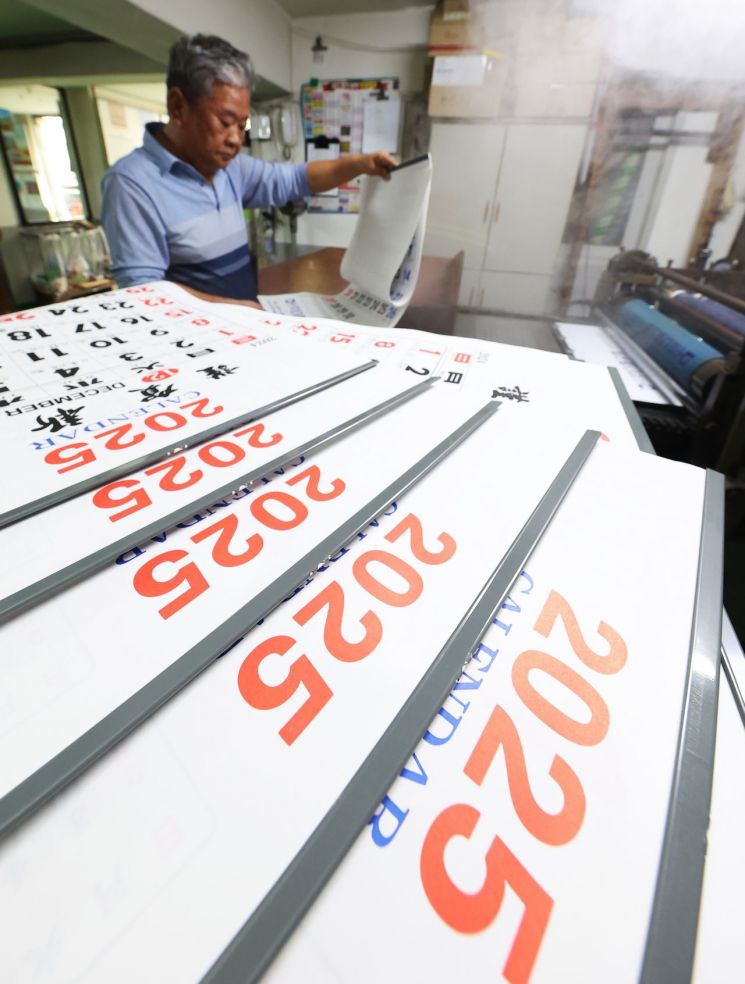
The Korea Aerospace Administration has announced the 2026 Monthly Calendar Guidelines, which serve as the basis for the production of the 2026 national calendar (Dangi 4359).
The 'Monthly Calendar Guidelines' are data released annually by the Korea Aerospace Administration in accordance with astronomical laws. They provide the public with accurate dates, seasonal divisions, and public holidays as determined by related laws, so that people can use them in daily life and various activities. These guidelines serve as the standard for calendar production each year.
Based on organizations implementing a five-day workweek, there will be a total of eight instances of holidays lasting three days or more.
The Lunar New Year holiday (February 14-18), which includes Saturday and Sunday, will be the longest at five days. The Chuseok holiday (September 24-27), which includes Sunday, will last four days.
Other multi-day holidays are as follows: February 28-March 2 (March 1st Movement Day and substitute holiday), May 23-25 (Buddha's Birthday and substitute holiday), August 15-17 (Liberation Day and substitute holiday), October 3-5 (National Foundation Day and substitute holiday), October 9-11 (Hangeul Day and Saturday/Sunday), and December 25-27 (Christmas and Saturday/Sunday).
The major traditional holidays are as follows: Lunar New Year's Day (lunar January 1) falls on February 17 (Tuesday); Jeongwol Daeboreum (lunar January 15) is on March 3 (Tuesday); Dano (lunar May 5) is on June 19 (Friday); Chilseok (lunar July 7) is on August 19 (Wednesday); Chuseok (lunar August 15) is on September 25 (Friday). Hansik is on April 6 (Monday), Chobok is on July 15 (Wednesday), Jungbok is on July 25 (Saturday), and Malbok is on August 14 (Friday).
Further details on the 2026 Monthly Calendar Guidelines can be found from the 30th in the official gazette, as well as on the websites of the Korea Aerospace Administration and the Korea Astronomy and Space Science Institute's Astronomical Knowledge and Information Center.
© The Asia Business Daily(www.asiae.co.kr). All rights reserved.
![Clutching a Stolen Dior Bag, Saying "I Hate Being Poor but Real"... The Grotesque Con of a "Human Knockoff" [Slate]](https://cwcontent.asiae.co.kr/asiaresize/183/2026021902243444107_1771435474.jpg)











