Korea Economic Research Institute and Mono Research Survey
500 Job Seekers in Their 40s and 50s on Reemployment
Most Desire Expansion of Flexible and Part-Time Job Opportunities
A recent survey found that middle-aged male job seekers consider wage levels the most important condition for reemployment, while female job seekers prioritize working hours. The survey also revealed that both groups most desire the expansion of flexible work arrangements and part-time job opportunities as reemployment support policies.
The Korea Economic Research Institute announced on June 30 the results of a reemployment perception survey conducted by Mono Research, a polling agency, targeting 500 job seekers in their 40s and 50s.
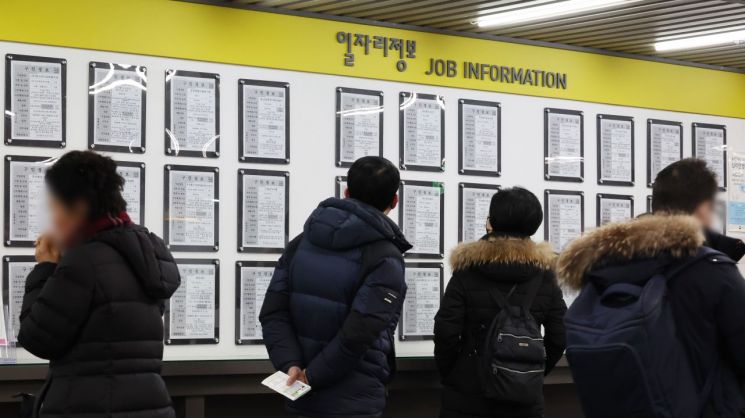 Job seekers visiting the Seoul Western Employment Welfare Plus Center in Mapo-gu, Seoul, are looking over job information. Photo by Yonhap News
According to the survey, the most common reason for leaving a job among men in their 40s and 50s was "layoff or recommended resignation" (22.5%), while for women, it was "childcare, caregiving, or housework" (43.2%).
Notably, among female respondents in their 40s and 50s who had not engaged in job-seeking activities in the past year, 38.7% cited "childcare, caregiving, or housework" as the reason for not seeking employment. The Korea Economic Research Institute explained, "The caregiving role within the family is a decisive factor leading women to withdraw from economic activity."
For middle-aged male job seekers, the most important employment condition when seeking reemployment was wage level (33.7%). Among female job seekers in the same age group, the highest proportion (49.7%) chose working hours as the most important factor. The Korea Economic Research Institute interpreted this as, "For women, the flexibility of working hours is crucial due to the need to balance family caregiving and housework responsibilities."
The survey also found that the average minimum pre-tax annual salary desired by job seekers in their 40s and 50s for reemployment was 41.49 million won, which is about 75% of their previous salary. Additionally, the average desired working age upon reemployment was found to be 65.6 years.
When asked about the most burdensome household expenditure, 35.7% of job seekers in their 40s and 50s cited "living expenses for their own household's food, clothing, and shelter." This was followed by children's private education and tuition fees (17.7%), their own household's medical and health-related expenses (16.9%), and repayment of loan principal and interest (15.8%). Furthermore, when asked about their level of preparation for retirement, 76.3% responded that it was "insufficient," indicating a very high level of concern.
Regarding policy tasks to support reemployment of job seekers in their 40s and 50s, the most frequently cited was "expansion of middle-aged-friendly flexible work arrangements and part-time jobs" (22.2%). Other responses included "strengthening job training and career transition support specialized for the middle-aged" (22.0%), "expanding public sector jobs for the middle-aged" (17.9%), and "providing employment incentives to employers to increase demand for hiring the middle-aged" (15.7%).
In particular, the proportion of women who chose the expansion of flexible work arrangements and part-time jobs (24.5%) was higher than that of men (19.8%).
Lee Sangho, head of the Economic and Industrial Division at the Korea Economic Research Institute, stated, "It is necessary to implement customized employment support policies to ensure that the 40s and 50s generation, who play a central role in the economy, are not marginalized in employment policies." He added, "In particular, efforts to enhance the flexibility of working hours for work-life balance must be made for women."
© The Asia Business Daily(www.asiae.co.kr). All rights reserved.

















