The Ministry of Culture, Sports and Tourism announced on June 30 that, together with the King Sejong Institute Foundation, it has newly designated 11 King Sejong Institutes in 9 countries. With this, the total number of King Sejong Institutes worldwide has increased to 252 locations in 87 countries.
The first King Sejong Institute was established in Ulaanbaatar, Mongolia in 2007. At that time, there were only 13 King Sejong Institutes in 3 countries, with just 740 students enrolled annually. However, last year, the number of students studying Korean at King Sejong Institutes, both online and offline, reached 210,374. In 2012, the government launched the King Sejong Institute Foundation to provide systematic support.
For this round of new King Sejong Institute designations, 94 institutions from 43 countries applied, resulting in a record-high competition rate of 8.5 to 1. The King Sejong Institute Designation Evaluation Committee, composed of experts in Korean language education and international cultural exchange, conducted a thorough process over approximately four months, including document review, on-site inspections, and final evaluations. As a result, 11 institutions with outstanding operational capabilities were selected as new King Sejong Institutes.
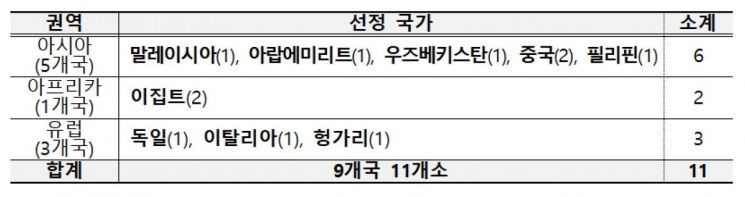
The government announced that it has increased the number of King Sejong Institutes in Egypt, where demand for Korean language education is rapidly rising, to three. Previously, only one King Sejong Institute was operated by the Korean Cultural Center in Egypt. Now, one new institute each will be operated by Ain Shams University in Cairo and Alexandria University in Alexandria, both prestigious educational institutions. In addition, a new King Sejong Institute has been designated in Uzbekistan, where seven institutes are already in operation. The government explained that this decision took into account the recent sharp increase in the number of applicants for the Test of Proficiency in Korean (TOPIK) and the fact that the number of international students from Uzbekistan at higher education institutions in Korea is the fourth largest after China, Vietnam, and Mongolia, totaling 12,025. Furthermore, five new institutes have been designated in Asia?including Malaysia, the Philippines, China, and the United Arab Emirates?where exchanges with Korea are active. Three new institutes have also been designated in Europe, including Germany, Italy, and Hungary, where interest in Korean Wave (Hallyu) content such as dramas, films, and music is growing.
The Ministry stated that it plans to use this year's new designations as a springboard to further promote the global spread of the Korean language and culture, which is a key pledge of the new government. Currently, there are five regional hub King Sejong Institutes established worldwide, and the Ministry plans to gradually expand this number to 20 by 2030. The goal is to discover capable new institutes, strengthen support and management within each region, and collaborate with overseas institutions to build regional Korean language ecosystems. Based on these efforts, the Ministry aims to gradually increase the number of King Sejong Institutes so that more than 350 institutes will be designated and operated by 2030.
Lee Jeongmi, Director of Cultural Policy at the Ministry of Culture, Sports and Tourism, stated, "The King Sejong Institute is at the forefront as a cultural outpost for promoting the Korean language and culture worldwide. We will strengthen our support to expand the number of capable King Sejong Institutes, so that the Korean language and culture can become a central pillar on the global stage."
© The Asia Business Daily(www.asiae.co.kr). All rights reserved.
![Clutching a Stolen Dior Bag, Saying "I Hate Being Poor but Real"... The Grotesque Con of a "Human Knockoff" [Slate]](https://cwcontent.asiae.co.kr/asiaresize/183/2026021902243444107_1771435474.jpg)











