Proposal to Include in Government's 'Childcare Support Program'
Partial Support for Basic Hourly Fee... Easing the Financial Burden
High Satisfaction Among User Families... Positive Feedback from Housekeepers
Expansion of Foreign Workforce... Utilizing Caregivers and Nursing Assistants
The Seoul Metropolitan Government has decided to actively propose including foreign housekeepers in the government's 'Childcare Support Program' in order to expand and stabilize the operation of foreign housekeepers.
According to Seoul City on June 30, the city is currently discussing with the Ministry of Employment and Labor the possibility of including foreign housekeepers in the government's 'Public Childcare Support Program,' which provides public care service subsidies ranging from 85% to 15% of costs depending on income level.
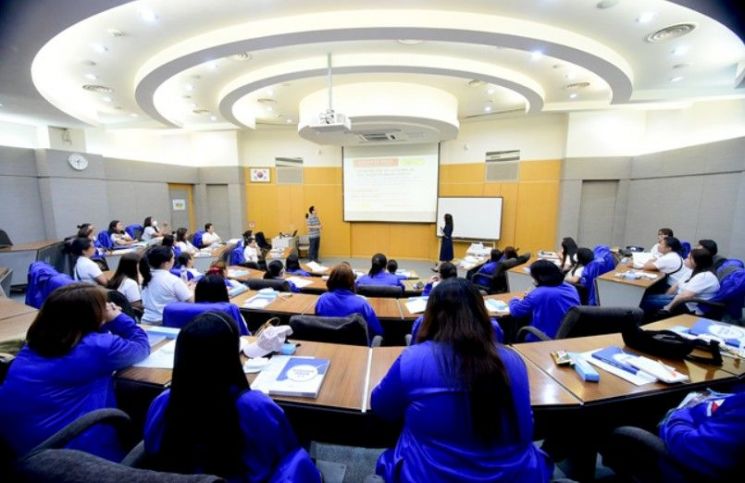 Filipino housekeepers participating in the pilot project for foreign housekeepers entered the country in August last year. The photo shows housekeepers receiving training before being assigned to the field. Seoul City
 Photo by Seoul City
Seoul City conducted a pilot project for foreign housekeepers from September last year to February this year, and since March, has adjusted service fees to reflect actual costs and allowed service providers to operate autonomously.
According to a performance study by the Ministry of Employment and Labor, 84% of users were satisfied with the service, and there were no housekeepers who expressed negative opinions about clients. Although there were many concerns about potential human rights violations due to the fact that this was the nation's first pilot project for in-home services, there were also situations where housekeepers enjoyed interacting with children, and relationships with client families were maintained smoothly. In particular, there were positive changes in time management and psychological stability for client families, which was especially pronounced among dual-income couples.
The main issue is the cost. The usage fee is 16,800 won per hour, which reflects severance pay and company operating expenses. For those using the service four hours a day, five days a week, the monthly cost is about 1.46 million won. In response, Seoul City plans to actively propose to the Ministry of Gender Equality and Family that foreign housekeepers be included in the government's 'Public Childcare Support Program.' If this is implemented, a portion of the basic hourly fee for up to 960 hours per year could be subsidized, which is expected to significantly reduce the financial burden.
However, despite the fact that applicants must wait more than three months to receive childcare support, the review process has been delayed due to concerns about encroaching on domestic care jobs. Furthermore, with the new administration now in place, it remains uncertain whether the government will expand foreign labor under this support system.
Internally, the city is also beginning to consider long-term strategies for foreign labor policy. Mayor Oh Se-hoon recently stated during a city council session, "During the pilot project, my thinking changed and I now believe the Japanese model may be a wiser approach," adding, "Paying the minimum wage and, in the long run, accepting foreign workers as good neighbors under a framework of social integration may be the only sustainable policy." This clearly signals a shift in thinking away from simply supplying foreign labor at low cost.
The city also indicated that it will actively respond to expanding the scope for introducing foreign workers. Mayor Oh said, "We cannot ignore the shortage of caregivers and nursing assistants in the existing childcare sector. That would be a dereliction of duty," adding, "We need to consider how to make the best use of excellent foreign workers and accept them as good neighbors. Objecting out of instinctive resistance does not help solve the looming shortage of care workers in the future."
Seoul City plans to hold further discussions with the Ministry of Employment and Labor regarding the expansion of foreign labor. At the end of last year, after conducting a demand survey among 'housekeeping certification agencies' in Seoul, the city conveyed its intention to introduce an additional 950 or so workers from 12 companies to the ministry.
On June 30, Seoul City released a manual for the foreign housekeeper pilot project, which includes all procedures such as the two-year preparation phase since September 2022, work processes, selection and matching of client families, roles of service providers, scope of work, management guidelines, complaint handling, specialized training, service fee calculation, areas for improvement, and relevant laws and regulations. The manual is intended to prepare for the full-scale project and will be provided as a reference for local governments nationwide if the program is expanded.
Kim Sunsoon, Director of the Women and Family Policy Office at Seoul City, said, "The foreign housekeeper program is not about using foreign labor cheaply, but rather providing an additional option for families in need of care support," adding, "For families who need care support but feel burdened due to low income, we will establish measures to link them to the government’s public childcare support program so that they can receive income-based assistance. We will continue in-depth discussions with the new administration to expand this initiative into a full-scale project."
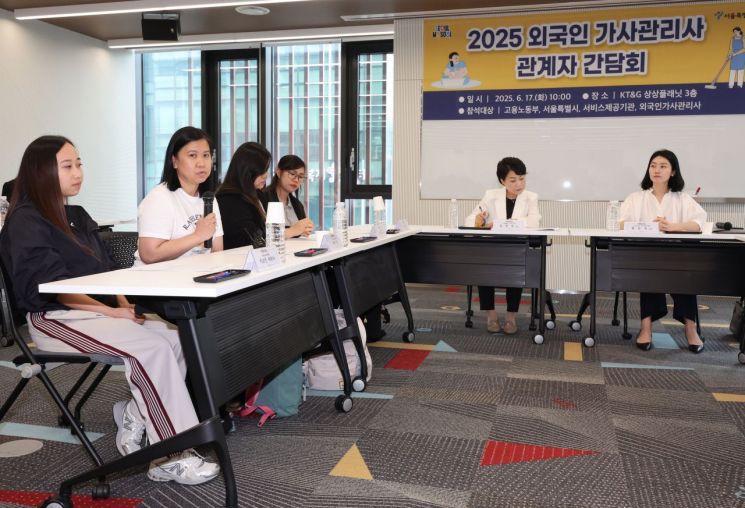 On the 17th, a 'Foreign Housekeeper Meeting' was held at KT&G Sangsang Planet in Seongdong-gu, Seoul. Photo by Yonhap News
© The Asia Business Daily(www.asiae.co.kr). All rights reserved.


















