Eight Local Governments Collaborate
to Promote National Garden Designation
Eight local governments that share Anyangcheon have agreed to work together to transform Anyangcheon into a landmark destination, and Yoo Sunghoon, head of Seoul’s Geumcheon District Office, has been elected as the fourth president of the ‘Anyangcheon Landmark and Advancement Administrative Council’.
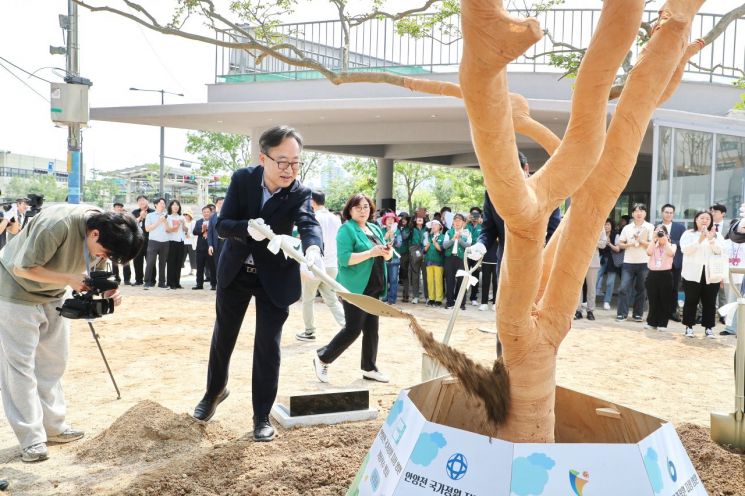 Yoo Sunghoon, head of Geumcheon District Office, planted a commemorative tree on the 23rd to pray for the designation of Anyangcheon as a national garden. Provided by Geumcheon District Office.
On the 30th, Geumcheon District Office announced that representatives from eight relevant local governments in Seoul and Gyeonggi Province attended the council’s regular general meeting, which was recently held at Geumcheon District Office, to discuss cooperation measures. At this meeting, Ha Eunho, mayor of Gunpo, was elected as vice president. During the meeting, participants shared the achievements of projects by region and future plans, and agreed to strengthen the cooperative system for the designation of Anyangcheon as a national garden.
After the general meeting, a commemorative tree planting ceremony was held at Geumnarae Central Park in front of Geumcheon District Office to pray for the designation of Anyangcheon as a national garden. The heads of each local government planted crape myrtle trees as a symbol of cooperation and toured the ‘Anyangcheon National Garden Administrative Council Commemorative Garden,’ reaffirming the importance of solidarity.
Anyangcheon is a river with a total length of 31.88 kilometers. It originates from the west side of Baegunsan in Uiwang, Gyeonggi Province, flows through Gunpo, Anyang, Gwangmyeong, and Seoul’s Geumcheon, Guro, Yangcheon, and Yeongdeungpo districts, and joins the Han River west of Seongsan Bridge. Of this, the section passing through Geumcheon District is 7.64 kilometers long.
Since 2019, Geumcheon District has created a rose path by planting more than 150,000 roses of 68 varieties along about 2 kilometers of the Anyangcheon riverside. The district has also established an urban forest for climate response by planting about 1,400 trees, including Skyrocket junipers, which help reduce fine dust. Key elements of the landmark project also include the maintenance of the 13th course of the Seoul Trail, an urban agriculture experience farm, a park golf course, and a playground for companion dogs.
The four local governments in the Gyeonggi region are proceeding with detailed design and consultations with relevant agencies, aiming to obtain approval from Gyeonggi Province for the creation of a local garden in the second half of the year. Their plan is to apply for local garden registration and begin operations next year, and then pursue national garden designation for the Seoul region by 2030.
Yoo Sunghoon, head of Geumcheon District Office, stated, “Anyangcheon is a great gift that allows people to enjoy nature up close,” and added, “As council president, I will do my best to establish Anyangcheon as a national garden.” Previously, in May, the council also submitted a proposal to include this initiative in the presidential pledges.
© The Asia Business Daily(www.asiae.co.kr). All rights reserved.
![Clutching a Stolen Dior Bag, Saying "I Hate Being Poor but Real"... The Grotesque Con of a "Human Knockoff" [Slate]](https://cwcontent.asiae.co.kr/asiaresize/183/2026021902243444107_1771435474.jpg)











