'Korea Shipping Association Presidents' Workshop' Held
"Building Busan Port as a Hub Requires Preemptive Investment and Cooperation"
SK Shipping and Hyundai Glovis Receive Shipping Top Awards
Yang Changho, Executive Vice President of the Korea Shipping Association, stated on the 27th that the Lee Jaemyung administration's pledge to develop the Arctic route is "timely."
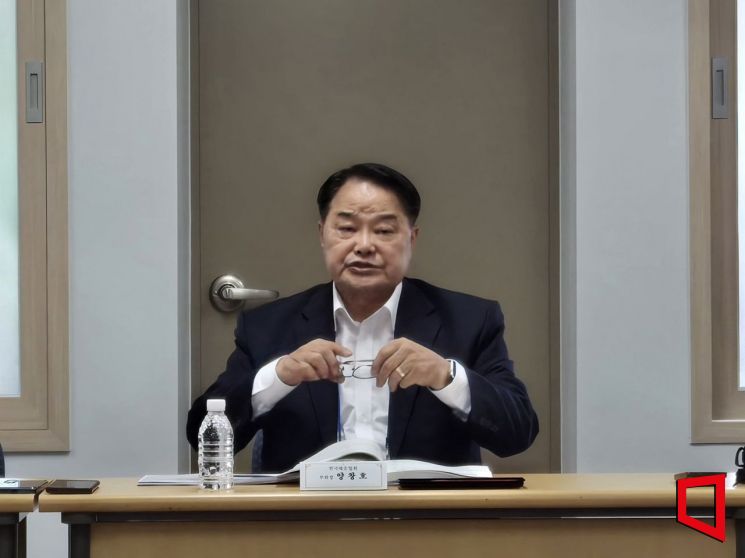 Yang Changho, Executive Vice President of the Korea Shipping Association, is holding a press conference at the '2025 Shipping Association Presidents Workshop' held on the 27th at the Saemaeul Undong Central Training Center in Bundang-gu, Seongnam-si, Gyeonggi Province. Photo by Noh Kyungjo
On this day, at the '2025 Shipping Association Presidents' Workshop' held at the Saemaeul Undong Central Training Center in Bundang-gu, Seongnam-si, Gyeonggi Province, Yang met with reporters and said, "If we think about the Arctic route five or ten years from now, it will be too late," emphasizing the importance of immediate action.
The development of the Arctic route was a pledge made by President Lee during his presidential campaign, in which he promised to develop Busan into a Northeast Asian maritime capital. The plan involves relocating the Ministry of Oceans and Fisheries and HMM to Busan to prepare for the era of the Arctic route.
The Arctic route is a new maritime shipping lane that passes through the Arctic Ocean, providing the shortest connection between Asia and Europe. In the past, thick sea ice made year-round navigation impossible. However, due to recent climate change, melting ice has extended the period during which navigation is possible.
In particular, as logistics costs are lower than on existing routes, maritime powers such as the United States and Russia, as well as global port nations, are competing to pioneer the Arctic route. Experts have predicted that by the summer of 2030, it will be possible to navigate the Arctic route.
Yang stated, "The Arctic route is still covered by ice for most of the year, so it is not yet possible to establish a regular container ship route or for bulk carriers and gas carriers to use this route to Europe." However, he added, "The time when it will be possible to operate for at least six months, instead of just two to three months as now, is not far off."
He also emphasized, "A shipping route requires ports and hinterlands to be sustainable, and I believe Busan stands to benefit the most in this process." He continued, "If Busan Port is to become a hub port like Singapore, we need to carefully consider and invest in what needs to be prepared from now on." He also noted the necessity of cooperation with neighboring countries if needed.
However, regarding the relocation of the Ministry of Oceans and Fisheries and HMM to Busan, Yang said, "In terms of how much this helps revitalize Busan Port, there is not much difference compared to being in Seoul," and added, "While it may help strengthen Busan's status as a maritime capital, it is unclear whether it will directly lead to revitalization of the shipping industry itself or to increased sales and profitability."
In this context, he ruled out the possibility of the Shipping Association relocating to Busan. He explained, "There is talk that all shipping-related organizations should move, but this refers to government and public institutions." He added, "We are monitoring whether there are calls for the association's relocation in Busan, but so far there have been none. If necessary, we can simply strengthen the functions of the Busan office."
Furthermore, if the Ministry of Oceans and Fisheries relocates to Busan, "its functions and roles should be expanded, and integrated administration between shipping, shipbuilding, and offshore plant industries is necessary." Yang stated, "The domestic shipbuilding industry has grown as an export industry rather than a strategic industry, making it important to increase export volume, but as a result, bulk carriers and small vessels with low profitability are not being built." He added, "To address this, shipbuilding, offshore plants, and shipping need to be integrated."
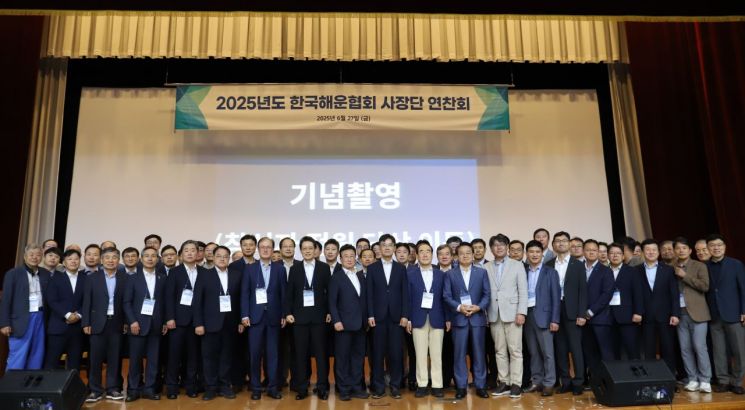 On the 27th, attendees are taking a commemorative photo at the "2025 Shipping Association Presidents' Workshop" held at the Saemaul Undong Central Training Center in Bundang-gu, Seongnam-si, Gyeonggi Province. Provided by Korea Shipping Association
Meanwhile, at the workshop, the Korea Shipping Association announced that it would actively promote the following for the renewed growth of the shipping industry: timely transition to eco-friendly vessels; operation of a strategic merchant fleet and nurturing of talent; and enhancement of maritime infrastructure competitiveness through joint growth with related organizations.
In his opening address, Association President Park Jungseok stated, "Due to the uncertainty of the international situation, strengthening of decarbonization regulations, and restrictions on shipping alliances, the shipping industry is facing huge waves," and continued, "We will overcome the numerous challenges ahead so that the shipping industry can solidly support the national economy."
At the third Shipping Top Awards ceremony held during the workshop, SK Shipping was honored for achieving 30 million tons of transport in the tanker sector last year, and Hyundai Glovis was recognized for achieving 3 million CEU (one CEU is the space needed to transport one car) in the car carrier sector.
© The Asia Business Daily(www.asiae.co.kr). All rights reserved.
![Clutching a Stolen Dior Bag, Saying "I Hate Being Poor but Real"... The Grotesque Con of a "Human Knockoff" [Slate]](https://cwcontent.asiae.co.kr/asiaresize/183/2026021902243444107_1771435474.jpg)

















