Expanding Sustainable, Community-Centered Services
The Ministry of Health and Welfare and the National Institute for Korean Medicine Development held the "2025 Korean Medicine Health Care Project Performance Conference" at Peace and Park Convention in Seoul on June 27, sharing outstanding cases that contributed to the promotion of health and welfare in local communities.
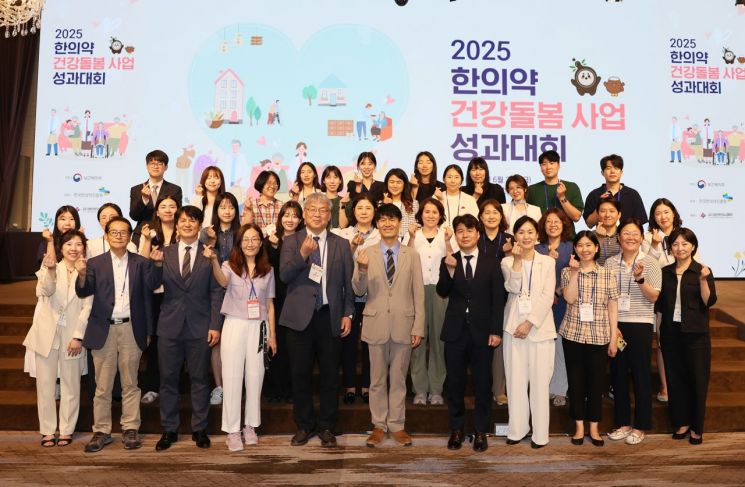 The Ministry of Health and Welfare and the National Institute for Korean Medicine Development are holding the "2025 Korean Medicine Health Care Project Performance Conference" at Peace and Park Convention in Seoul and taking a group photo. Photo by National Institute for Korean Medicine Development
More than 120 officials from related organizations, including the Ministry of Health and Welfare, the Association of Korean Medicine, local governments from cities, counties, and districts across the country, and regional Korean medicine societies attended the event, demonstrating significant interest in the Korean Medicine Health Care Project.
The Korean Medicine Health Care Project is a preventive, community-based integrated care service that comprehensively supports healthcare, housing, and daily living based on Korean medicine.
Promoted by the National Institute for Korean Medicine Development in cooperation with local governments and regional Korean medicine societies, this project has made a substantial contribution to improving the health and quality of life of local residents.
The first part of the event featured an awards ceremony recognizing outstanding local governments, organizations, and individuals who actively implemented the Korean Medicine Health Care Project in 2024 and contributed to the health improvement of local residents.
In the group category for the Minister of Health and Welfare Award, Bucheon City in Gyeonggi Province and Yeonsu District in Incheon received the grand prize.
Additionally, Buk District in Gwangju and Deogyang District in Goyang City, Gyeonggi Province received the top excellence award, while Ansan City in Gyeonggi Province and Buk District in Busan received the excellence award. The regional Korean medicine societies of these local governments were also honored with the President's Award from the National Institute for Korean Medicine Development.
Notably, Bucheon City in Gyeonggi Province was the only region nationwide to implement collaborative home visits by both Korean and Western medicine practitioners, setting an exemplary model for integrated medical services. Yeonsu District in Incheon was recognized as an outstanding case for providing a one-stop service, from health screenings to identifying high-risk individuals and managing integrated treatment for appropriate care.
In the individual category, the Minister of Health and Welfare Commendation was awarded to Lee Soyoung (Bucheon City, Gyeonggi Province), Kang Ikyeong (Yeonsu District, Incheon), Lee Jonggil (Gwangju Buk District Korean Medicine Society), Oh Saebin (Deogyang District, Goyang City, Gyeonggi Province), Min Woongki (Ansan City Korean Medicine Society, Gyeonggi Province), Park Jinho (Busan Buk District Korean Medicine Society), and So Changwoo (Yuseong District, Daejeon).
In the contribution category, Bang Hoyul (Dongbang Shintong Bubu Korean Medicine Clinic, Geoje City, Gyeongnam), Kim Seulgi (Myeongje Korean Medicine Clinic, Seo District, Gwangju), and Kim Beomseok (Jungdong Korean Medicine Clinic, Bucheon City, Gyeonggi Province) received the Minister of Health and Welfare Award.
During the second part of the event, the National Institute for Korean Medicine Development presented the current status of this year’s health care project, and shared case studies from six outstanding local governments and contributions from award recipients, drawing a positive response from attendees.
Lee Hwadong, Acting President of the National Institute for Korean Medicine Development, stated, "I would like to express my deep gratitude to all the practitioners who have diligently carried out the Korean Medicine Health Care Project in the field," and added, "The National Institute for Korean Medicine Development will continue to actively support sustainable, community-centered health care services through close cooperation with related organizations."
The operational cases of local governments that implemented the Korean Medicine Health Care Project in 2024 will be published as the "2024 Korean Medicine Health Care Project Casebook," and the case contributions from recipients will be compiled as the "Korean Medicine Health Care Recipient Case Collection." Both will be made available in the data room on the National Institute for Korean Medicine Development website in the second half of this year.
© The Asia Business Daily(www.asiae.co.kr). All rights reserved.

















