MFDS Reports Pharmaceutical Exports Up 28% to 12.7 Trillion Won
Biopharmaceutical Production Surges 26%, Surpassing 6 Trillion Won
Last year, domestic pharmaceutical production exceeded 32 trillion won, setting a new all-time high. In particular, production of biopharmaceuticals surged by 26.4% in a single year, surpassing 6 trillion won for the first time.
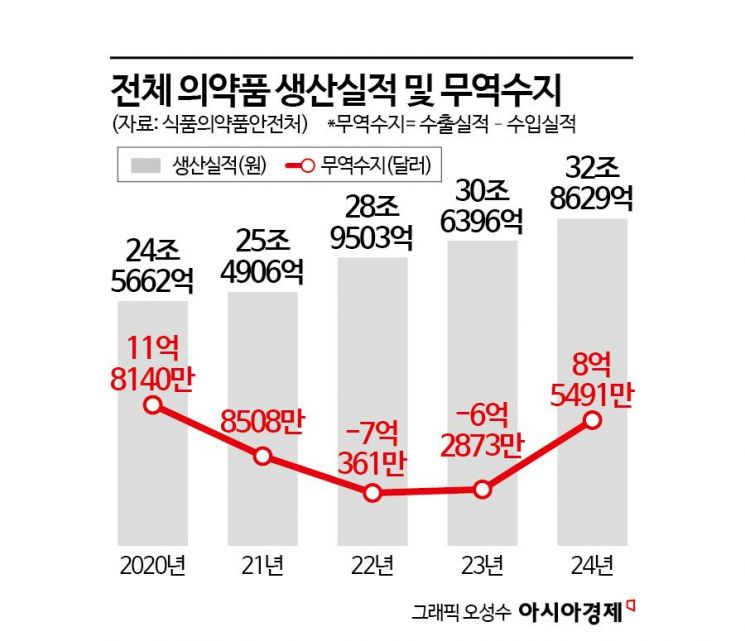
According to the Ministry of Food and Drug Safety on June 27, domestic pharmaceutical production in the previous year reached 32.8629 trillion won, a 7.3% increase compared to the previous year (30.6396 trillion won). This is the highest figure since related statistics began in 1998, accounting for 1.29% of the nation's GDP and 4.80% of the total manufacturing sector GDP.
Domestic pharmaceutical production has continued to rise over the past decade, recording 24.5662 trillion won in 2020, 25.4906 trillion won in 2021, 28.9503 trillion won in 2022, and 30.6396 trillion won in 2023.
The size of the pharmaceutical market also saw a slight increase, rising 0.7% from 31.4606 trillion won in 2023 to 31.6965 trillion won last year. Pharmaceutical exports reached 12.6749 trillion won, a 28.2% increase from the previous year (9.8851 trillion won), with exports surpassing imports and turning the trade balance to a surplus for the first time in three years.
In terms of production composition, finished pharmaceuticals accounted for 86.6% and active pharmaceutical ingredients for 13.4%. Notably, active pharmaceutical ingredients showed significant growth last year, increasing by 16.8% to 4.4007 trillion won from 3.7689 trillion won the previous year. During the same period, finished pharmaceutical production rose by 5.9% to 28.4623 trillion won. Among finished pharmaceuticals, over-the-counter drugs increased by 9.9% to 4.2357 trillion won from 3.8554 trillion won, and prescription drugs rose by 5.3% to 24.2265 trillion won.
Pharmaceutical exports last year reached 12.6749 trillion won, a 28.2% increase from the previous year (9.8851 trillion won), marking the highest figure in the past five years. Imports rose by 7.5% to 11.5085 trillion won from 10.7061 trillion won the previous year. As a result, the trade balance recorded a surplus of 1.1664 trillion won, shifting from deficit to surplus for the first time in three years.
There were three companies with pharmaceutical production exceeding 1 trillion won: Celltrion, Hanmi Pharmaceutical, and Chong Kun Dang, the same as the previous year. The combined production of these three companies totaled 5.0408 trillion won, a 28.2% increase from 3.9313 trillion won the previous year, with their share of total production also expanding to 15.3%.
Among all pharmaceuticals, biopharmaceutical production reached approximately 6.3125 trillion won, a 26.4% increase from the previous year (4.9936 trillion won), surpassing the 6 trillion won mark for the first time. This growth was attributed to balanced increases across all categories, including recombinant drugs, vaccines, and toxins/antitoxins.
By product category, recombinant drugs accounted for the largest share at 58.1%, followed by vaccines (13.3%), toxins/antitoxins (10.7%), plasma derivatives (8.7%), blood products (7.9%), and cell therapy products (1.3%). In particular, production of recombinant drugs surged by 42.7% compared to the previous year, which is interpreted as resulting from increased market share and export volumes in major global markets such as North America, Central and South America, and Europe.
The trade balance for biopharmaceuticals recorded a surplus of approximately $916.92 million, the largest surplus in the past five years. Exports of plasma derivatives, including immunoglobulins, also increased significantly, with some products obtaining marketing approvals or winning national tenders in major countries, leading to active expansion into global markets.
By country, Hungary was the largest export destination for biopharmaceuticals at $1.23346 billion, followed by the United States ($608.67 million), Turkiye ($432.06 million), and Brazil ($144.04 million). Notably, exports to Hungary increased more than fivefold compared to the previous year, attributed to Hungary's role as an export hub for recombinant drugs, which facilitated expanded exports to Europe. Due to the introduction of vaccines for the COVID-19 JN.1 variant and obesity treatments, biopharmaceutical imports increased by 18.5% to $2.29967 billion from $1.94003 billion the previous year.
Meanwhile, the total market size for quasi-drugs last year was 1.7544 trillion won, a slight decrease from 1.8313 trillion won the previous year. This was due to a contraction in the market for quarantine products such as masks and topical disinfectants as COVID-19 became endemic. Excluding quarantine products, the quasi-drug market size (1.6056 trillion won) saw a slight increase. The top five quasi-drug product categories by production were toothpaste (405.1 billion won), tonics and restorative products (348.6 billion won), sanitary products (297.8 billion won), bandages (158.6 billion won), and masks (83.6 billion won).
© The Asia Business Daily(www.asiae.co.kr). All rights reserved.

















