Division of Roles: Korea Forest Service for Prevention, National Fire Agency for Firefighting
Proposals for Continuous Drone Surveillance and Expansion of Forest Roads
Expansion of Fire-Resistant Forests and Enhanced Support for Wildfire Victims
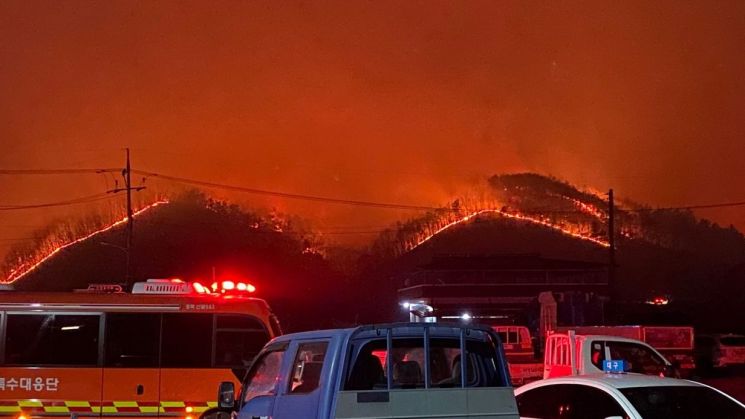
Regarding the so-called "monster wildfire" that struck the Yeongnam region at the end of March this year?recorded as the worst wildfire to date?the National Assembly Research Service has proposed a comprehensive overhaul of the wildfire response system. The Korea Forest Service should be clearly tasked with wildfire prevention, while the National Fire Agency should be responsible for firefighting. The Research Service also suggested expanding the creation of fire-resistant forests and establishing an effective support system for wildfire victims.
On June 27, Lee Gwanhu, Chief of the National Assembly Research Service, held a press conference at the National Assembly and called for a complete restructuring of the response system in light of the recurring large-scale wildfires. Previous wildfires in South Gyeongsang, North Gyeongsang, and Ulsan resulted in 183 casualties (27 deaths and 156 injuries) and caused damages amounting to 1.08 trillion won, representing astronomical losses. The frequency and scale of wildfires have been increasing, partly due to abnormal weather events.
First, regarding wildfire response, the Research Service explained that "it is necessary to clearly designate the lead and supporting agencies at each stage." Currently, a complex system is in place where command is transferred depending on the size and location of the wildfire. The Research Service recommends transitioning to a functionally specialized system: the Korea Forest Service should handle prevention, the National Fire Agency should manage firefighting, local governments should oversee resident evacuation, and specialized agencies for each sector should be responsible for recovery.
In terms of resident evacuation, the Research Service emphasized the need to strengthen the roles and responsibilities of local governments to ensure ongoing evacuation efforts at the scene. Local governments should develop tailored evacuation plans based on the unique characteristics of each region, such as local geography, population structure, and distribution of vulnerable groups, and establish preparedness systems through training and drills based on actual disaster cases.
The Research Service also recommended establishing a support system for animals, in addition to humans. The current disaster management system is human-centric and lacks evacuation or relief systems for animals. Accordingly, the Research Service suggested that policies should be developed to establish shelters for animals?either shared or dedicated?during disasters.
Regarding wildfire recovery, the Research Service proposed legal amendments in response to the increasing scale of wildfires, as well as measures to support the long-term use of temporary housing for victims. Additionally, they recommended support measures to help villages destroyed by wildfires restore their communities, and called for the establishment of a response system to address health issues, including post-traumatic stress disorder (PTSD), among affected residents.
For wildfire prevention, the Research Service proposed several solutions: expanding government support for the creation of fire-resistant forests as part of reforestation projects to prevent large-scale wildfires; expanding forest roads to aid firefighting efforts; amending the Aviation Safety Act to enable continuous drone surveillance; promoting the creation of fire-resistant forests through the use of public interest direct payment programs in the forestry sector; and enacting integrated support legislation that does not distinguish between natural and social disasters.
Regarding the large wildfires in the Yeongnam region, the Research Service judged that the government focused on recovery after firefighting but neglected to clarify responsibility. To address this, a Wildfire Response Research Task Force was formed, which conducted on-site inspections over two months to identify problems in the current response system and seek improvements.
Chief Lee stated, "We have proposed legislative and policy tasks for each stage?prevention, response, and recovery?to enhance the effectiveness, efficiency, and field applicability of government measures that have been repeatedly implemented. I hope that these proposals, which ensure that specialized agencies can fulfill their roles at each stage, will be given top priority so that wildfire response and victim support measures are not repeated every year, and that sufficient discussion will lead to insightful solutions to the key issues."
© The Asia Business Daily(www.asiae.co.kr). All rights reserved.
![Clutching a Stolen Dior Bag, Saying "I Hate Being Poor but Real"... The Grotesque Con of a "Human Knockoff" [Slate]](https://cwcontent.asiae.co.kr/asiaresize/183/2026021902243444107_1771435474.jpg)
















