Processing of the Commercial Act, Four Major Agriculture Bills, and Yellow Envelope Act
Election of Budget Committee Chair Needed for Supplementary Budget Review
The Democratic Party of Korea has decided to accelerate its efforts to process a total of 40 bills during the June extraordinary session of the National Assembly, including bills subject to the right of reconsideration (veto) exercised by former President Yoon Suk Yeol, bipartisan common pledges, and livelihood-related legislation. Regarding the recent surge in real estate prices, the party criticized the previous Yoon Suk Yeol administration’s policy of easing loan regulations and expressed the view that these policies need to be normalized.
Jin Sungjoon, the Democratic Party's Policy Committee Chair, held a press briefing at the National Assembly on the afternoon of June 26 and stated, "The Democratic Party aims to process a total of 40 bills during the June extraordinary session, including 13 bills vetoed by former President Yoon, 16 urgent livelihood-related bills that both parties pledged during the last presidential election, and 11 livelihood bills that the Democratic Party believes should be swiftly promoted."
The bills prioritized by the Democratic Party include the four major agriculture bills (the Grain Management Act, the Act on Distribution and Price Stabilization of Agricultural and Fishery Products, the Act on Measures for Agricultural and Fishery Disasters, and the Agricultural and Fishery Disaster Insurance Act), an amendment to the Commercial Act introducing a duty of diligence for directors, and the so-called Yellow Envelope Act (amendments to Articles 2 and 3 of the Trade Union Act).
The party also announced its intention to resume the Bipartisan Livelihood Common Pledge Promotion Council. Previously, during the last presidential election, both parties proposed to promote livelihood bills such as the Commercial Building Lease Protection Act, which mandates the disclosure of management fee details, and the Fair Transactions in Subcontracting Act, which expands the scope of payment linkage.
The Democratic Party also plans to continue promoting bills it pursued while in opposition, such as the Public Institution Operation Act, which links the terms of the president and heads of public institutions, and amendments to the Personnel Hearing Act, without any changes.
The party is also pushing for the passage of amendments to the Martial Law Act, which would prohibit the entry of military and police into the National Assembly after the declaration of martial law; amendments to the Aviation Safety Act to regulate the distribution of leaflets to North Korea; and amendments to the Personnel Hearing Act to separate closed hearings for verifying candidates' morality from open hearings for policy matters. Jin emphasized, "If we fail to process these bills during the June extraordinary session, which runs until July 4, we will pursue them in the July session."
Regarding the recent sharp rise in Seoul real estate prices, the party attributed the situation to the Yoon Suk Yeol administration. According to the Korea Real Estate Board, apartment prices in Seoul rose by 0.43% in the fourth week of June (June 17-23), marking the highest weekly increase in six years and nine months since the second week of September 2018 (0.45%) during the Moon Jae-in administration.
Jin pointed out, "Policies such as the easing of loan management regulations under the Yoon Suk Yeol administration have led to the current surge in Seoul housing prices." He also argued, "The Yoon administration viewed the stabilization of housing prices achieved by the previous Moon Jae-in administration as a sign of a real estate recession. Consistent policies to boost housing prices, such as reductions in comprehensive real estate taxes, relaxation of loan regulations, and indiscriminate policy finance support, have contributed to the current price surge."
Jin also criticized Seoul Mayor Oh Sehoon's decision to lift land transaction permit zones, stating, "Although transaction volume has increased significantly, what is concerning is that the proportion of gap investments has reached 40%, indicating that speculative demand is rapidly growing."
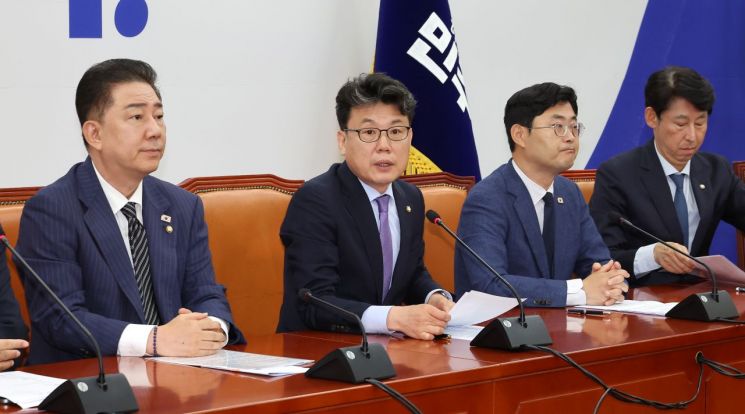
Jin also expressed concern about the increase in household loans due to apartment transactions, stating, "The government must immediately normalize the lax lending environment by comprehensively considering various factors such as the interest rate environment, household debt management, financial soundness, protection of genuine homebuyers, and polarization between Seoul and regional areas. In addition, the government should accelerate institutional reforms to vitalize the capital market so that market funds can flow into productive sectors that benefit the Korean economy, rather than unproductive areas such as real estate."
Regarding the vacancy in the chairmanship of the Special Committee on Budget and Accounts, which is responsible for the comprehensive review of the supplementary budget bill, Jin said, "I hope the People Power Party does not hold the supplementary budget for people's livelihoods hostage over the issue of parliamentary committee formation." He urged, "Please cooperate so that the National Assembly can convene a plenary session on June 27, elect the budget committee chair and others, and promptly begin deliberations on the supplementary budget."
Regarding the Science, ICT, Broadcasting, and Communications Committee's renewed push for the three broadcasting laws (amendments to the Broadcasting Act, the Foundation for Broadcast Culture Act, and the Korea Educational Broadcasting System Act), Jin stated, "Our goal is to process the Broadcasting Act as quickly as possible. It is important to pass the bill through bipartisan agreement to ensure smooth implementation. However, if the opposition party objects for political reasons, we will be determined to push it through unilaterally."
In response to concerns from economic organizations regarding the Commercial Act amendment, Jin countered that the Supreme Court has established that business judgments are not subject to liability, calling such concerns "excessive worry."
© The Asia Business Daily(www.asiae.co.kr). All rights reserved.

















