Listening to Challenges on His First On-Site Visit Since Taking Office
Seeking Crisis Response Through "Leadership by Direct Engagement"
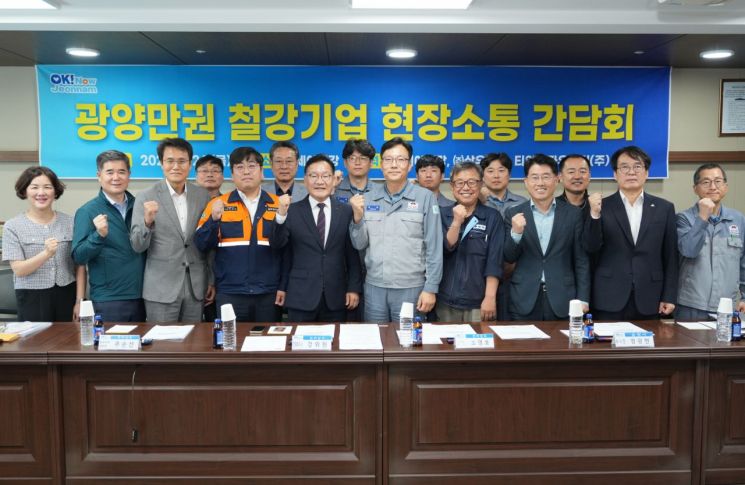 Kang Wonil, Vice Governor for Economy of Jeonnam Province, Steel Company On-site Communication Meeting Scene. Provided by Jeonnam Province
On June 26, Jeonnam Province began a series of on-site visits focused on public livelihood issues by visiting key steel and secondary battery companies in the Yulchon Industrial Complex in the Gwangyang Bay Area, including Seah Steel and POSCO Pilbara Lithium Solution. The province listened carefully to the pressing challenges faced by these industries and began working on solutions.
This series of on-site visits is part of Vice Governor for Economy Kang Wonil's "leadership through direct engagement," in which he personally visits industrial sites to communicate directly and address crisis situations. This approach reflects his commitment to prioritizing on-the-ground realities over written reports.
On his first public livelihood-focused visit since taking office, Vice Governor Kang visited steel and secondary battery companies to seek response strategies through direct communication with the field. He addressed the complex industrial crisis caused by several factors: the global slowdown in demand for steel, the imposition of high tariffs by the United States, the influx of low-priced Chinese products, and the declining price competitiveness of secondary battery materials.
As of 2023, Jeonnam Province accounts for 34.4% (22.97 million tons) of the nation's steel production, with a production value of 22 trillion won, representing 23.1% of the region's gross regional domestic product (GRDP), making it a steel-centered region. However, recently, the business environment for small and medium-sized enterprises has rapidly deteriorated due to declining exports, stagnation in downstream industries, and the influx of low-priced products.
Steel companies attending the meeting strongly raised concerns about the increased cost burden from rising electricity rates, protectionist trade policies in export markets, and the urgent need to transition to AI-based smart manufacturing.
Vice Governor Kang explained that the province is providing multifaceted support centered on the "Steel Industry Grand Transformation Mega Project," including the transition to low-carbon facilities, establishment of smart manufacturing systems, fostering high value-added industries, and strengthening research and development (R&D) capabilities. He added, "We will also actively propose the enactment of a 'Special Act on Supporting National Key Industries' to the central government."
Regarding the proactive policy support requested by secondary battery companies?such as the realization of acquisition tax reduction incentives within the Opportunity Development Zone and designation as a specialized complex for advanced strategic industries?he stated, "The Gwangyang Bay Area is the nation's only production base with a system capable of both securing overseas minerals and producing materials for secondary batteries. We will strongly urge the government to designate additional specialized complexes."
Vice Governor Kang emphasized, "After hearing directly from the field, I realized how severe the industrial crisis is and how difficult the situation truly is. I will ensure that this on-site meeting leads to actionable solutions."
© The Asia Business Daily(www.asiae.co.kr). All rights reserved.

















