Emergence of Climate-Resilient Species
Aquaculture Expansion Following Yeosu and Goheung
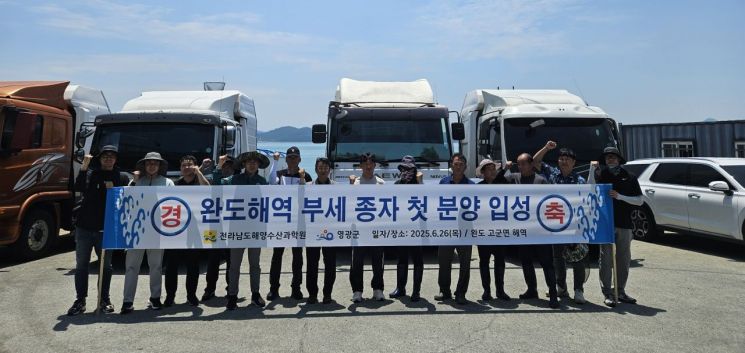 100,000 juvenile Buse fish, a species resistant to high temperatures, were first distributed on the 26th to cage aquaculture farms in the Wando sea area. Provided by Jeonnam Province
The Jeonnam Institute of Maritime and Fisheries Science announced that, as abnormal temperature phenomena due to climate change are becoming more frequent, it has distributed 100,000 juvenile Buse fish, a species resistant to high temperatures, for the first time on the 26th to cage aquaculture farms in the Wando sea area. This initiative aims to address mass mortality and decreased productivity among existing farmed fish species.
After achieving the first successful mass production of 300,000 artificially bred Buse juveniles in Korea in 2015, the Yeonggwang Branch (West Sea Specialty Test Site) has continuously developed offshore cage farming techniques that closely resemble the natural environment since 2023. These efforts have focused on improving the quality of farmed Buse by optimizing body shape, coloration, market size, and appropriate shipping periods.
In the meantime, Buse aquaculture has been successfully carried out in areas such as Dolsan and Geomundo in Yeosu, as well as Nokdong in Goheung. The initial wholesale price at the fishery cooperative auction in 2022 was 6,500 won per kilogram for fish weighing 350g each. However, in 2024, the price rose by 177% to 18,000 won per kilogram.
Fisheries in the Yeosu region that both farm and process Buse have produced products such as "Buse Gulbi" and supplied them to department stores as holiday gifts, achieving sales of approximately 900 million won (4,500 boxes) over the past year.
Meanwhile, Jeonnam Province began systematic research in 2023 to develop alternative species for high-temperature conditions, specifically to determine the critical temperature tolerance of Buse. Experimental results confirmed that Buse can be farmed without mortality up to 30°C (29°C for juveniles and 30°C for adults).
Based on these findings, Jeonnam Province, in cooperation with Yeonggwang-gun, the home of Gulbi, has distributed 24,000cc of fertilized Buse eggs and 500,000 high-quality juveniles from March to this month to nine seed production and cage aquaculture sites in Yeosu, Goheung, and other areas, in order to expand the farming of yellow croaker and Buse.
Kim Chungnam, Director of the Jeonnam Institute of Maritime and Fisheries Science, stated, "I am very pleased that Buse, which has been farmed in Yeosu and Goheung, is now being farmed for the first time in Wando. If Buse farming succeeds in Wando as well, aquaculture farmers struggling with high-temperature damage will become even more competitive."
© The Asia Business Daily(www.asiae.co.kr). All rights reserved.
![Clutching a Stolen Dior Bag, Saying "I Hate Being Poor but Real"... The Grotesque Con of a "Human Knockoff" [Slate]](https://cwcontent.asiae.co.kr/asiaresize/183/2026021902243444107_1771435474.jpg)
















