International Finance Center's Outlook for the Second Half of the Global Economy and International Financial Markets
Global Stock Prices to Rise Further on Strong Corporate Earnings and Economic Stimulus
US Market Dominance Weakens... Diversification into Non-US Portfolios
Global Push for De-dollarization... Dollar Index Expected to Weaken Gradually
There is an outlook that global stock prices will rise in the second half of this year, supported by solid corporate earnings and economic stimulus measures in major countries. In particular, there is analysis that AI-related stocks still have considerable room for further gains. The US dollar is expected to continue its weakening trend as signs of a slowdown in US growth become more apparent.
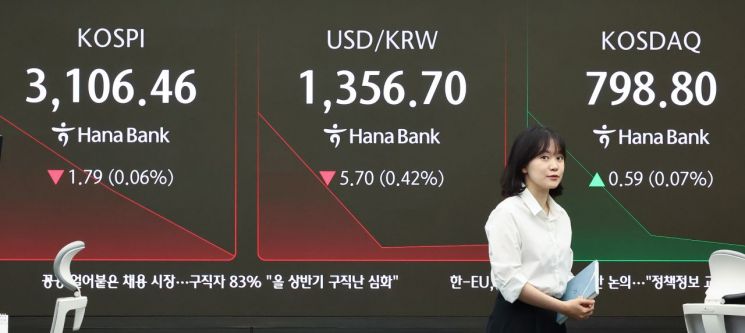
Lee Yongjae, President of the International Finance Center, stated this at the '2025 Second Half Global Economy and International Financial Market Outlook' press briefing held at the Bankers Club in Jung-gu, Seoul, on June 26. Lee said, "In the US, policy support such as tax cuts and increased fiscal spending, along with continued investment in AI, will drive annual corporate profit growth," and added, "In particular, AI-related stocks have recently recovered more quickly than other sectors, so there is a possibility that the upward trend will continue."
AI-related stocks have risen 27% from their April lows, which followed the US announcement of reciprocal tariffs, showing a steep recovery compared to the S&P 500's 9% gain. The International Finance Center analyzed that, given the ongoing investment cycle in AI infrastructure such as semiconductors and the progress in monetization driven by AI cloud demand, there is ample room for further gains.
However, it is expected that the extent of the increase will be limited. This is due to downward revisions in earnings estimates resulting from a slowdown in the real economy in the second half of the year. Lee said, "Portfolio diversification into markets outside the US will weaken the US's dominant position," and added, "As the status of the dollar weakens, active economic stimulus in Europe and emerging markets, as well as regional differences in stock valuations, will ease the US stock market's exceptional strength."
The dollar is expected to weaken on the back of slowing growth. The exceptionalism that had dominated the US market for some time has faded, and as global capital seeks to 'de-dollarize,' a gradual weakening of the dollar is anticipated. Lee explained, "Due to signs of weakness in long-term leading indicators and the prolonged uncertainty in the trade environment, it is inevitable that the US economy's vitality will decline compared to recent years," adding, "The Dollar Index (DXY) will show a gentle weakening trend." Accordingly, the won-dollar exchange rate is also expected to remain under downward pressure. The temporary decoupling of the won and the dollar in the first half of this year was seen as a short-term phenomenon. US Treasury yields are expected to rise, especially for long-term bonds, due to an increased term premium from policy uncertainty, rising Treasury supply, and weakening foreign investor demand.
The global economy is expected to inevitably slow down in the second half of the year. Due to the implementation of high tariffs resulting from negotiation delays, weakened consumption and investment caused by policy uncertainty, and continued sluggish domestic demand in major countries, the global economic growth rate, which was 3% (quarter-on-quarter annualized) in the first quarter, is projected to slow to between 1.5% and 2% in the second half. South Korea's economic growth rate is expected to be around 1% this year, reflecting the effects of the supplementary budget. Lee pointed out, "As growth slows, major countries such as the US, the Eurozone, and China will strengthen their fiscal stimulus policies," but also warned, "In this process, concerns over fiscal soundness may increase due to high levels of government debt and interest burdens from high interest rates, especially in advanced economies."
Fiscal policy is expected to be the most powerful variable in the international financial markets in the second half of the year. The fiscal stimulus measures of major countries are forecast to determine the direction of financial markets. In addition, the real economic impact of tariffs and changes in monetary policy due to high interest rates and inflation are also expected to have an effect.
© The Asia Business Daily(www.asiae.co.kr). All rights reserved.


















