S&P 500 Approaches 6,100
Ceasefire in the Middle East, Rate Cuts Among Key Factors
Some Financial Institutions Forecast a Rise to 6,550
Optimism about the U.S. stock market in the second half of the year is spreading widely across Wall Street. The so-called "four major momentum factors"?easing Middle East conflicts, the possibility of interest rate cuts, productivity gains driven by artificial intelligence (AI), and slowing inflation?are expected to support the market and push indexes higher. Despite concerns over tariff risks that weighed on the market in the first half of the year, investor sentiment is recovering rapidly.
Rick Rieder, Global Chief Investment Officer of Fixed Income at BlackRock, the world’s largest asset manager, said at the Morningstar Investment Conference on the 25th (local time), "AI is having the effect of lowering inflation," and predicted that the U.S. stock market is highly likely to reach record highs in the second half of the year.
On this day, the S&P 500 index closed at 6,092.16, coming close to its all-time intraday high (6,147.43) and record closing high (6,144.15) set in February. Rieder stated, "Productivity improvements driven by AI will offset inflationary pressures from tariffs," and diagnosed that "tariffs will be a one-time adjustment rather than an ongoing challenge for the U.S. economy."
Rieder also continued his optimistic outlook, saying, "Because the U.S. economy is more service-oriented than goods-oriented, the likelihood of a recession is low, and investors will not easily give up on U.S. stocks." He predicted that the Federal Reserve would cut its benchmark interest rate twice starting in September, forecasting a favorable trend for the stock market in the second half of the year.
Jeremy Siegel, a professor at the Wharton School, also predicted further gains for the S&P 500 index. Siegel said, "The current upward trend will continue, and it is almost certain that new record highs will be set." He identified the easing of geopolitical risks due to a ceasefire in the Middle East, the trend of slowing inflation, cost reductions and productivity improvements through AI, and expectations of interest rate cuts as key factors that will drive the stock market higher.
He particularly analyzed that AI can absorb the burden of tariffs and ease inflation fears. "Companies can use AI to offset tariff costs, and this could have a greater effect than expected," he emphasized.
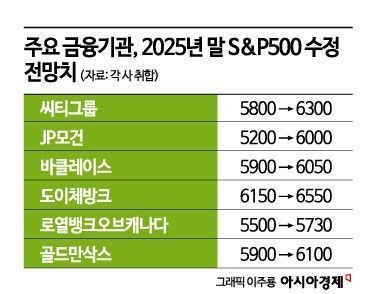
Major financial institutions that had previously lowered their S&P 500 forecasts after President Donald Trump’s announcement of tariff policies have recently raised their targets across the board. JP Morgan raised its target from 5,200 to 6,000, Goldman Sachs from 5,900 to 6,100, and Deutsche Bank presented the most optimistic target at 6,550. Morgan Stanley also recently projected that the index could reach 6,500 by the second quarter of 2025. With slowing inflation and expectations of interest rate cuts, optimism is quickly spreading again on Wall Street.
Binky Chadha, Global Chief Strategist at Deutsche Bank, cited the decline in the effective tariff rate as the reason for raising the target, saying, "The direct and indirect impact of tariffs on corporate earnings has decreased." However, some caution remains. The financial publication Barron’s noted, "While it is true that the S&P 500 has risen close to record highs, there are limits to a further rally without improvements in the performance of specific industries and companies, especially given valuation concerns," expressing a note of caution.
© The Asia Business Daily(www.asiae.co.kr). All rights reserved.

















