Installed Near Hongdae Entrance Station with Heavy Foot Traffic
Real-time Detection of Soil Movement, Ground Subsidence, and Deformation
On June 26, Mapo-gu, Seoul, announced that it has established a proactive response system by introducing the nation's first 'Embedded Internet of Things (IoT) Monitoring System' capable of measuring ground displacement in real time to prevent accidents such as sinkholes.
The 'Embedded IoT Monitoring System' works by embedding sensors in the road surface to detect road subsidence or subtle deformations in real time, and wirelessly transmitting this information to an integrated control system.
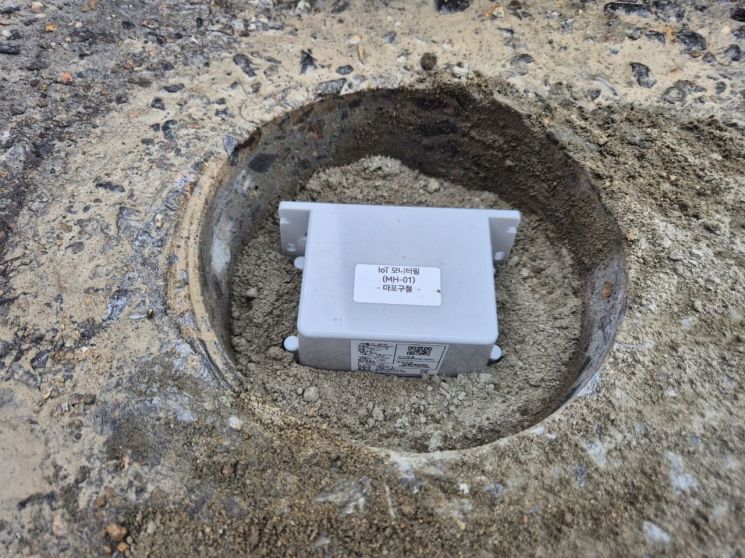 Mapo-gu's 'Embedded IoT Monitoring System' installed near Hongdae Entrance Exit 9. Provided by Mapo-gu.
The real-time displacement data is linked to the Mapo-gu integrated control system, where it is analyzed 24 hours a day. If any abnormal signs are detected, the information is immediately sent to relevant departments and personnel for on-site inspection and safety measures.
The installation site was selected as the area near Exit 9 of Hongdae Entrance Station, which has a high volume of foot traffic and is considered a location with significant concerns about ground safety. A total of three sensors have been installed and are currently in operation in this area.
Starting with this initiative, Mapo-gu plans to prioritize and select installation zones in areas vulnerable to ground instability, such as densely populated areas, subway station vicinities, and large construction sites, and will gradually expand the system in phases.
Mapo-gu stated, "Currently, we regularly inspect the ground using ground-penetrating radar (GPR), but this method is limited to the time of inspection. With the embedded IoT monitoring system, we will be able to continuously track urban ground changes and respond quickly and accurately through real-time analysis."
This project is led by Mapo-gu, with the system supplied by a specialized AIoT (Artificial Intelligence of Things) company, and expert research institutions, including the Korea Research Institute of Standards and Science, collaborating to precisely analyze and verify the data collected by the sensors.
In the short term, the system will enhance real-time response capabilities to accidents such as sinkholes. In the long term, it will be used to accumulate scientific data for evaluating the safety of underground structures and establishing ground reinforcement policies.
Additionally, Mapo-gu is working on advancing a 'Sinkhole Risk Prediction Model' that predicts the likelihood of sinkhole occurrences in advance, by linking the accumulated data with an artificial intelligence (AI)-based analysis system.
Park Kangsoo, Mayor of Mapo-gu, stated, "Since sinkholes are highly dangerous accidents that occur without warning, it is most important to detect and respond to them in advance. We will do our utmost to closely monitor everyday risk factors and protect the safety of residents by actively utilizing advanced technology."
© The Asia Business Daily(www.asiae.co.kr). All rights reserved.

















