Number of Foreign Workers in Korea Surpasses One Million
Japanese Nationals Account for Less Than 1 Percent
Japanese Government and Universities Actively Encourage Settlement
"Expanding Korea-Japan Cooperation Requires Increased Human Exchange"
Recently, the popularity of "K-content" such as movies and dramas has fueled a surge in demand among Japanese nationals hoping to work in South Korea. However, it has been found that the actual rate of successful employment remains low. Experts point out that in order to achieve substantial economic cooperation between Korea and Japan, it is necessary to expand human exchanges, such as by encouraging talent from both countries to work at companies in the other country.
According to an analysis by Asia Economy on June 26, based on data from Statistics Korea and Japan's Ministry of Health, Labour and Welfare, last year, South Korean nationals employed in Japan accounted for over 3% of all foreign workers in Japan. In contrast, Japanese nationals made up less than 1% of all foreign workers in South Korea. Notably, the proportion of Japanese employees in Korea, which stood at 1.3% in 2014, has continued to decline since 2022.
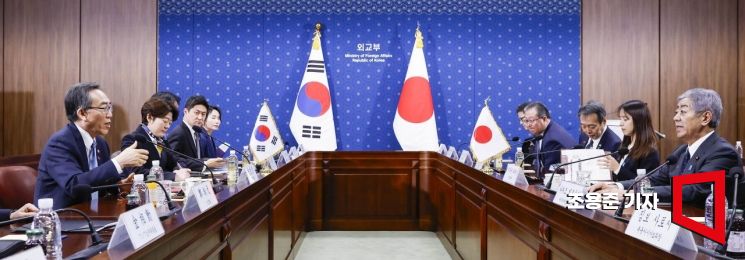 Foreign Minister Cho Taeyeol and Japanese Foreign Minister Iwaya Takeshi are holding a Korea-Japan Foreign Ministers' Meeting on the 13th at the Ministry of Foreign Affairs in Jongno-gu, Seoul. Photo by Cho Yongjun
There is strong interest among Japanese nationals in working in South Korea. The number of Japanese nationals coming to Korea for employment has also increased significantly. According to statistics from the Ministry of Justice, as of February this year, there were 3,262 Japanese nationals residing in South Korea with employment visas, representing an increase of nearly 50% compared to 2,273 in March 2023, two years earlier. In particular, there has been a sharp rise in the number of Japanese nationals entering Korea on working holiday (tourist employment) visas. According to a report published last year by the Ministry of Culture, Sports and Tourism and the Korea Tourism Organization, from 2005 to 2023, a cumulative total of 34,656 Japanese nationals entered Korea on working holiday visas, ranking first among all nationalities.
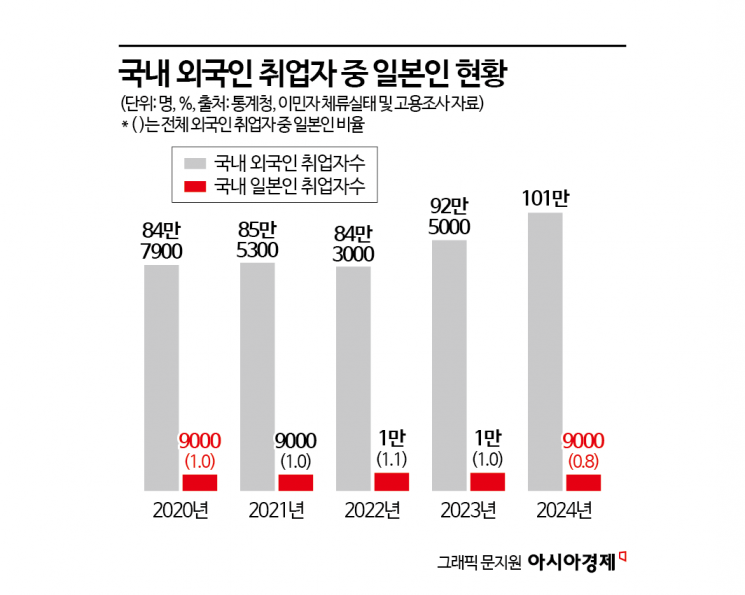
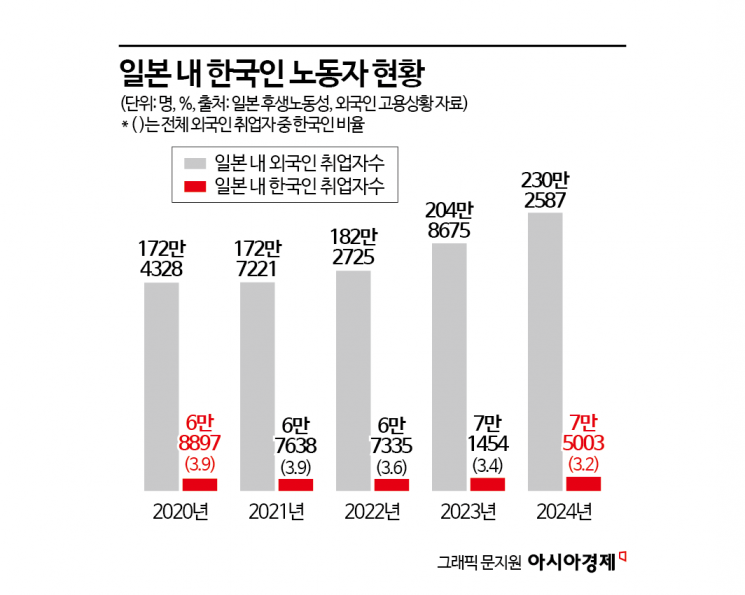
However, this strong interest is not translating into actual employment. As of last year, there were 75,003 South Korean nationals working in Japan, more than eight times the number of Japanese nationals employed in Korea (9,000). Compared to 11,000 in 2014, the number of Japanese nationals employed in Korea has actually decreased.
Some analysts attribute this to differences in employment-related policies between the two countries. Japan is more proactive than Korea in facilitating employment for foreign nationals. The government and universities are actively operating employment programs for foreign workers to address issues such as population decline and aging. In 2027, Japan plans to introduce a "fostering employment system" for foreign workers, aiming not only to attract foreign labor but also to help them settle in Japan. Universities have recently been holding joint company information sessions for international students and are adding business Japanese as a required subject, further encouraging foreign nationals to settle in Japan.
In contrast, Korea lacks comprehensive support for exchanges between Korean and Japanese talent across the economic sector. There are ongoing calls for systematic government-level support for employment to facilitate meaningful Korea-Japan exchanges. The Korea Chamber of Commerce and Industry recently proposed a growth model to the government, centered on a Korea-Japan economic alliance and the recruitment of five million overseas talents.
Choi Eunmi, a research fellow at the Asan Institute for Policy Studies, said, "We need to consider ways to turn Japanese interest in Korea into long-term exchange," adding, "It is necessary for the government and companies to establish institutional foundations so that Japanese nationals can find employment in Korea."
© The Asia Business Daily(www.asiae.co.kr). All rights reserved.



















