NATO Leaders Agree to Raise Defense Spending to 5% of GDP by 2035
No Mention of Ukraine's Membership in Joint Statement
The 32 member countries of the North Atlantic Treaty Organization (NATO) officially agreed on June 25 (local time) to increase defense spending to a total of 5% of their gross domestic product (GDP) by 2035.
On this day, NATO leaders pledged in a joint statement adopted in The Hague, Netherlands, to allocate at least 3.5% of their annual GDP to core defense needs in order to implement the "NATO Military Capability Targets"?a plan to strengthen military power?and to submit annual plans for this purpose. They also agreed to spend up to 1.5% of GDP on indirect costs, such as protecting critical infrastructure, network defense, and strengthening the defense industrial base.
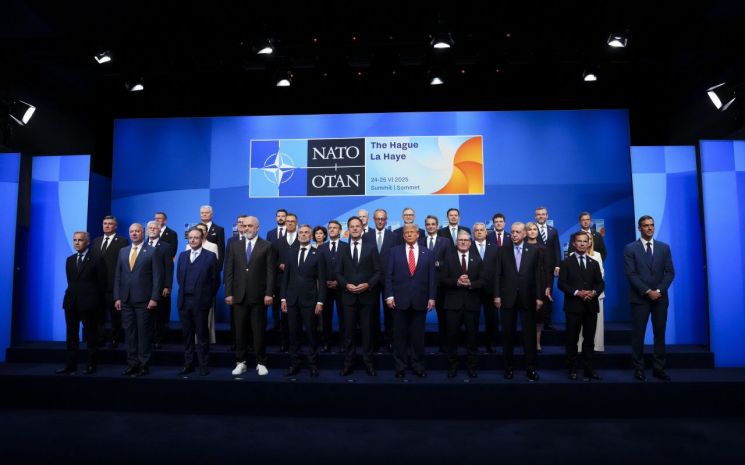 On the 25th (local time), heads of member countries attending the NATO summit are taking a commemorative photo. Photo by AP
This move aligns with the 5% GDP standard demanded by U.S. President Donald Trump. Although indirect costs are included, this is more than double the current target of 2% of GDP agreed upon in 2014.
The joint statement, which was released on a single A4 page and consisted of five paragraphs, also stated that the overall trajectory and balance of spending under the agreed plan would be reviewed again in 2029, based on the strategic environment and revised military capability targets at that time.
However, the statement did not include any mention of Ukraine's accession to NATO. The length of the statement was also significantly reduced from last year's 44-paragraph joint statement at the Washington summit during the Joe Biden administration. NATO stated in the joint statement, "The Allies reaffirm their unwavering sovereign commitments regarding support for Ukraine." It also said, "Their contributions to Ukraine's security are contributions to our own security, and in this regard, direct support for Ukraine and investments in the defense industry will be counted as part of the defense spending agreed upon today."
Last year, the statement included a pledge to "continue to support Ukraine on its irreversible path toward full integration with the Euro-Atlantic community, including NATO membership," as well as a commitment to provide Ukraine with at least 40 billion euros (about 63 trillion won) in 2025. The British daily The Guardian explained that this reflected the position of the United States.
Regarding Russia, the statement only referred to it as a "long-term threat to Euro-Atlantic security." This contrasts with previous summit statements since the outbreak of the Russia-Ukraine war in February 2022, which strongly condemned Russia's invasion of Ukraine each year.
The joint statement also reaffirmed "our ironclad commitment to collective defense as stipulated in Article 5 of the Washington Treaty (NATO Treaty): An attack against one Ally is considered an attack against all Allies."
The previous day, President Trump gave an ambiguous answer to a question about whether he would uphold Article 5 collective defense, saying, "It depends on how you define it," while on board his private plane. However, after the agreement to increase defense spending to 5%?a demand he had made?he changed his stance, saying, "I support it (NATO Article 5). That's why I'm here. If not, I wouldn't have come."
President Trump expressed satisfaction with the outcome of his first summit since returning to office, calling the 5% target "a historic figure that no one thought possible" and "a victory for America, Europe, and Western civilization." During last year's presidential campaign, Trump had criticized NATO's European allies for insufficient defense spending and sparked controversy by suggesting that he would encourage Russia to attack allies who failed to pay their share of defense costs.
Bloomberg News described the statement as "a major victory for President Trump, who has repeatedly criticized European allies for inadequate security spending," but also noted, "It is a major victory for European allies and NATO Secretary General Mark Rutte as well. Secretary General Rutte has worked for months to get the United States to reaffirm Article 5."
However, there are predictions that actually meeting the 5% defense spending target will not be easy. According to NATO, out of 31 member countries excluding Iceland, which has no military, only 23 exceeded the 2% threshold. Pedro Sanchez, the Prime Minister of Spain, who has opposed the 5% target, signed the joint statement but argued that Spain could meet NATO's plans while spending only 2.1%. Last year, Spain's defense spending was 1.24% of GDP.
Meanwhile, on this day, Secretary General Rutte issued the first joint statement with the four Indo-Pacific partners (IP4)?including Wi Sunglak, Korea's National Security Advisor, as well as Japan, Australia, and New Zealand?on the occasion of the summit. The statement specified, "To uphold an international rules-based order and support a safe, stable, and prosperous world, we are all increasing our respective defense spending and will seek ways to strengthen cooperation in the defense industry."
With NATO's 32 member countries announcing an agreement to increase defense spending and expressing their intention to cooperate with the IP4 on the defense industry, there are expectations that this will have a positive impact on Korea's defense exports to Europe.
© The Asia Business Daily(www.asiae.co.kr). All rights reserved.

















