"Non-Tariff Measures Should Be Addressed Through the FTA"
President Donald Trump of the United States announced reciprocal tariffs by country on April 2, including a 25% reciprocal tariff on Korean products. However, an analysis has found that there is a lack of economic justification for this measure.
The Korea Economic Institute of America (KEI), a Washington, D.C.-based think tank, stated in its report released on June 25 (local time) titled "Fairness and Reciprocity? Reconsidering Trump's Liberation Day Tariffs on Korea," that "there is no persuasive economic rationale for the tariff rate imposed on Korea."
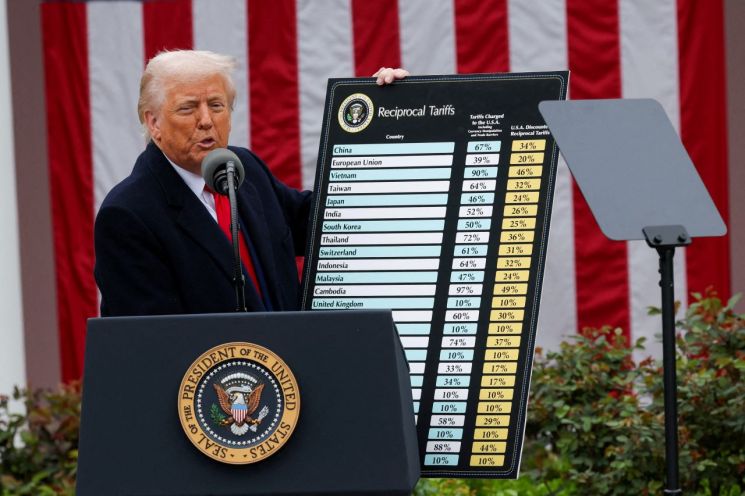 April 2, President Donald Trump of the United States announcing reciprocal tariffs. Photo by Reuters Yonhap News
The report went on to state, "This suggests that the tariffs should be understood not as a trade policy based on rational analysis, but rather as a political tool."
Regarding President Trump's use of the International Emergency Economic Powers Act (IEEPA) as the basis for imposing reciprocal tariffs, the report noted, "From a procedural perspective, it is clear why the Trump administration exercised executive authority to impose new tariff measures urgently and as a priority."
The report further analyzed, "Considering the president's goal of securing fiscal space for tax cuts through the 'Big Beautiful Bill' (BBB), tariffs have emerged as one of the preferred means to increase revenue."
The report also refuted the Trump administration's claim that Korea effectively imposes a 50% tariff on American products. "Based on the latest trade data from the Korea Customs Service and tariff data from the U.S. Department of Agriculture, the actual weighted average tariff rate Korea applied to U.S. imports in 2024 ranged from 0.19% to 2.87%, and a similar level is estimated for 2023," the report stated. "These results directly contradict the significantly higher figures cited by the U.S. Trade Representative (USTR) and the Department of Commerce, which appear to be primarily attributable to the trade balance difference between the United States and Korea."
The report continued, "Ninety-five percent of goods exported from the United States to Korea are tariff-free under the Korea-U.S. Free Trade Agreement (FTA), and most of the remaining tariffs apply to certain agricultural products subject to quotas. Of the remaining 5%, tariffs on 4% are scheduled to be eliminated by 2026."
The reason cited for imposing a 25% reciprocal tariff on Korea was the trade imbalance between the two countries. "Both countries benefit from the Korea-U.S. trade relationship, but the Trump administration has expressed concerns about the trade imbalance, which explains the background of the tariff measures imposed on Korea," the report explained.
Regarding the non-tariff measures in Korea that the United States has raised as an issue, the report stated, "While the USTR has provided an assessment of non-tariff measures, including the economic impact of regulations in Korea-U.S. trade, there is no mutually agreed evaluation that would justify U.S. tariff levels corresponding to reciprocal action against a trade partner like Korea."
The report also pointed out that country-specific non-tariff measures are complex and that there is no standard indicator for converting them into tariff equivalents. "In this situation, it may be more productive to initiate dialogue focusing on the issues identified by the USTR, rather than seeking ways to estimate the effects of non-tariff measures," the report suggested.
Regarding President Trump's reciprocal tariffs, the report stated, "Korea's tariffs on U.S. goods are close to 0%, and if U.S. tariffs significantly exceed this level, it would deviate from strict reciprocity. This would increase costs for U.S. consumers, add uncertainty for businesses, and strain bilateral relations."
The report concluded, "Our analysis shows that Korea maintains the fairest trade regime with the United States, including through the implementation of the Korea-U.S. FTA. If concerns about non-tariff measures or technical barriers to trade persist, we recommend utilizing the standard bilateral mechanisms." The report cited the 21 committees and working groups under the Korea-U.S. FTA as such mechanisms.
© The Asia Business Daily(www.asiae.co.kr). All rights reserved.

















