Policy Forum on Establishing a Graduate School of Translation Held on the 25th
Need to Nurture Talent to Translate Korean Literature into Foreign Languages
Existing Interpretation and Translation Graduate Schools Focus on Foreign Languages to Korean
Aiming to Open in 2027
Kim Hyuntaek, professor emeritus at Hankuk University of Foreign Studies, who participated as a presenter at a policy forum hosted by the Literature Translation Institute of Korea under the Ministry of Culture, Sports and Tourism on June 25 at Modu Arts Theater in Chungjeongno, Seoul, under the theme "The Future of Literary Translation: The Value of Human Translation in the AI Era," made this statement and emphasized the need to establish a graduate school dedicated to training professional translators of Korean literature.
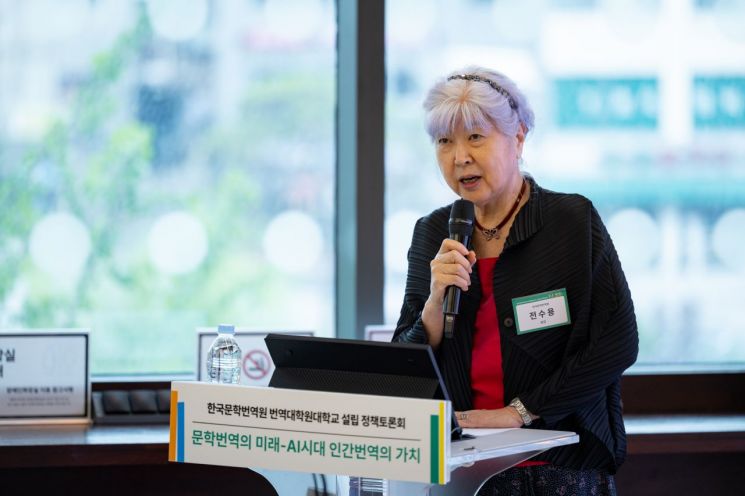 Jeon Suyong, president of the Literature Translation Institute of Korea, is speaking at a policy forum held on the 25th at Modu Arts Theater in Chungjeongno, Seoul, under the theme "The Future of Literary Translation: The Value of Human Translation in the AI Era." Literature Translation Institute of Korea
The discussion about establishing a graduate school at the Literature Translation Institute of Korea was initiated to create an institutional educational body with a unique level of expertise and philosophy, distinct from existing interpretation and translation graduate schools. Professor Kim pointed out, "The most notable difference from current interpretation and translation graduate schools is that it would focus exclusively on translation, not interpretation," adding, "While some translation courses exist at interpretation and translation graduate schools, most of them are classes translating foreign language texts into Korean."
He continued, "For example, translators capable of recreating works by author Han Kang as (foreign language) works of art are extremely rare," and insisted, "A specialized educational institution is absolutely necessary."
Choi Aeyoung, professor at the Translation Academy of the Literature Translation Institute of Korea, who also participated as a co-presenter, argued that the existing 'Academy' of the Literature Translation Institute should be elevated to a 'graduate school,' in order to foster professional translators specializing in Korean literature. She emphasized the role of literary translation as a tool for introducing Korea and Koreans to the world, stating, "Korean literature contains knowledge related to all dimensions of Korean life?past, present, and even future."
Regarding concerns that AI (artificial intelligence) translation could threaten human translators, Professor Choi drew a clear line. She said, "AI-generated answers may contain errors, and the responsibility for judgment always remains with the user. If the user cannot identify these errors, they may face serious problems," adding, "AI translation, which presents standardized and clich?d expressions generated by statistical combinations in an attempt to break away from formulaic language, is fundamentally contradictory to the essence of literary translation."
However, Ma Seunghye, professor in the Department of English Language and Literature at Dongguk University, who participated as a panelist, raised the possibility that AI could serve as a tool to enhance the capabilities of human translators. Professor Ma cited an example where AI translated the phrase "Eot Get Eot Get," which poet Kim Hyesoon used to unify past and future with the double consonant 'ssangsiot,' as "Was Will Was Will," and commented, "Examples suggested by AI can be used as a source of inspiration."
Other participants in the forum included novelist Moon Jiheok, Lee Guyong, CEO of KL Management, Lee Jaewon, head of the Tapas Web Novel Business Team at Kakao Entertainment, Jung Kiin, professor at Seoul National University of Science and Technology, and professional translator Jo Yongkyung.
Jeon Suyong, president of the Literature Translation Institute of Korea, stated, "At a time when AI technology is rapidly advancing, the value of human translation is being called upon to be even more sophisticated and essential," adding, "Through this forum, we will work to institutionalize the translation education system by establishing a graduate school, and lay the foundation for nurturing talent who will lead the globalization of Korean literature and cultural content."
The Institute is currently pursuing the establishment of a graduate school that will confer master's degrees, building on the achievements of its Translation Academy, which has been in operation since 2008, with the goal of opening in 2027.
© The Asia Business Daily(www.asiae.co.kr). All rights reserved.
![Clutching a Stolen Dior Bag, Saying "I Hate Being Poor but Real"... The Grotesque Con of a "Human Knockoff" [Slate]](https://cwcontent.asiae.co.kr/asiaresize/183/2026021902243444107_1771435474.jpg)
















