Testimonies Reveal Public Executions for Watching South Korean Dramas and K-pop in North Korea
Defectors Describe Harsh Crackdown on Foreign Culture and Severe Food Shortages Since COVID-19
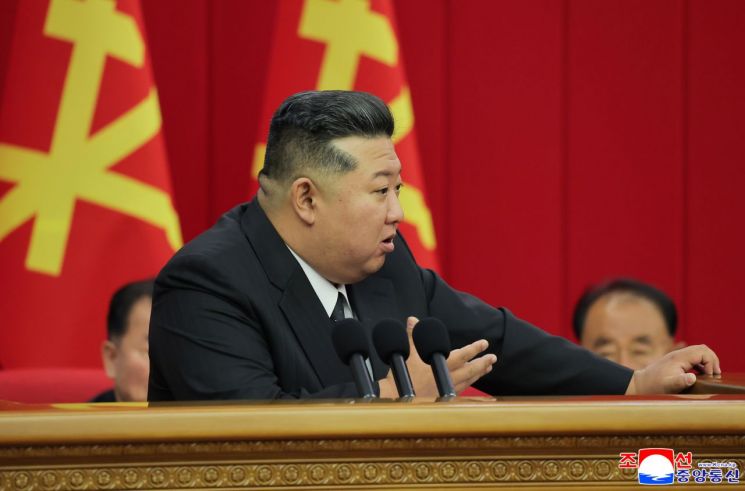 North Korean State Affairs Commission Chairman Kim Jong Un held an expanded meeting of the 12th plenary session of the 8th Central Committee of the Workers' Party from the 21st to the 23rd to discuss policy directions for the second half of the year, according to the Korean Central News Agency on the 24th. Photo by Yonhap News and Korean Central News Agency
There has been testimony from North Korean defectors stating that individuals who distribute or consume South Korean dramas and K-pop in North Korea are publicly executed. It has also been reported that North Korean authorities control even mobile phone emoticons in an effort to block the influx of foreign culture.
The UN Office of the High Commissioner for Human Rights in Seoul held an event on the 25th at the Seoul Global Center titled "The Human Rights Situation in North Korea Over the Past 10 Years as Seen by Victims and Witnesses," where testimonies from residents who defected after the rise of the Kim Jong Un regime were made public.
Kim Ilhyeok, who defected across the Northern Limit Line in the West Sea with his family in May 2023, testified that he witnessed a 22-year-old man being publicly executed by firing squad for distributing three South Korean dramas and about 70 K-pop songs. He stated that public executions occurred about twice every three months, and that as many as 12 people were executed at once during some of these events.
Since December 2020, North Korea has enforced the "Law on Rejecting Reactionary Ideology and Culture," which sentences those who distribute South Korean videos to death and imposes up to 15 years in prison for viewers. Defectors testified that this law is actually being used to carry out executions.
A female defector stated that "since 2015, mobile phone inspections have become more systematic," and that "if you saved a contact as 'oppa' in your phonebook, members of the Youth League would instruct you to change it to '00 comrade'." She added that attaching a heart (♥) emoticon after a name was also prohibited.
This defector said, "In the past, even if you were caught with South Korean dramas or music, you could avoid punishment by paying $300 to $400, but recently, the amount demanded has become much higher," and added, "I also enjoyed South Korean dramas, but I lived in constant fear that I could be executed by firing squad if I was caught."
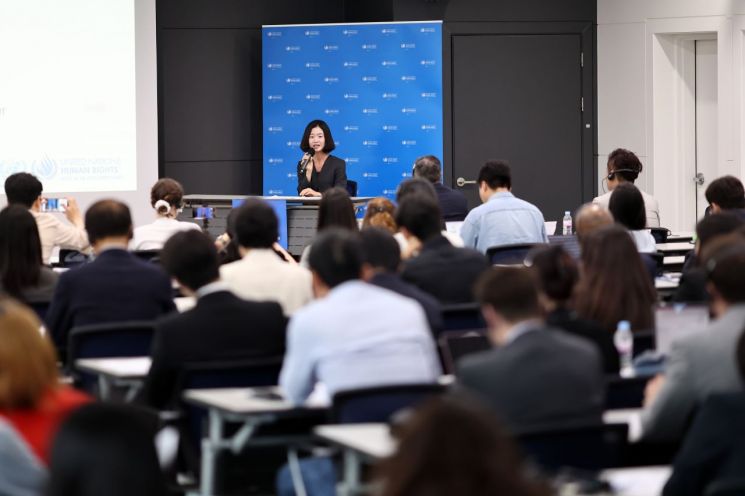 A North Korean defector is speaking at the session titled "UN Office of the High Commissioner for Human Rights in Seoul, The Human Rights Situation in the Democratic People's Republic of Korea Over the Past 10 Years as Seen by Victims and Witnesses," held on the 25th at the Seoul Global Center. Photo by Yonhap News
Defectors stated that food shortages in North Korea became severe during the COVID-19 pandemic. Kim Ilhyeok said, "Far more people died of starvation than from disease," and "the prices of food and daily necessities soared, and serious crimes became rampant."
Another female defector in her twenties testified that "before COVID-19, street orphans were rarely seen in the markets, but after the pandemic, the number of children who lost their parents and ended up on the streets increased dramatically."
There was also a reported spread of reluctance to give birth. One defector said, "It became fashionable for women to fear childbirth and avoid having children," and added, "Since 2023, a new law has been enacted that sentences people to one year in prison upon divorce." The "2024 White Paper on North Korean Human Rights," published by the Korea Institute for National Unification, also included testimony from defectors stating that women who choose divorce or abortion are sent to labor training camps.
The UN Office of the High Commissioner for Human Rights collected interviews with about 400 defectors through this event, and their testimonies are scheduled to be submitted as a follow-up report by the Commission of Inquiry (COI) at the 60th session of the UN Human Rights Council in September.
© The Asia Business Daily(www.asiae.co.kr). All rights reserved.
![Clutching a Stolen Dior Bag, Saying "I Hate Being Poor but Real"... The Grotesque Con of a "Human Knockoff" [Slate]](https://cwcontent.asiae.co.kr/asiaresize/183/2026021902243444107_1771435474.jpg)

















