64.3% Say "Business Conditions Have Worsened Compared to Last Year"
"Minimum Wage Is a Management Burden... It Should Be Frozen"
More than half of self-employed business owners perceive that their business conditions have worsened this year compared to last year. In particular, half of the respondents indicated that the minimum wage has placed a significant burden on their operations.
The Korea Economic Association announced on June 26 that these results were revealed through the "2025 Self-Employed Business Environment Perception Survey," which was conducted by the polling agency Mono Research with 500 self-employed business owners nationwide. According to the survey, 63.4% of self-employed respondents said that their situation has deteriorated compared to last year. Among them, 50.0% stated that the current minimum hourly wage of 10,030 won in 2025 is placing a significant burden on their business.

When breaking down the proportion of respondents who pointed to the burden of the minimum wage by industry, the figures were as follows: accommodation and food service (64.2%), wholesale and retail (51.9%), education and service (50.0%), and manufacturing (48.4%).
When asked about the appropriate increase rate for next year's minimum wage, the most common response was that it should be "frozen," at 44.2%. The proportion who chose a "1-3% increase" was 21.2%, while those who answered that it should be "reduced" accounted for 15.0%. By industry, those who favored freezing the minimum wage were most common in accommodation and food service (59.3%), followed by wholesale and retail (44.9%), and construction and real estate (42.7%).
Regarding the impact of minimum wage increases on employment, 65.0% of self-employed business owners responded that "there is already no capacity to hire." If the minimum wage were to be raised by 1-3%, 7.4% of self-employed respondents said they would give up on hiring or reduce their current staff. If it were raised by 3-6%, 9.4% said they would give up on hiring.
The Korea Economic Association commented on these trends, stating, "The sharp rise in the prices of raw materials such as grains and livestock products has increased cost pressures for the food service and wholesale and retail industries. An increase in the minimum wage could further weaken the hiring capacity of self-employed business owners, and such burdens may be passed on to consumers through higher sales prices."
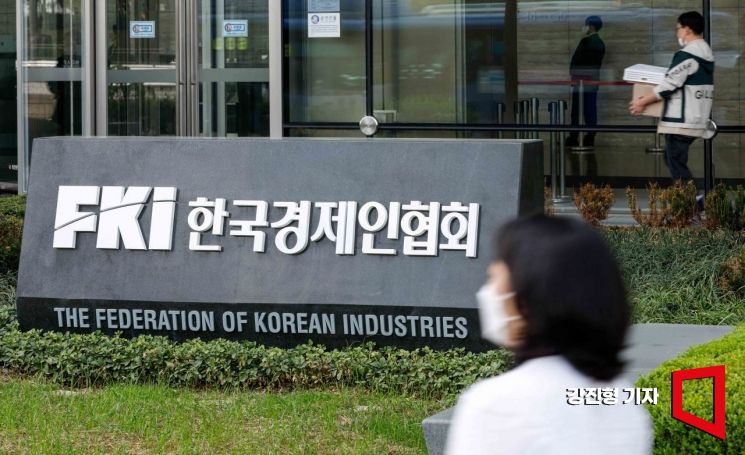 Employees of tenant companies are moving at the Korea Economic Association in Yeouido, Seoul. Photo by Kang Jinhyung
Limiting the rate of increase or applying differentiated minimum wages by industry were suggested as tasks to be addressed. Self-employed business owners identified the following as areas for improvement in the current minimum wage system: limiting the rate of increase in consideration of economic conditions (24.2%), applying differentiated minimum wages by industry or region (21.6%), and supplementing the criteria for determining the minimum wage, such as the employer's ability to pay (15.1%).
Lee Sangho, head of the Economic and Industrial Division at the Korea Economic Association, stated, "With rising food prices and a prolonged domestic demand slump, the business environment for self-employed owners has significantly worsened. If the minimum wage is raised sharply under these circumstances, it could have negative effects on the labor market, such as an increase in ultra-short-term workers and a contraction in employment. In order to ease the management burden on small businesses and revitalize the real economy, a comprehensive approach that takes into account the employer's ability to pay is necessary."
© The Asia Business Daily(www.asiae.co.kr). All rights reserved.


















